




01. Edit your 1120 schedule d instructions online
Type text, add images, blackout confidential details, add comments, highlights and more.

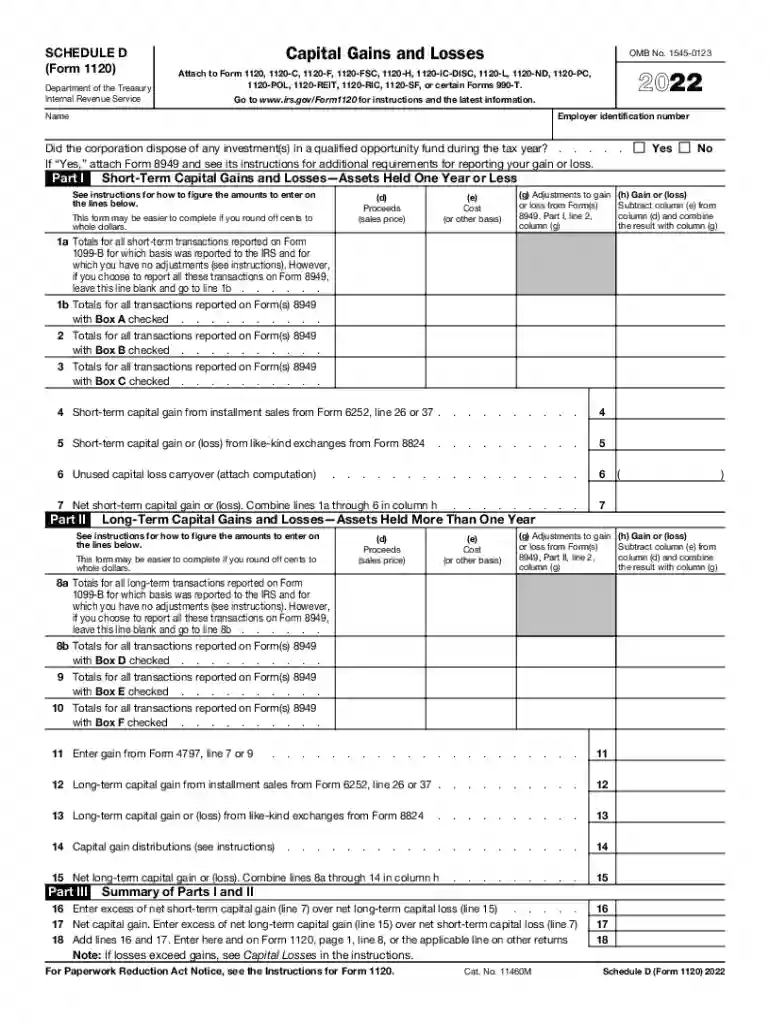
Type text, add images, blackout confidential details, add comments, highlights and more.

Draw your signature, type it, upload its image, or use your mobile device as a signature pad.

Send it via email, link, or fax. You can also download it, export it or print it out.
Schedule D (Form 1120-S) is a tax schedule used by S Corporations in the United States to report capital gains and losses. This form captures transactions that can impact the corporation’s taxable income for the year. It focuses on both short-term and long-term capital assets and requires detailed information on proceeds, cost basis, and any necessary adjustments. Understanding how to accurately report these figures is critical for compliance with IRS regulations.
Taxpayers can access the Instructions for Schedule D (Form 1120-S) directly from the Internal Revenue Service (IRS) website. These instructions are invaluable for comprehending how to fill out the form accurately. Besides the IRS portal, accounting software like TurboTax or QuickBooks that supports tax form preparation often includes these instructions as part of their support documentation. For those preferring physical copies, local IRS offices may provide printed versions, subject to availability.
Collect and Organize Capital Transaction Details: Start by gathering detailed information on all the corporation’s capital transactions over the tax year, including sale proceeds and the original costs.
Short-term Capital Gains and Losses: Enter data for assets held for one year or less, detailing the selling price, original cost, and any adjustments required.
Long-term Capital Gains and Losses: Report transactions for assets held more than a year, including similar details as the short-term section.
Net Gain or Loss Calculation: Use the form to calculate the net short-term and long-term gains or losses. Sum these figures to determine the total net gain or loss to report on Form 1120-S.
Attach to Form 1120-S: Complete Schedule D and attach it to Form 1120-S before submission to the IRS.
Adhering to IRS guidelines when completing Schedule D is essential for legal compliance and minimizing audit risks. The IRS outlines specific instructions for documentation and accuracy. Failure to follow these can result in penalties, making it crucial for taxpayers to review the guidelines thoroughly before filing.
Schedule D must be filed with Form 1120-S by the 15th day of the third month following the end of the corporation’s tax year, typically March 15 for calendar-year taxpayers. Timely filing ensures penalties are avoided and compliance with IRS regulations is maintained.
S Corporations face significant penalties for late submission or inaccuracies in Schedule D. These penalties include fines per shareholder per month for delayed filing, as well as potential interest on any underpaid taxes due to incorrect reporting. Ensuring accuracy and timely filing is imperative to avoid these financial repercussions.
We've got more versions of the 1120 schedule d instructions form. Select the right 1120 schedule d instructions version from the list and start editing it straight away!
| Versions | Form popularity | Fillable & printable |
|---|---|---|
| 2025 | 4.6 Satisfied (46 Votes) | |
| 2024 | 4.4 Satisfied (56 Votes) | |
| 2023 | 4.7 Satisfied (48 Votes) | |
| 2022 | 4.2 Satisfied (24 Votes) | |
| 2021 | 4.8 Satisfied (151 Votes) | |
| 2020 | 4.4 Satisfied (230 Votes) | |
| 2019 | 4.2 Satisfied (143 Votes) | |
| 2018 | 4.3 Satisfied (108 Votes) | |
| 2017 | 4.4 Satisfied (145 Votes) | |
| 2016 | 4.3 Satisfied (99 Votes) | |
| 2015 | 4.4 Satisfied (33 Votes) | |
| 2014 | 4.1 Satisfied (60 Votes) | |
| 2013 | 4.2 Satisfied (67 Votes) | |
| 2012 | 4 Satisfied (40 Votes) | |
| 2011 | 4 Satisfied (60 Votes) |
At DocHub, your data security is our priority. We follow HIPAA, SOC2, GDPR, and other standards, so you can work on your documents with confidence.
For tax years beginning after July 4, 2025, an. S corporation must complete a separate Schedule A (Form. 1062) for each sale or exchange of qualified farmlandRead more
See Instructions for Form 1120. RENTAL REAL ESTATE AND ROYALTIES. 4. Instructions for Schedule E; IRS Pub. 527, ResidentialRead more


