




01. Edit your hs7 form online
Type text, add images, blackout confidential details, add comments, highlights and more.

Type text, add images, blackout confidential details, add comments, highlights and more.

Draw your signature, type it, upload its image, or use your mobile device as a signature pad.

Send hs 7 form via email, link, or fax. You can also download it, export it or print it out.
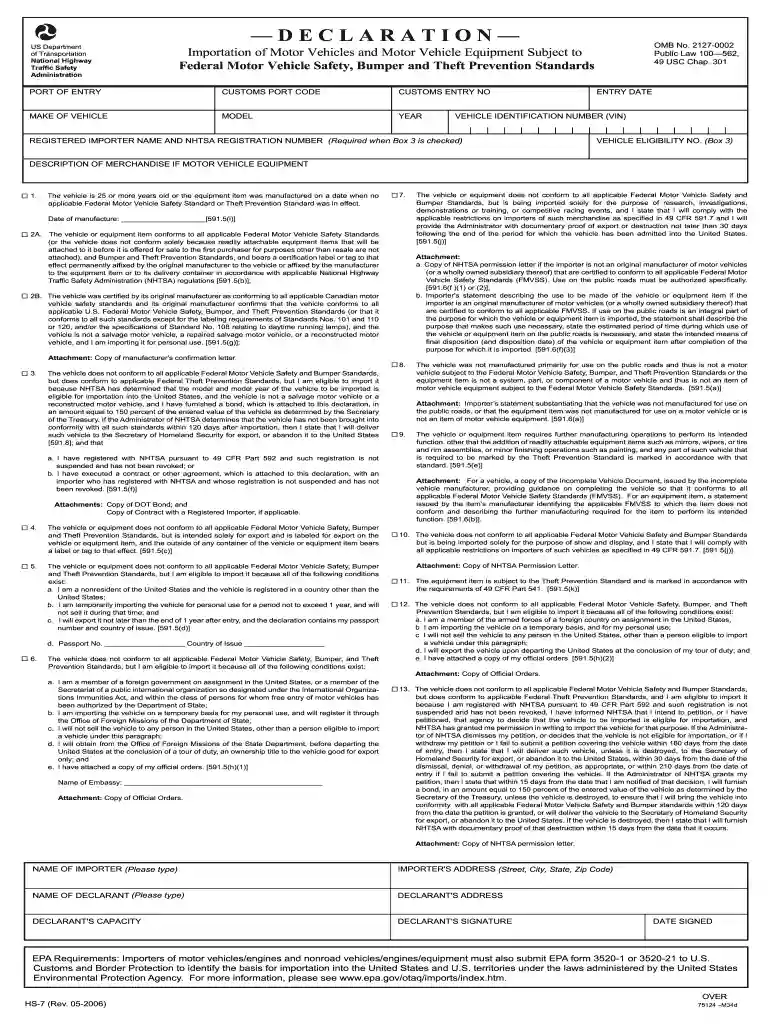
The dot form HS 7 is a crucial document from the National Highway Traffic Safety Administration (NHTSA) related to the importation of motor vehicles and equipment into the United States. It serves as a declaration form that collects pertinent information regarding the vehicle's eligibility for import under various safety and emission standards.
The dot form HS 7 includes several essential sections that must be completed accurately to ensure a smooth import process. Key elements of the form consist of:
Completing the dot form HS 7 involves a systematic approach to ensure accuracy. The following steps guide you through the process:
The dot form HS 7 carries legal significance as it verifies the details of vehicle importation in compliance with U.S. regulations. Misrepresentation or inaccuracies on the form can lead to substantial penalties, including:
Understanding the terminology associated with the dot form HS 7 is essential for efficient completion and compliance. Key terms include:
Practical applications of the dot form HS 7 can vary based on individual circumstances. Here are a few scenarios where the form is necessary:
Clarifying common queries about the dot form HS 7 enhances understanding. Here are some frequently asked questions and their answers:
Who Needs to Complete the Dot Form HS 7? Individuals or entities looking to import vehicles into the U.S. need to fill out the dot form HS 7 to ensure compliance with NHTSA regulations.
Where Can You Obtain the Dot Form HS 7? The form is available through the NHTSA website or authorized import specialists and can typically be filled out online or printed for manual submission.
Are There Deadlines to Submit the HS 7 Form? Timelines for submission can vary based on the specific importation circumstances, but it is essential to complete it before the vehicle's arrival in the U.S.
To effectively complete the dot form HS 7, several documents are needed:
The dot form HS 7 can be submitted through various methods:
Understanding these aspects ensures a smooth and compliant process for importing vehicles into the United States.
We've got more versions of the hs7 form form. Select the right hs7 form version from the list and start editing it straight away!
At DocHub, your data security is our priority. We follow HIPAA, SOC2, GDPR, and other standards, so you can work on your documents with confidence.


This quick tutorial will show you how to complete the nhtsa hs7 declaration form. Any person knowingly making a false declaration is subject to a fine of not
DOT. Declaration Form HS-7 (). In the case where GM Canada CCC is not able furnish a compliance letterRead more


