Minimum Data Set 3 0 Resident Assessment Instrument User's 2026

Get Form
Minimum Data Set 3 0 Resident Assessment Instrument User's Preview on Page 1

Here's how it works

01. Edit your form online
Type text, add images, blackout confidential details, add comments, highlights and more.

02. Sign it in a few clicks
Draw your signature, type it, upload its image, or use your mobile device as a signature pad.

03. Share your form with others
Send it via email, link, or fax. You can also download it, export it or print it out.

Understanding the Minimum Data Set 3.0 Resident Assessment Instrument

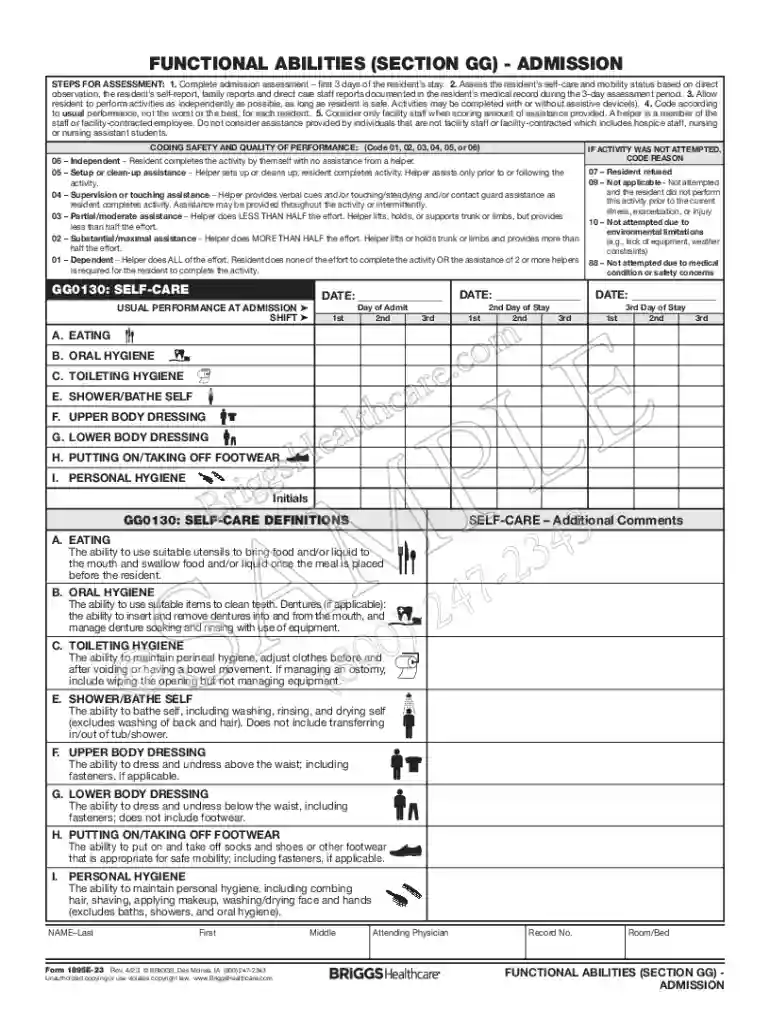
The Minimum Data Set (MDS) 3.0 Resident Assessment Instrument is a comprehensive assessment tool used in long-term care facilities to evaluate the functional capabilities of residents. This tool is essential in assessing areas such as self-care, mobility, cognitive patterns, and mood. Facilities use the data from MDS assessments for care planning and determining Medicare and Medicaid reimbursements. The MDS 3.0 helps ensure that residents receive appropriate and personalized care based on their assessed needs.

Completing the MDS 3.0 Resident Assessment Instrument

Step-by-Step Instructions

  1. Initial Assessment: Conduct this upon the resident's admission to the facility. It must be completed within the first three days.
  2. Coding Performance: Assess and code the resident's performance in various domains like mobility and self-care, ranging from complete independence (code 06) to total dependence (code 01).
  3. Review and Validate: Ensure accuracy by reviewing entered data and cross-referencing with nursing staff observations.
  4. Submit Assessment: Send the completed MDS form to the appropriate state and federal databases to ensure compliance with regulatory standards.

Importance of Accuracy

Correct and detailed completion of the MDS form is crucial. Errors can lead to inadequate care planning and incorrect reimbursement levels. Inaccurate data might affect the resident's care and the facility's compliance standing.

Key Elements of MDS 3.0

  • Resident Information: Includes detailed personal data, medical conditions, and background.
  • Cognitive Patterns: Assesses memory, problem-solving, and communication abilities.
  • Physical and Occupational Therapy Utilization: Notes the frequency and type of therapies received by the resident.
  • Health Conditions: Covers pain management, diseases, and other medical conditions impacting the resident's quality of life.

Who Uses the MDS 3.0?

MDS 3.0 is utilized primarily by healthcare professionals in nursing homes and long-term care facilities:

  • Nurses and Care Staff: Conduct assessments and document findings.
  • Social Workers: Use the data for social and emotional care planning.
  • Administrators: Rely on MDS data for staffing and resource allocation decisions.

Legal and Compliance Considerations

Compliance with Federal Regulations

Facilities using the MDS 3.0 must adhere to federal regulations, particularly those outlined by the Centers for Medicare & Medicaid Services (CMS). Regular audits ensure that facilities remain compliant, and compliance is critical for receiving federal funding.

State-Specific Regulations

Though federally mandated, some states may have additional requirements. Facilities must stay informed about any state-specific guidelines to ensure full compliance.

Digital vs. Paper Version of MDS 3.0

Benefits of Digital Completion

  • Efficiency: Digital entries can reduce errors, speed up submission processes, and facilitate easy access to historical data.
  • Integration: Digital tools often integrate with other healthcare software platforms, streamlining the care process.

Considerations for Paper Use

While many facilities are moving digital, some may still use paper forms due to limited access to digital tools or staff training.

Software Compatibility

Integration with Health Record Systems

MDS 3.0 is compatible with many Electronic Health Records (EHR) systems, ensuring that data collected can seamlessly integrate into broader patient records. This compatibility facilitates comprehensive care planning.

Versions and Alternatives

The MDS 3.0 has evolved from previous versions, incorporating more comprehensive assessments and improving accuracy in data collection. Alternative assessments may be used for different populations or in related healthcare settings.

Examples of Using MDS 3.0

In practice, a nursing home may utilize MDS 3.0 assessments to monitor a resident with mobility challenges, tailoring physical therapy sessions to improve mobility. Similarly, MDS data might guide dietary adjustments for residents with specific nutritional needs.

Penalties for Non-Compliance

Failure to accurately complete and submit MDS assessments can result in penalties, including fines or a reduction in Medicare and Medicaid reimbursements. Non-compliance may also impact the facility's accreditation status and its reputation within the community.

be ready to get more

Complete this form in 5 minutes or less

Get form

Got questions?

We have answers to the most popular questions from our customers. If you can't find an answer to your question, please contact us.
Contact us
Nursing homes are required to submit Omnibus Budget Reconciliation Act (OBRA) required Minimum Data Set (MDS) records for all residents in Medicare- or Medicaid-certified beds regardless of the payer source.
A registered nurse must conduct or coordinate each assessment with the appropriate participation of health professionals. (i) Certification. (1) A registered nurse must sign and docHub that the assessment is completed.
The Minimum Data Set (MDS) Frequency data summarizes health status indicators for active residents currently in nursing homes. The MDS is part of the Federally-mandated process for clinical assessment of all residents in Medicare and Medicaid certified nursing homes.
The Resident Assessment Instrument (RAI) process is a means of ensuring that residents receive the highest quality of care and can maintain the highest quality of life. The process helps nursing professionals and staff assess a residents strengths and needs to create an individualized care plan.
The Resident Assessment Instrument (RAI) helps facility staff to gather definitive information on a residents strengths and needs, which must be addressed in an individualized care plan.

Security and compliance

At DocHub, your data security is our priority. We follow HIPAA, SOC2, GDPR, and other standards, so you can work on your documents with confidence.

Learn more
ccpa2
pci-dss
gdpr-compliance
hipaa
soc-compliance

People also ask

The Resident Assessment Instrument/Minimum Data Set (RAI/MDS) is a comprehensive assessment and care planning process used by the nursing home industry since 1990 as a requirement for nursing home participation in the Medicare and Medicaid programs.
The Minimum Data Set (MDS) is a standardized assessment tool that measures health status in nursing home residents. MDS assessments are completed every 3 months (or more often, depending on circumstances) on nearly all residents of nursing homes in the United States.

Related links