8D :: Problem Solving Worksheet - The Quality Portal 2026

Get Form
8D :: Problem Solving Worksheet - The Quality Portal Preview on Page 1

Here's how it works

01. Edit your form online
Type text, add images, blackout confidential details, add comments, highlights and more.

02. Sign it in a few clicks
Draw your signature, type it, upload its image, or use your mobile device as a signature pad.

03. Share your form with others
Send it via email, link, or fax. You can also download it, export it or print it out.

Definition and Meaning

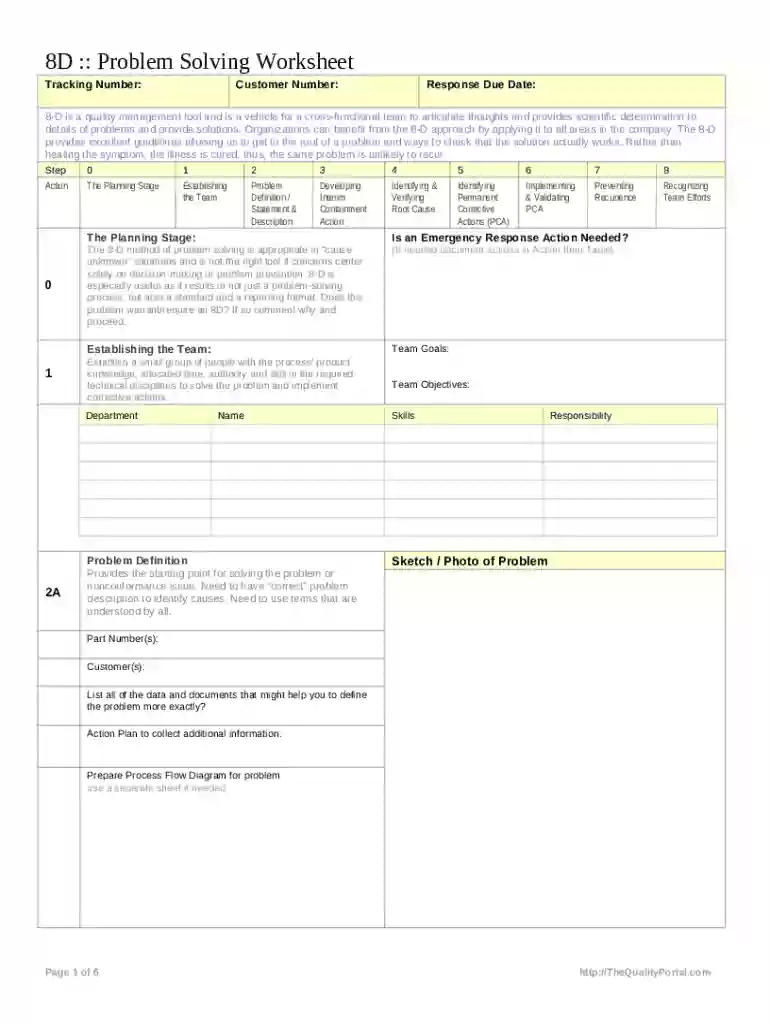
The 8D Problem Solving Worksheet is a structured tool designed to help teams identify, analyze, and solve complex issues within an organization. This method emphasizes a systematic approach to problem-solving that not only addresses symptoms but identifies and remediates root causes. The use of this worksheet is prevalent in quality management processes, particularly in manufacturing and product development. By employing the 8D methodology, organizations can ensure sustained improvements and prevent recurrence of issues.

Key Elements of the 8D Problem Solving Worksheet

The 8D Problem Solving Worksheet features several core components essential for effective problem resolution. The primary elements include:

  • Establishing a Team: Critical to the 8D process is assembling a cross-functional team with diverse expertise to ensure a comprehensive problem-solving approach.
  • Defining the Problem: Precise problem definition helps in understanding the extent and impact of the issue, enabling targeted solutions.
  • Implementing Interim Actions: Temporary measures are put in place to mitigate the problem's effects while a permanent solution is developed.
  • Root Cause Identification: Using methods such as the 5 Whys or Fishbone Analysis, the underlying causes of the problem are determined.
  • Developing Corrective Actions: Permanent solutions are designed to address root causes and prevent problem recurrence.

Steps to Complete the 8D Problem Solving Worksheet

  1. Establish Team: Gather a cross-disciplinary team with the skills needed to tackle the issue at hand.
  2. Define Problem: Clearly articulate the problem with data to support its impact and scope.
  3. Develop Interim Containment Actions: Implement short-term measures to control the immediate impacts of the problem.
  4. Determine Root Cause: Analyze the problem using appropriate tools to uncover its fundamental cause.
  5. Choose Corrective Actions: Develop and evaluate potential long-term solutions that resolve the root cause.
  6. Implement Corrective Actions: Put the best solution into practice and monitor for effectiveness.
  7. Prevent Recurrence: Adjust processes and controls to prevent the problem from happening again.
  8. Celebrate Success: Recognize and document the success of the team and solution for future reference.

How to Obtain the 8D Problem Solving Worksheet

The 8D Problem Solving Worksheet can often be obtained through various online portals specializing in quality management tools, such as The Quality Portal. Additionally, some organizations may provide this form internally as part of their quality control systems. It is often available as a downloadable document in formats like PDF or DOC for ease of use and distribution among team members.

Who Typically Uses the 8D Problem Solving Worksheet

Typically, the worksheet is utilized by teams in manufacturing, quality control, and product design environments. It is instrumental for managers, quality assurance teams, and continuous improvement teams who seek to eliminate quality issues and improve operational efficiency. The method’s structured approach makes it suitable for any organization or team aiming to implement a rigorous and methodical problem-solving process.


decoration image ratings of Dochub

Important Terms Related to the 8D Problem Solving Worksheet

To effectively use the 8D Problem Solving Worksheet, it is important to be familiar with several key terms:

  • Root Cause: The primary underlying factor leading to a problem.
  • Interim Actions: Short-term measures to manage the problem's impact while developing a permanent solution.
  • Corrective Actions: Steps taken to address root causes and prevent future issues.
  • Cross-Functional Team: A group composed of members from different departments collaborating towards a common goal.

Examples of Using the 8D Problem Solving Worksheet

In practice, the 8D Problem Solving Worksheet has been used in several scenarios:

  • Automotive Industry: To address recurring defects in a vehicle component, enhancing product quality and customer satisfaction.
  • Electronics Manufacturing: Resolving assembly line issues that lead to increased product returns and warranty claims.
  • Consumer Goods: Identifying and correcting packaging errors that resulted in customer complaints and brand reputation risks.

Digital vs. Paper Version

While traditional paper versions of the 8D Problem Solving Worksheet are still in use, digital versions offer enhanced convenience and flexibility. Digital worksheets allow for:

  • Easy Sharing and Collaboration: Facilitating input from team members regardless of their physical location.
  • Real-Time Updates: Ensuring all contributors have access to the most current version.
  • Better Documentation and Archiving: Electronic storage enables efficient retrieval and analysis for future reference.

Software Compatibility

The 8D Problem Solving Worksheet is compatible with various document management and quality control software solutions. Tools such as TurboTax, QuickBooks, and various PDF editors can aid in the organization and presentation of the worksheet's data, providing a seamless experience across different platforms. This compatibility ensures teams can integrate the 8D process into their existing workflows and systems effortlessly.

be ready to get more

Complete this form in 5 minutes or less

Get form

Got questions?

We have answers to the most popular questions from our customers. If you can't find an answer to your question, please contact us.
Contact us
The primary aims of the 8D methodology are to identify the root cause, correct and eliminate problems in a team approach, while making the problems solved useful in product and process improvement. Then it proposes and implements a short-term fix and a long-term solution to prevent the recurring problem.
You can follow these steps when using an 8D form: Create a plan. Start by collecting information about the issue you want to resolve. Form a team. Describe the problem. Contain the problem. Identify root causes. Decide on a permanent corrective plan. Implement your solution. Prevent reoccurring problems.
The 8D report provides a record of the problem, the root cause(s) identified, and corrective and preventive actions (CAPA System) taken to eliminate the problems circumstances.
What is the 8D problem-solving process? The 8D process is a decision-making process designed specifically to help teams identify, correct, and prevent recurring problems. It focuses on root cause analysis, resolution, and prevention of problems that can degrade quality, efficiency, and customer satisfaction.
This process is an expansion of the Plan, Do, Check, and Act (PDCA) cycle. Steps one through five are part of the planning process, step six is the doing process, step seven is the checking process, and step eight is the acting part of the cycle.

Security and compliance

At DocHub, your data security is our priority. We follow HIPAA, SOC2, GDPR, and other standards, so you can work on your documents with confidence.
Learn more
ccpa2
pci-dss
gdpr-compliance
hipaa
soc-compliance

People also ask

The eight disciplines (8D) model is a problem solving approach typically employed by quality engineers or other professionals, and is most commonly used by the automotive industry but has also been successfully applied in healthcare, retail, finance, government, and manufacturing.
8D Problem-Solving Method And RCA In 8D, the steps related to RCA are: Quantify and convert the problem symptom into Object and Defect. Use Repeated Whys to turn the symptom into a Problem Statement. Gather possible causes using tools like Fishbone or Affinity Diagram.

Related links