




01. Edit your form online
Type text, add images, blackout confidential details, add comments, highlights and more.

Type text, add images, blackout confidential details, add comments, highlights and more.

Draw your signature, type it, upload its image, or use your mobile device as a signature pad.

Send it via email, link, or fax. You can also download it, export it or print it out.
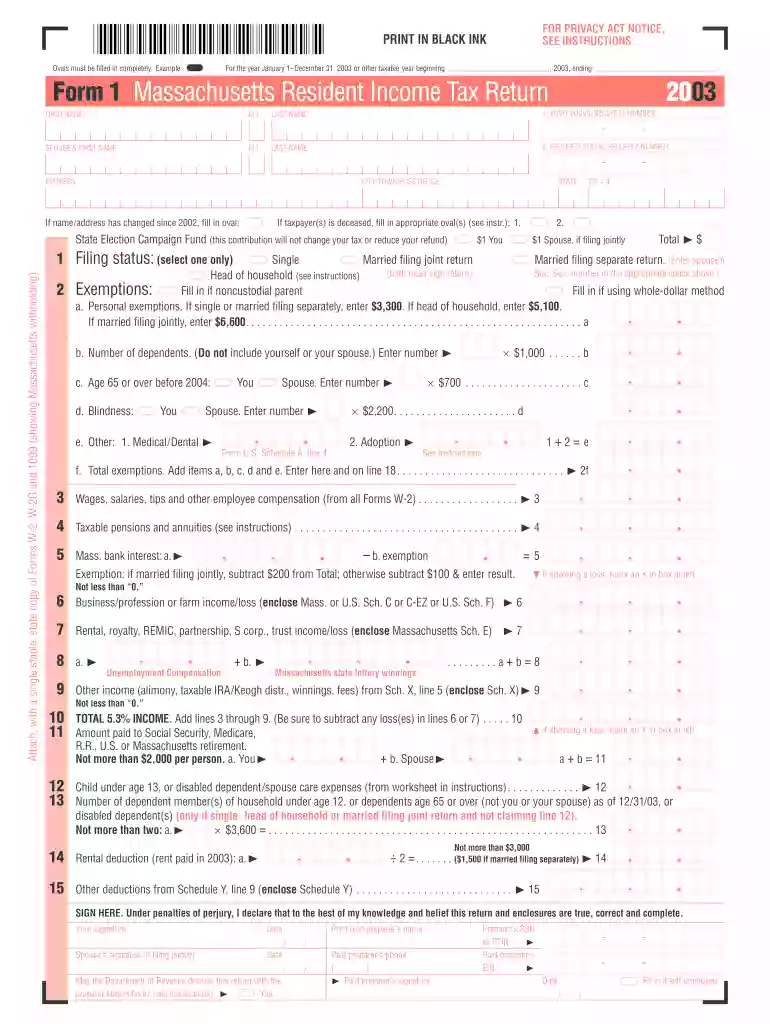
The 2003 Form 1 is a Massachusetts Resident Income Tax Return used by taxpayers to report their annual earnings and calculate any taxes owed to the state of Massachusetts. This form is used to provide necessary personal and financial information required to assess an individual's tax responsibilities. It includes sections for personal details, income documentation, deductions, credits, and final tax calculations. The form ensures compliance with state tax laws and helps residents fulfill their fiscal obligations each year.
Gather Necessary Documents: Before starting, collect relevant documents such as W-2s, 1099s, receipts for deductions, and prior year's tax returns to provide accurate information.
Enter Personal Information: Complete the top section of the form with your name, address, and Social Security number to establish your identity.
Select Filing Status: Choose your filing status from options like Single, Married Filing Jointly, Married Filing Separately, or Head of Household.
Report Income: List all sources of income, including wages, self-employment income, interest, dividends, and other taxable incomes.
Claim Deductions and Credits: Enter eligible deductions such as student loan interest and childcare expenses, and claim applicable state credits to reduce tax liability.
Calculate and Pay Tax: Determine your taxable income after deductions, and calculate the tax owed using the state tax tables. Include any payments made throughout the year.
Sign and Date the Form: Execute the form by signing and dating it to affirm that all information provided is accurate to the best of your knowledge.
Withholding: Taxes taken out of your paycheck by employers, credited against the income tax you owe.
Exemption: Reductions in taxable income based on dependents or filing status, helping lower tax obligations.
Filing Status: A category defining your household and financial situation, impacting tax calculations. Options include Single, Married Filing Jointly, etc.
Adjustments: Changes made to gross income to calculate adjusted gross income (AGI), which affects tax rates and credits.
The standard deadline for submitting the 2003 Form 1 is April 15th of the following year. It's important to file by this date to avoid late fees and penalties. In circumstances where an extension is needed, residents must apply before the deadline and anticipate interest charges on any taxes owed.
Residents can acquire the 2003 Form 1 from the Massachusetts Department of Revenue's website, through local libraries, or by visiting tax assistance centers within the state. It's also possible to request the form by mail for those with limited internet access.
This form is designed exclusively for Massachusetts residents for state tax reporting purposes. Misuse, such as falsifying information or submitting incorrect data, can result in penalties including fines, increased scrutiny from tax authorities, or legal action.
When filling out the 2003 Form 1, ensure the availability of:
Failing to file the 2003 Form 1 or incorrectly reporting income may result in penalties such as:
Unresolved issues with state tax responsibilities can lead to further legal consequences, including liens or wage garnishments.
The 2003 Form 1 is available in both digital and paper formats. The digital version offers benefits such as real-time calculations, ease of corrections, and electronic submission, which increases convenience and reduces errors. In contrast, the paper form necessitates manual calculations and submitting physical documents, appealing to those less inclined towards digital solutions. The choice depends on personal preference and access to technology.
We've got more versions of the 2003 form 1 form. Select the right 2003 form 1 version from the list and start editing it straight away!
| Versions | Form popularity | Fillable & printable |
|---|---|---|
| 2025 | 4.4 Satisfied (54 Votes) | |
| 2024 | 4.9 Satisfied (28 Votes) | |
| 2023 | 4.5 Satisfied (35 Votes) | |
| 2022 | 4.8 Satisfied (26 Votes) | |
| 2021 | 4.8 Satisfied (30 Votes) | |
| 2020 | 4.3 Satisfied (154 Votes) | |
| 2019 | 4.1 Satisfied (27 Votes) | |
| 2018 | 4.1 Satisfied (52 Votes) | |
| 2017 | 4.2 Satisfied (65 Votes) | |
| 2017 | 3.9 Satisfied (48 Votes) | |
| 2016 | 4.4 Satisfied (637 Votes) | |
| 2015 | 4.4 Satisfied (317 Votes) | |
| 2014 | 4 Satisfied (60 Votes) | |
| 2013 | 4 Satisfied (44 Votes) | |
| 2012 | 4 Satisfied (49 Votes) |
Microsoft Word doesn’t have signing tools to generate valid eSignatures and enforceable forms. Luckily, DocHub is an online eSignature-compliant editor that works with various document formats, such as .doc files. Sign in to your account and import the Word version of your 2003 form 1 from your device and cloud, or URL - our editor will automatically turn it into an editable PDF. Make all necessary alterations in your document and click Sign to generate your own legally-binding electronic signature. You will find four signing options from which to choose.
If you are using Chrome, there are two straightforward methods to modify your 2003 form 1 online. First, visit the DocHub website, add your document, and modify it using our toolbar. You can also install our Chrome extension and modify any document by dragging and dropping it in your browser window.
At DocHub, your data security is our priority. We follow HIPAA, SOC2, GDPR, and other standards, so you can work on your documents with confidence.
Jan 1, 2003 University of New Hampshire, University of New Hampshire NEASC self-study report 2003. Form 1: financial data FY 1999-2002. Part 1. (2003).Read more
See the 2003 Premium Payment Package for the instructions for Form 1-EZ (a) Amount paid by check or electronic funds transfer with 2003 Form 1-ES (item 8 of.Read more


