




01. Edit your massachusetts form 2014 online
Type text, add images, blackout confidential details, add comments, highlights and more.

Type text, add images, blackout confidential details, add comments, highlights and more.

Draw your signature, type it, upload its image, or use your mobile device as a signature pad.

Send it via email, link, or fax. You can also download it, export it or print it out.
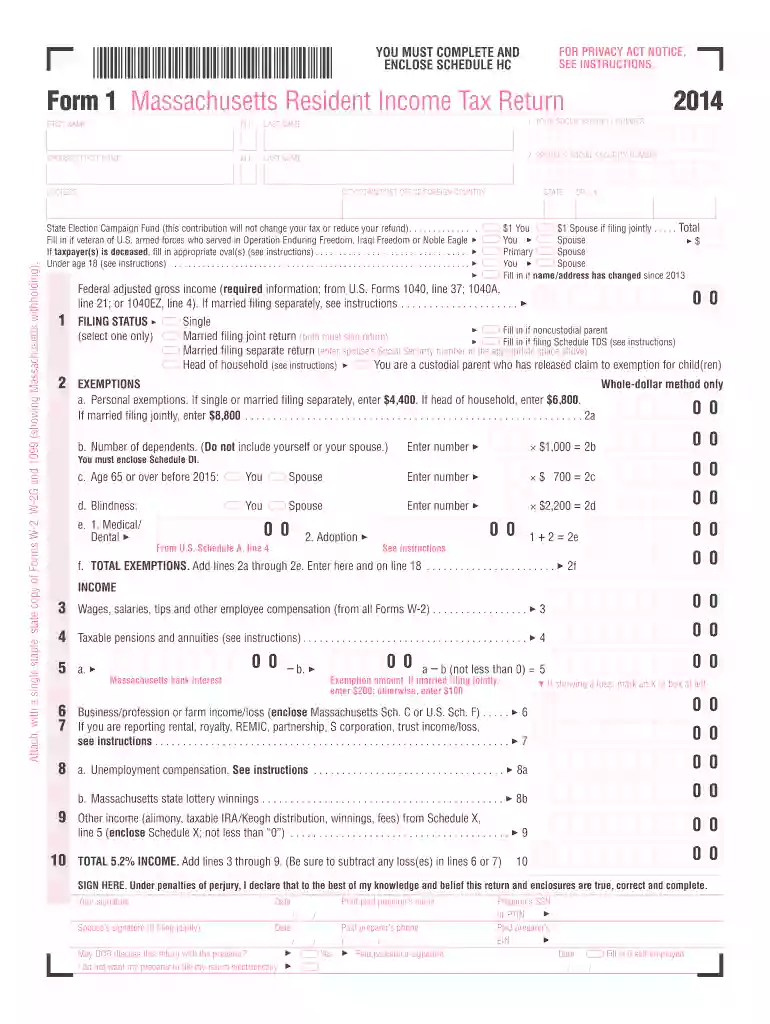
The Massachusetts Resident Income Tax Return, commonly referred to as Form 2014 MA, is a critical document for taxpayers residing in Massachusetts. It allows residents to report their income, claim deductions, and calculate their tax liability for the year 2014. This form ensures compliance with state tax regulations and helps determine the taxpayer's final tax obligation or refund. By accurately completing Form 2014 MA, individuals can avoid penalties and ensure they are fulfilling their tax responsibilities as mandated by the state.
Taxpayers can acquire Form 2014 MA through various channels to facilitate ease of access. It is available for download on the official Massachusetts Department of Revenue (DOR) website. Alternatively, individuals may request a physical copy by contacting the DOR or visiting in-person assistance centers. Some tax preparation software programs also include downloadable versions of this form, making it convenient for users to access while filing their taxes electronically.
Form 2014 MA comprises several essential sections that taxpayers must complete diligently:
Understanding terminology is vital for accurately completing Form 2014 MA:
Massachusetts imposes specific rules that deviate from federal guidelines:
The deadline for submitting Form 2014 MA follows the federal tax deadline, typically April 15. However, extensions might be available if requested before the original deadline. It is crucial for taxpayers to adhere to these timelines to avoid penalties or interest on overdue taxes.
Failure to file or inaccurate reporting on Form 2014 MA can result in penalties:
Anne, a Massachusetts resident, receives income from various sources, including part-time employment, rental properties, and investment dividends. By using Form 2014 MA, Anne accurately reports all income, claims applicable deductions such as mortgage interest, and calculates her tax liability. This process ensures compliance and positions her for a potential state tax refund. Such examples underscore the versatility of Form 2014 MA in accommodating diverse taxpayer scenarios.
We've got more versions of the massachusetts form 2014 form. Select the right massachusetts form 2014 version from the list and start editing it straight away!
| Versions | Form popularity | Fillable & printable |
|---|---|---|
| 2025 | 4.4 Satisfied (54 Votes) | |
| 2024 | 4.9 Satisfied (28 Votes) | |
| 2023 | 4.5 Satisfied (35 Votes) | |
| 2022 | 4.8 Satisfied (26 Votes) | |
| 2021 | 4.8 Satisfied (30 Votes) | |
| 2020 | 4.3 Satisfied (154 Votes) | |
| 2019 | 4.1 Satisfied (27 Votes) | |
| 2018 | 4.1 Satisfied (52 Votes) | |
| 2017 | 4.2 Satisfied (65 Votes) | |
| 2017 | 3.9 Satisfied (48 Votes) | |
| 2016 | 4.4 Satisfied (637 Votes) | |
| 2015 | 4.4 Satisfied (317 Votes) | |
| 2014 | 4 Satisfied (60 Votes) | |
| 2013 | 4 Satisfied (44 Votes) | |
| 2012 | 4 Satisfied (49 Votes) |
At DocHub, your data security is our priority. We follow HIPAA, SOC2, GDPR, and other standards, so you can work on your documents with confidence.
May 8, 2025 Monson 2014 solar farm is an operating solar photovoltaic (PV) farm in Monson, Hampden County, Massachusetts, United States.
Jun 8, 2012 General Instructions: Submission of proposals is to be made directly to the program unit that manages them, allowing for more rapid distributionRead more
Please enclose $5.00 filing fee check payable to the Comm of MA-DTC. Do not staple the check to the form. Mail the original plus one (1) copy of AnnualRead more


