




01. Edit your 2017 massachusetts income tax online
Type text, add images, blackout confidential details, add comments, highlights and more.

Type text, add images, blackout confidential details, add comments, highlights and more.

Draw your signature, type it, upload its image, or use your mobile device as a signature pad.

Send it via email, link, or fax. You can also download it, export it or print it out.
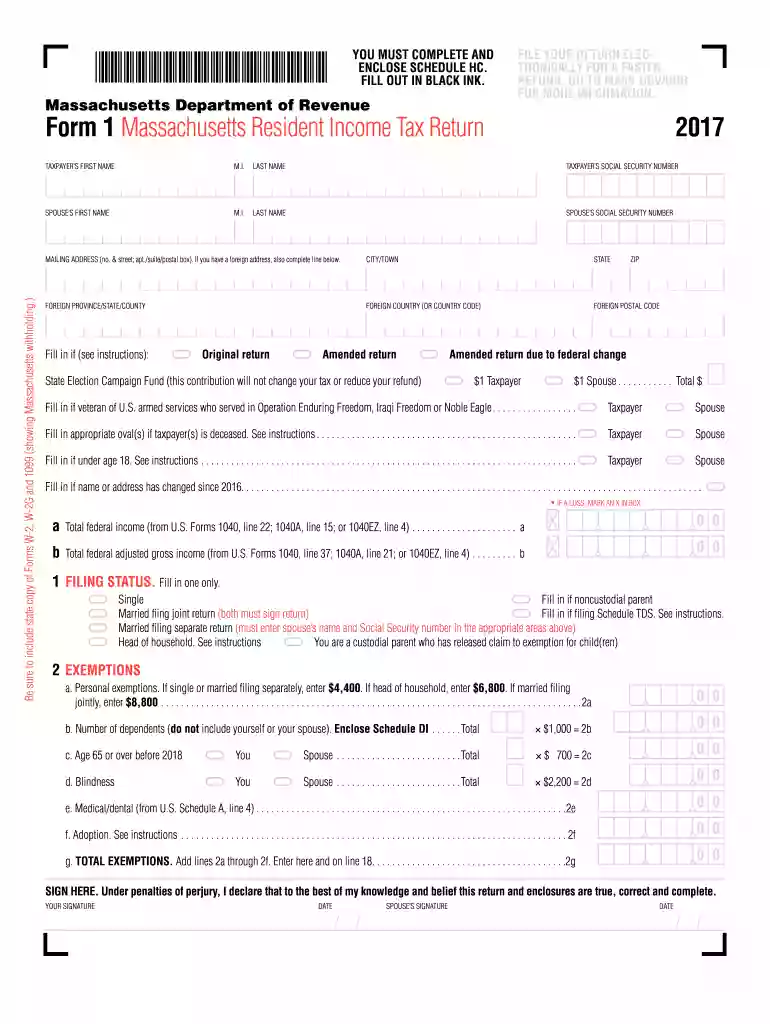
The "Mass dor fillable formDocHubcom 2" primarily refers to the Massachusetts Department of Revenue's (DOR) Resident Income Tax Return Form 1. This form is designated for residents of Massachusetts to report their income, calculate their personal income tax liabilities, and identify any tax refunds or payments owed to the state. The term “fillable” indicates that the form can be completed electronically, which allows for streamlined filing and can significantly reduce errors that may occur with manual entries. This form was available for completion and submission through DocHub.com during the tax years 2017 to 2019, offering users features such as automatic calculations, easy data entry, and secure document handling.
Using the Mass DOR fillable form on DocHub.com involves accessing the platform and selecting the appropriate tax form. Once selected, users can begin by importing their data into the designated fields directly on the form. The fillable nature of the form ensures that entries are neat and easy to read, and the system offers automated calculations to ensure accuracy in tax computations. Users can enter details like personal information, income data, deductions, exemptions, and tax credits. After completing the form, users can seamlessly submit it online or choose to print and mail a hard copy if preferred. Importantly, DocHub's tools allow users to save their progress and return later, ensuring the form can be completed at their convenience.
This form is primarily used by Massachusetts residents who need to file their state income tax returns. It is relevant for individuals with various income sources, including salaried employees, self-employed individuals, retirees who need to report pension and social security income, and investors with dividends or interest income. The form is beneficial for those who prefer a digital solution for tax filing and appreciate the convenience of online tax tools over traditional paper forms.


The form is legally recognized and required under the Massachusetts state tax law for resident income tax reporting. Compliance with tax regulations necessitates the accurate completion and timely submission of Form 1, ensuring the taxpayer meets their legal obligations. As an official state tax document, the fillable form captures the necessary information needed by the Massachusetts DOR to assess individual tax filings and obligations. Using the fillable version ensures adherence to electronic filing standards set by state authorities.
Taxpayers are required to file their Massachusetts Resident Income Tax Return by April 15th each tax year. If the deadline falls on a weekend or holiday, it is typically extended to the next business day. It’s crucial for taxpayers to adhere to these deadlines to avoid late fees and penalties. DocHub.com users can utilize automated reminders to ensure they complete and submit their forms promptly. Extensions can also be requested through the state’s tax authority for those needing additional time to prepare their filings.
Massachusetts allows the submission of Form 1 electronically through platforms like DocHub, providing a secure and efficient method of filing. Users also have the option to print the completed form and mail it directly to the Massachusetts Department of Revenue. Electronic filing is often faster and provides immediate confirmation of receipt. Mailed submissions, however, require adequate postage and may take longer to process.
When completing the Mass DOR fillable form, individuals should have access to various financial documents to ensure accurate reporting:
Having these documents at hand simplifies the completion process and ensures all reported information is precise.
Understanding these elements is crucial for accurately filling out and filing the form with the Massachusetts Department of Revenue.
We've got more versions of the 2017 massachusetts income tax form. Select the right 2017 massachusetts income tax version from the list and start editing it straight away!
| Versions | Form popularity | Fillable & printable |
|---|---|---|
| 2025 | 4.4 Satisfied (54 Votes) | |
| 2024 | 4.9 Satisfied (28 Votes) | |
| 2023 | 4.5 Satisfied (35 Votes) | |
| 2022 | 4.8 Satisfied (26 Votes) | |
| 2021 | 4.8 Satisfied (30 Votes) | |
| 2020 | 4.3 Satisfied (154 Votes) | |
| 2019 | 4.1 Satisfied (27 Votes) | |
| 2018 | 4.1 Satisfied (52 Votes) | |
| 2017 | 4.2 Satisfied (65 Votes) | |
| 2017 | 3.9 Satisfied (48 Votes) | |
| 2016 | 4.4 Satisfied (637 Votes) | |
| 2015 | 4.4 Satisfied (317 Votes) | |
| 2014 | 4 Satisfied (60 Votes) | |
| 2013 | 4 Satisfied (44 Votes) | |
| 2012 | 4 Satisfied (49 Votes) |
At DocHub, your data security is our priority. We follow HIPAA, SOC2, GDPR, and other standards, so you can work on your documents with confidence.


