
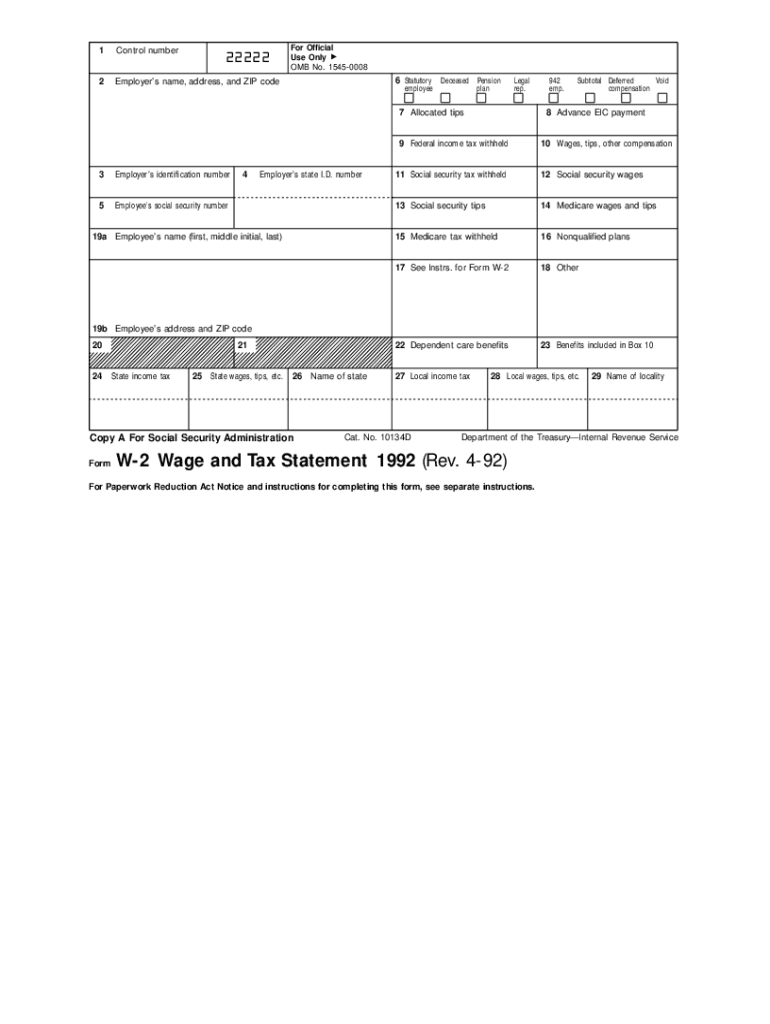







Definition and Purpose of the Form W-2 Wage and Tax Statement 1992 (Rev. 4-92)
The Form W-2, Wage and Tax Statement 1992 (Rev. 4-92), is a tax document used to report wages, tips, and other compensation paid to employees, as well as the taxes withheld from these payments throughout the fiscal year. This form serves as a critical report for both employees and the Internal Revenue Service (IRS), helping ensure accurate filing for income tax returns.
- Employer Responsibility: Employers must provide each employee with a copy of the Form W-2 annually by January 31st, detailing the prior year’s earnings.
- Employee Usage: Employees use the information from the W-2 to complete their tax returns and claim various credits, such as the Earned Income Credit (EIC).
- IRS Filing: Employers submit a copy to the Social Security Administration (SSA) as part of compliance with federal tax regulations, which then aids the IRS in matching wage and tax information.
How to Obtain the Form W-2 Wage and Tax Statement 1992 (Rev. 4-92)
Employees typically receive the Form W-2 directly from their employers. However, if you need a W-2 form from 1992 or are unable to obtain it through normal employment channels, consider the following options:
- Contact Your Employer: Start by reaching out to your former employer’s HR or payroll department.
- IRS Request: You can request copies of past filed returns, which include W-2 information, using IRS Form 4506.
- SSA Records: The Social Security Administration can provide W-2 forms for social security purposes.
- Tax Preparation Services: Some professional tax preparers or platforms may have archived forms if you filed with them previously.
Steps to Complete the Form W-2 Wage and Tax Statement 1992 (Rev. 4-92)
Accurate completion of the Form W-2 involves the following steps:
-
Employer Identification: Enter the employer's name, address, and Employer Identification Number (EIN).
-
Employee Details: Include the employee's name, address, Social Security Number (SSN), and employment details.
-
Wage Reporting:
- Box 1: Report total wages, tips, and other compensation.
- Box 2: Federal income tax withheld.
- Box 3: Social Security wages and their respective taxes.
- Box 5: Medicare wages and taxes.
-
State and Local Taxes: Complete sections for state income tax and any applicable local tax jurisdiction.
-
Verify Information: Double-check entries for any discrepancies before submitting.
Key Elements of the Form W-2 Wage and Tax Statement 1992 (Rev. 4-92)
Several key elements comprise the Form W-2:
- Personal Information: Employee's full name and SSN.
- Wages and Taxes: Includes breakdowns of federal, state, and local tax withholdings.
- Compensation Types: Includes wages, tips, and other forms of compensation.
- Benefits and Deductions: Reflects contributions to retirement plans, health savings accounts, and any applicable deductions.
Understanding these elements helps both employers and employees ensure accurate tax reporting and compliance.
IRS Guidelines for the Form W-2 Wage and Tax Statement 1992 (Rev. 4-92)
The IRS provides strict guidelines regarding the handling and submission of the Form W-2:
- Deadline Compliance: Employers must furnish paper or electronic copies to employees by January 31st of each year.
- Filing with SSA: Simultaneously, employers must file copies of all W-2s with the SSA.
- Record Keeping: Employers are advised to maintain records of W-2s issued and filed for at least four years in order to answer any queries from the IRS or SSA.
Filing Deadlines and Important Dates
Deadlines associated with the Form W-2 are critical for tax compliance:
- January 31st: Deadline for employers to provide employees with W-2s.
- February 28th: Paper filing with SSA deadline if electronically filing isn’t used.
- Snowstorm Date: For those filing electronically, the deadline is March 31st.
- Extensions: Employers may apply for a thirty-day extension using Form 8809 under certain circumstances.
Penalties for Non-Compliance
Failure to comply with the regulations around Form W-2 can have consequences:
- Late Filing Penalties: Penalties increase based on lateness, starting from $50 per form if filed within 30 days, up to $270 per form after August 1st.
- Incorrect Information Penalty: Employers might face penalties for submitting incorrect statements, especially if corrective actions are not undertaken promptly.
- Intentional Disregard: A higher penalty rate applies if the non-compliance is found to be intentional.
Employers must ensure accuracy and timeliness to avoid unnecessary penalties.
Digital vs. Paper Version
Choosing between digital and paper versions of the Form W-2 involves several considerations:
- Digital Benefits: E-forms can be easier to distribute and file, reducing the chance of data-entry errors often associated with manual processes.
- Paper Requirements: Some states or employees might require physical copies for their records.
- Archiving: Digital versions are generally easier to archive and retrieve for future references or audits.
Employers and employees should decide based on their specific operational and compliance needs.
Software Compatibility (TurboTax, QuickBooks, etc.)
Several popular tax and accounting software solutions can streamline the preparation and submission of Form W-2:
- TurboTax: Offers functionalities for both personal and professional tax preparation, easily importing W-2 forms.
- QuickBooks: Integrates payroll systems for generating and managing W-2s.
- H&R Block: Similar to TurboTax, it offers robust import capabilities for electronic W-2 management.
These tools enhance accuracy and ease the burden of tax compliance by automating calculations and form entries.




