




01. Edit your 2016 schedule c online
Type text, add images, blackout confidential details, add comments, highlights and more.

Type text, add images, blackout confidential details, add comments, highlights and more.

Draw your signature, type it, upload its image, or use your mobile device as a signature pad.

Send 2016 schedule c instructions via email, link, or fax. You can also download it, export it or print it out.
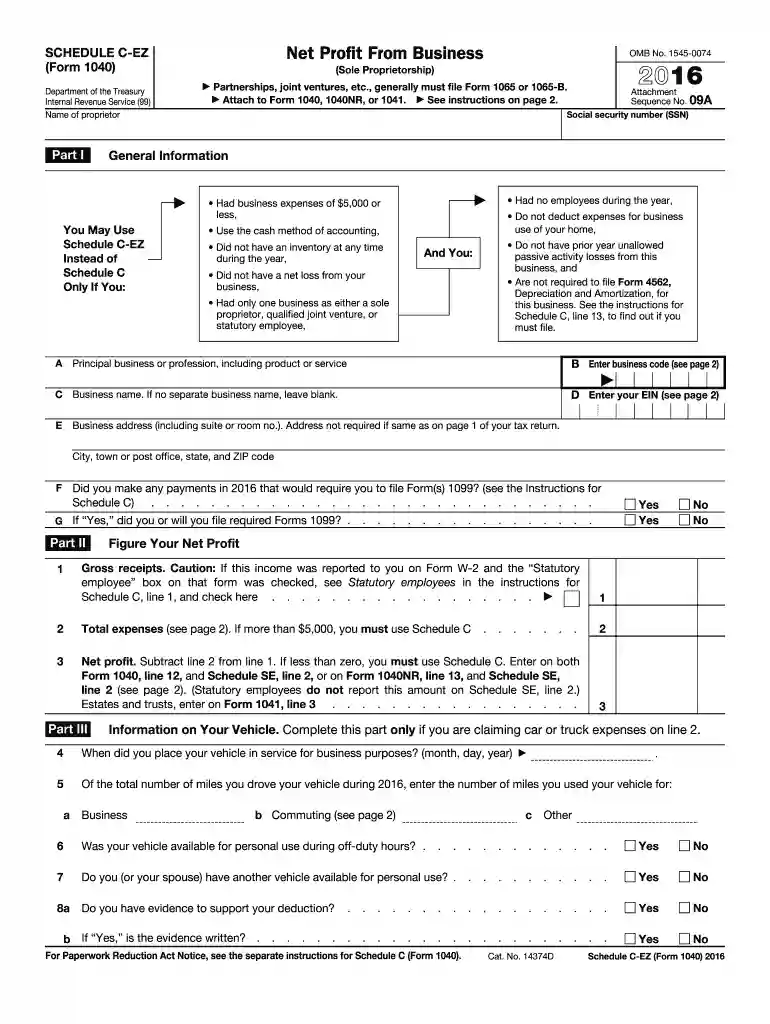
The 1040 Schedule C-EZ, a streamlined tax form, is designed for small sole proprietorships or qualified joint ventures to report net profit. It simplifies the process of detailing income and expenses compared to the full Schedule C, making it ideal for businesses with straightforward financials. Businesses without employees and with $5,000 or less in business expenses are typically eligible to use this form. It provides a simple way to calculate business profit, focusing on major areas such as gross receipts and total expenses.
Not all businesses are eligible to use the Schedule C-EZ form. Key eligibility criteria include:
Meeting these criteria allows small business owners to leverage this form, saving time and simplifying their tax filing process.


Completing the Schedule C-EZ involves several steps:
Ensuring accuracy in these steps is crucial to reflect your business's true financial position and minimize discrepancies during IRS reviews.
The Schedule C-EZ consists of several critical sections:
Each section of the form is designed to capture concise, relevant business information, ensuring clarity and simplicity.
Familiarity with important terms helps in navigating the Schedule C-EZ:
Understanding these terms ensures better accuracy in completing and filing the form.
According to IRS guidelines, Schedule C-EZ can be used by those meeting specific criteria and preferring a simplified reporting method:
IRS guidelines underline the importance of adherence to filing rules, protecting businesses against audits or penalties.
Being aware of filing deadlines is crucial for compliance:
Timely submission ensures businesses avoid late fees and interest on unpaid taxes.
Failure to comply with IRS regulations regarding Schedule C-EZ can result in penalties:
Understanding the implications of these penalties emphasizes the importance of accurate and timely filings.
We've got more versions of the 2016 schedule c form. Select the right 2016 schedule c version from the list and start editing it straight away!
| Versions | Form popularity | Fillable & printable |
|---|---|---|
| 2018 | 4.8 Satisfied (37 Votes) | |
| 2017 | 4.3 Satisfied (158 Votes) | |
| 2016 | 4.3 Satisfied (70 Votes) | |
| 2015 | 3.9 Satisfied (34 Votes) | |
| 2014 | 4 Satisfied (41 Votes) | |
| 2013 | 3.8 Satisfied (45 Votes) | |
| 2011 | 4 Satisfied (54 Votes) | |
| 2010 | 4 Satisfied (50 Votes) | |
| 2009 | 4.3 Satisfied (64 Votes) | |
| 2007 | 4.1 Satisfied (39 Votes) |
At DocHub, your data security is our priority. We follow HIPAA, SOC2, GDPR, and other standards, so you can work on your documents with confidence.
If less than zero, you must use Schedule C. Enter on both. Form 1040, line 12, and Schedule SE, line 2, or on Form 1040NR, line 13, and Schedule SE,.Read more
Jan 19, 2017 Individuals Form 1040, line 41, or Form. 1040NR, line 39. Estates and trusts See the instructions for Form 1041, line 22, for information.Read more
fill in your name, address, social security number, telephone number and, if married, your spouses name and social security number;. check Box A below yourRead more


