




01. Edit your 2017 schedule c ez online
Type text, add images, blackout confidential details, add comments, highlights and more.

Type text, add images, blackout confidential details, add comments, highlights and more.

Draw your signature, type it, upload its image, or use your mobile device as a signature pad.

Send 2017 schedule c instructions via email, link, or fax. You can also download it, export it or print it out.
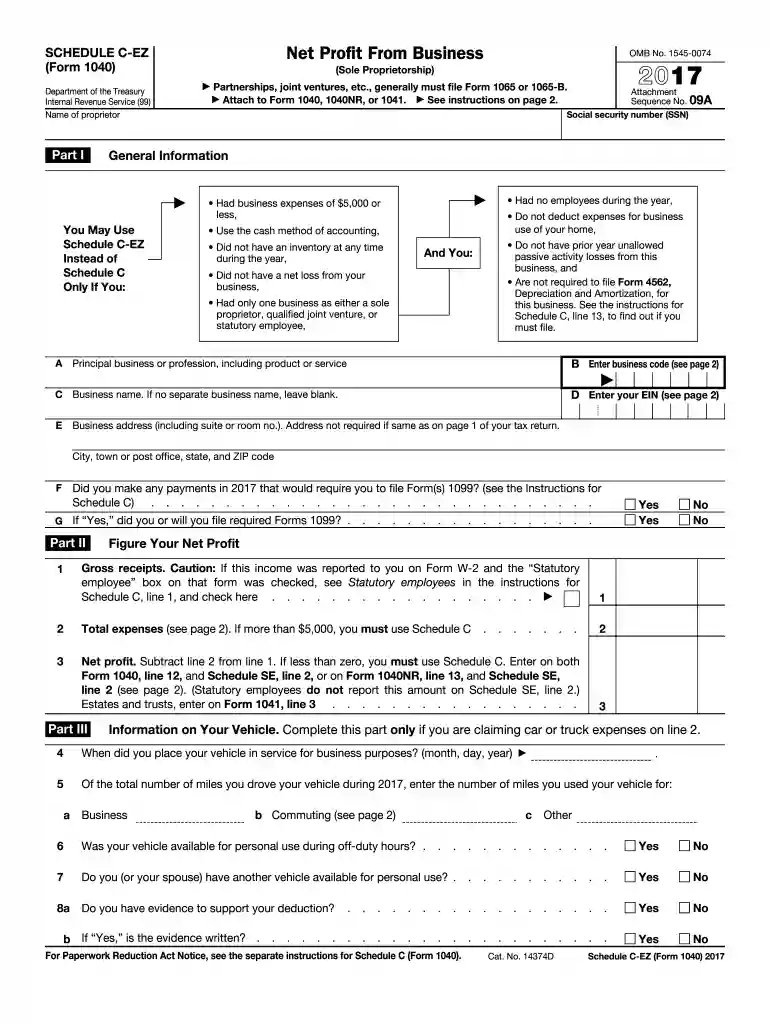
Schedule C-EZ (Form 1040) for 2017 was a simplified version of Schedule C, designed for sole proprietors to report their net profit from business activities. It provided a streamlined method for individuals with straightforward financial situations to document their income and expenses without the complexity of a full Schedule C. This form was specifically beneficial for small business owners or self-employed individuals who met specific criteria, such as not having any employees and incurring minimal business expenses.
To use the Schedule C-EZ for 2017, taxpayers had to meet specific criteria. These included having business expenses of $5,000 or less and no employees. Additionally, the proprietor's business could not involve inventory or require them to use depreciation or deduction of the cost of goods sold. The form was not suitable for individuals who claimed a deduction for home office use or were using the accrual accounting method. Individuals should verify that they meet all these requirements to simplify their tax filing process.


Gathering Information: Collect details of the gross income received from your business activities. You will also need to have documented evidence of deductible expenses.
Filling Out Business Information: Enter your business name and address, principal business code, and other identification information required at the top of the form.
Gross Income Entry: Report total gross income by adding all income earned during the tax year from your sole proprietorship.
Deductible Expenses: List allowable expenses under $5,000, including items like office supplies or minor repairs, and ensure they do not exceed the threshold.
Net Profit Calculation: Subtract deductible expenses from your gross income to calculate the net profit, which would be transferred to Line 12 of Form 1040.
Record Keeping: Ensure all financial documents that support your entries are well-organized and retained for possible audit purposes.
Income Records: Statements or receipts confirming all business income received within the year.
Expense Receipts: Documentation for all business-related expenses claimed.
Previous Tax Returns: Prior tax returns if applicable, to ensure consistency and accuracy in reporting.
Business Records: Any licenses, registration, or documentation of your business structure, if relevant.
Taxpayers had several options for submitting the Schedule C-EZ form in 2017. The form could be filed electronically using tax software approved by the IRS, such as TurboTax or QuickBooks, which often provided step-by-step guidance. Alternatively, the completed form could be mailed to the IRS as part of the taxpayer's annual income tax return. It was crucial to ensure all forms, including any additional schedules or forms required, were included in the submission to avoid processing delays.
The IRS provided specific guidelines for completing Schedule C-EZ, emphasizing accuracy in reporting. Taxpayers were advised to review the full instructions provided with the form to ensure compliance with IRS requirements. This included understanding which business expenses were deductible and knowing how to accurately report various types of income. Adhering to these guidelines was important to avoid penalties and ensure the correct calculation of net income.
Failure to accurately complete the Schedule C-EZ or to file it on time could lead to penalties from the IRS. These could range from late filing charges to more severe consequences if income was underreported. It was crucial for taxpayers to verify their eligibility, confirm the accuracy of their figures, and ensure timely submission to prevent incurring any penalties.
Both digital and paper versions of Schedule C-EZ were available for the 2017 tax year. Filing electronically was often preferred due to its convenience, faster processing times, and built-in error checks provided by filing software. However, a paper version was also an option for those who preferred a manual method. In both cases, ensuring the form was filled out correctly and submitted by the deadline was essential to avoid any issues with the IRS.
We've got more versions of the 2017 schedule c ez form. Select the right 2017 schedule c ez version from the list and start editing it straight away!
| Versions | Form popularity | Fillable & printable |
|---|---|---|
| 2018 | 4.8 Satisfied (37 Votes) | |
| 2017 | 4.3 Satisfied (158 Votes) | |
| 2016 | 4.3 Satisfied (70 Votes) | |
| 2015 | 3.9 Satisfied (34 Votes) | |
| 2014 | 4 Satisfied (41 Votes) | |
| 2013 | 3.8 Satisfied (45 Votes) | |
| 2011 | 4 Satisfied (54 Votes) | |
| 2010 | 4 Satisfied (50 Votes) | |
| 2009 | 4.3 Satisfied (64 Votes) | |
| 2007 | 4.1 Satisfied (39 Votes) |
At DocHub, your data security is our priority. We follow HIPAA, SOC2, GDPR, and other standards, so you can work on your documents with confidence.
Dec 6, 2017 Attach to Form 1045 a copy of Form. 6781 and Schedule D (Form 1040) for the year of the net section 1256 contracts loss and an amended Form.Read more
Had no employees during the year,. Do not deduct expenses for business use of your home,. Do not have prior year unallowed.Read more
You, or your spouse if married, have earned income during 2017. If line 1a or 1b on Schedule H or H-EZ is 62 or more, you do not need to complete lines 1c orRead more


