




01. Edit your schedule c ez online
Type text, add images, blackout confidential details, add comments, highlights and more.

Type text, add images, blackout confidential details, add comments, highlights and more.

Draw your signature, type it, upload its image, or use your mobile device as a signature pad.

Send schedule c tax form via email, link, or fax. You can also download it, export it or print it out.
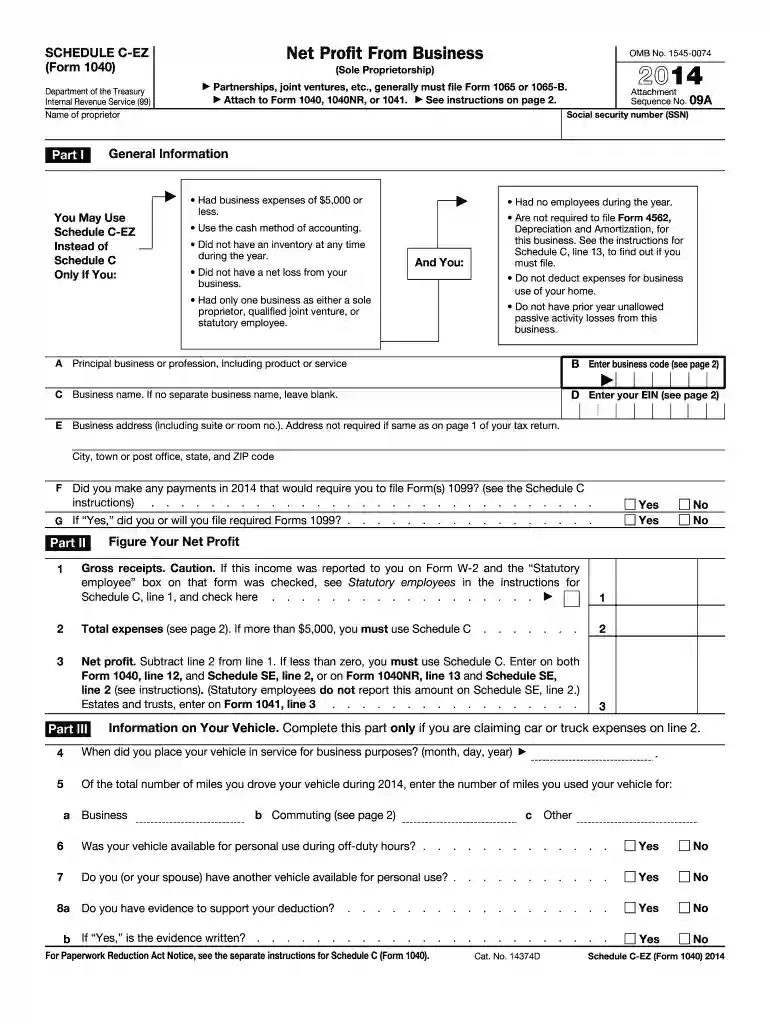
Schedule C-EZ (Form 1040) was designed as a simplified version of Schedule C for sole proprietors to report net profits from a business. This form enables those with uncomplicated tax situations to file without the extensive details required by the regular Schedule C. Its primary use is to streamline the filing process for small business owners who meet specific conditions, such as having limited business expenses and not carrying any inventory. By using Schedule C-EZ, eligible taxpayers can save time and reduce the paperwork involved in tax preparation.
Eligibility to use Schedule C-EZ requires meeting several specific conditions. First, your business expenses should not exceed $5,000. Additionally, you should not have any employees, nor should you own or lease any property associated with the business. The form is not applicable if you are operating your business as a corporation or partnership. Importantly, you must use the cash method of accounting, and your total business inventory should be zero. Understanding these criteria is crucial for determining if Schedule C-EZ is suitable for your filing needs.


Schedule C-EZ focuses on key elements essential for reporting net profit efficiently. Among these are gross receipts or sales, total business expenses, and vehicle information for those who use vehicles for business purposes. The form also considers business mileage and other travel costs when applicable. This concise structure ensures that all necessary fiscal information regarding small business operations is documented without complicating the filing process.
If you used a vehicle for your business, you must report mileage on Schedule C-EZ. Ensure accurate records of total miles driven for business purposes throughout the year as this impacts the deductions you can claim.
Filing Schedule C-EZ is a straightforward process, especially if you fulfill the eligibility criteria. The steps are methodically organized to streamline the process.
Schedule C-EZ is primarily used by small business owners who maintain straightforward operations. Sole proprietors with minimal expenses, freelancing individuals, and certain independent contractors find this form advantageous for its simplicity and ease of use.
Familiarity with terminology specific to Schedule C-EZ ensures accurate completion and reporting. Critical terms include gross receipts, net earnings, business mileage, and cash method accounting. An understanding of these terms helps in determining eligibility and accurate tax reporting.
The IRS provides comprehensive guidelines for completing Schedule C-EZ to ensure accuracy and compliance. These guidelines underscore the requirements for eligibility and specific instructions for each section of the form. Adhering to IRS instructions is fundamental to avoid errors or potential audits.
Adhering to the filing deadline for Schedule C-EZ is crucial to avoid any penalties. Typically, this form is due with your Form 1040 by April 15, unless an extension is filed. Ensure that all related documents are complete and submitted to the IRS within the stipulated timeframe.
Should you require additional time, filing an extension provides the flexibility to extend your deadline to October 15. Remember, the extension allows for more time to file the paperwork, not to pay any taxes due.
Failure to comply with the requirements for filing Schedule C-EZ can lead to penalties. These may include late filing fees or penalties for underreporting income. The IRS enforces strict guidelines, so accuracy and timeliness are paramount.
By understanding the essentials of the 2014 Schedule C-EZ and following these detailed guidelines, taxpayers can navigate the tax filing process effectively, ensuring compliance and optimizing their tax situation.
We've got more versions of the schedule c ez form. Select the right schedule c ez version from the list and start editing it straight away!
| Versions | Form popularity | Fillable & printable |
|---|---|---|
| 2018 | 4.8 Satisfied (37 Votes) | |
| 2017 | 4.3 Satisfied (158 Votes) | |
| 2016 | 4.3 Satisfied (70 Votes) | |
| 2015 | 3.9 Satisfied (34 Votes) | |
| 2014 | 4 Satisfied (41 Votes) | |
| 2013 | 3.8 Satisfied (45 Votes) | |
| 2011 | 4 Satisfied (54 Votes) | |
| 2010 | 4 Satisfied (50 Votes) | |
| 2009 | 4.3 Satisfied (64 Votes) | |
| 2007 | 4.1 Satisfied (39 Votes) |
At DocHub, your data security is our priority. We follow HIPAA, SOC2, GDPR, and other standards, so you can work on your documents with confidence.
Earned income credit (EIC). You may be able to take the EIC for 2015 if your adjusted gross income. (AGI) is less than a certain amount.Read more
See the instructions for. Schedule C, line 13, to find out if you must file. Do not deduct expenses for business use of your home. Do not have prior yearRead more
Feb 8, 2018 For impairment-related work ex- penses, use the appropriate business form (1040 Sched- ules C, C-EZ, E, and F; Form 2106, Employee Business.Read more


