




01. Edit your schedule c ez online
Type text, add images, blackout confidential details, add comments, highlights and more.

Type text, add images, blackout confidential details, add comments, highlights and more.

Draw your signature, type it, upload its image, or use your mobile device as a signature pad.

Send schedule c form via email, link, or fax. You can also download it, export it or print it out.
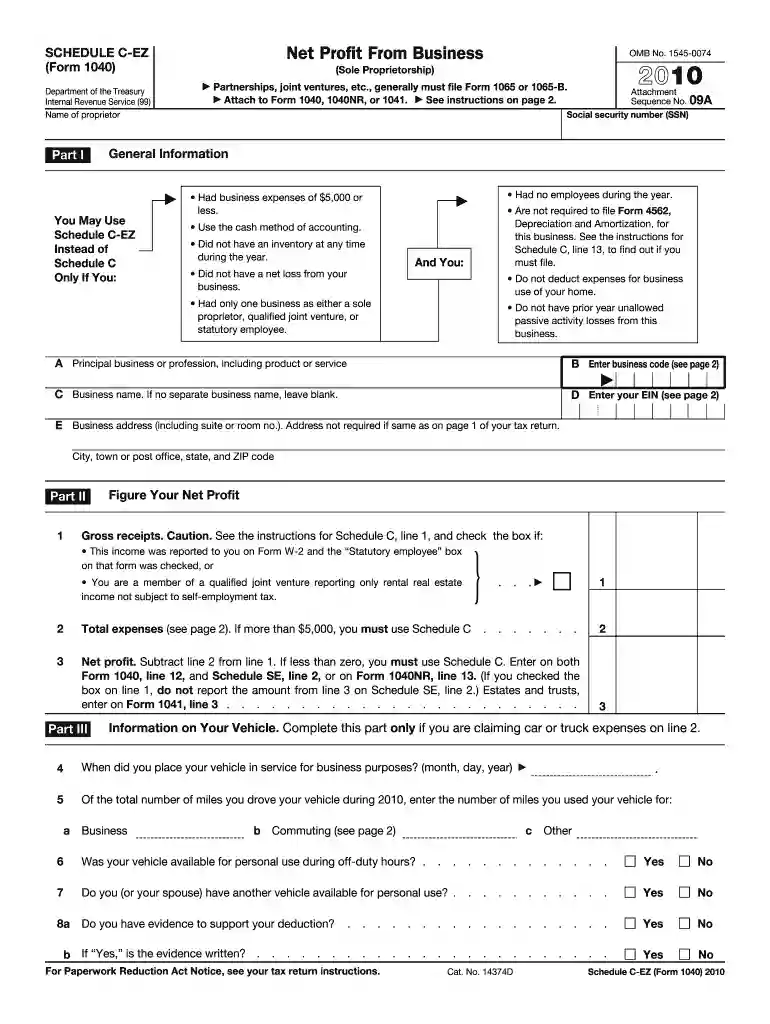
The 2010 Schedule C-EZ form is a simplified version of the Schedule C, used by sole proprietors to report their net profit from business activities. This form is applicable for taxpayers who meet certain criteria, such as having business expenses not exceeding $5,000, no employees, and not claiming depreciation or a home office deduction. By streamlining the reporting process, the Schedule C-EZ allows eligible business owners to fulfill their tax obligations with reduced paperwork.
To use the 2010 Schedule C-EZ form, a taxpayer must satisfy specific requirements. Key eligibility criteria include:


Taxpayers can obtain the 2010 Schedule C-EZ form from various sources. It is available on the Internal Revenue Service (IRS) website for download in PDF format. Alternatively, physical copies can be requested from the IRS through the mail. Additionally, tax preparation software often provides access to this form within their digital tools, and tax professionals can supply the form as part of their services.
Completing the 2010 Schedule C-EZ involves several steps to ensure accuracy:
The form consists of specific elements critical to reporting and calculating business income, such as:
The IRS provides detailed guidelines on completing the Schedule C-EZ form, which are crucial for compliance:
For taxpayers using the 2010 Schedule C-EZ, adhering to deadlines is crucial:
We've got more versions of the schedule c ez form. Select the right schedule c ez version from the list and start editing it straight away!
| Versions | Form popularity | Fillable & printable |
|---|---|---|
| 2018 | 4.8 Satisfied (37 Votes) | |
| 2017 | 4.3 Satisfied (158 Votes) | |
| 2016 | 4.3 Satisfied (70 Votes) | |
| 2015 | 3.9 Satisfied (34 Votes) | |
| 2014 | 4 Satisfied (41 Votes) | |
| 2013 | 3.8 Satisfied (45 Votes) | |
| 2011 | 4 Satisfied (54 Votes) | |
| 2010 | 4 Satisfied (50 Votes) | |
| 2009 | 4.3 Satisfied (64 Votes) | |
| 2007 | 4.1 Satisfied (39 Votes) |
At DocHub, your data security is our priority. We follow HIPAA, SOC2, GDPR, and other standards, so you can work on your documents with confidence.
When claiming the auto or truck deduction, Part IV of Schedule C, Part III of Schedule C-EZ, or Part V of Form 4562,. Depreciation and Amortization, must beRead more
Utah Corporation Return Schedules: Attach applicable. Utah schedules A, B, C, D, E, H, J, and/or M. Federal Return: Attach only pages 1 through 5 of your.Read more
See the instructions for Schedule C, line 1, and check the box if: This income was reported to you on Form W-2 and the Statutory employee box on that formRead more


