




01. Edit your 2007 f form online
Type text, add images, blackout confidential details, add comments, highlights and more.

Type text, add images, blackout confidential details, add comments, highlights and more.

Draw your signature, type it, upload its image, or use your mobile device as a signature pad.

Send it via email, link, or fax. You can also download it, export it or print it out.
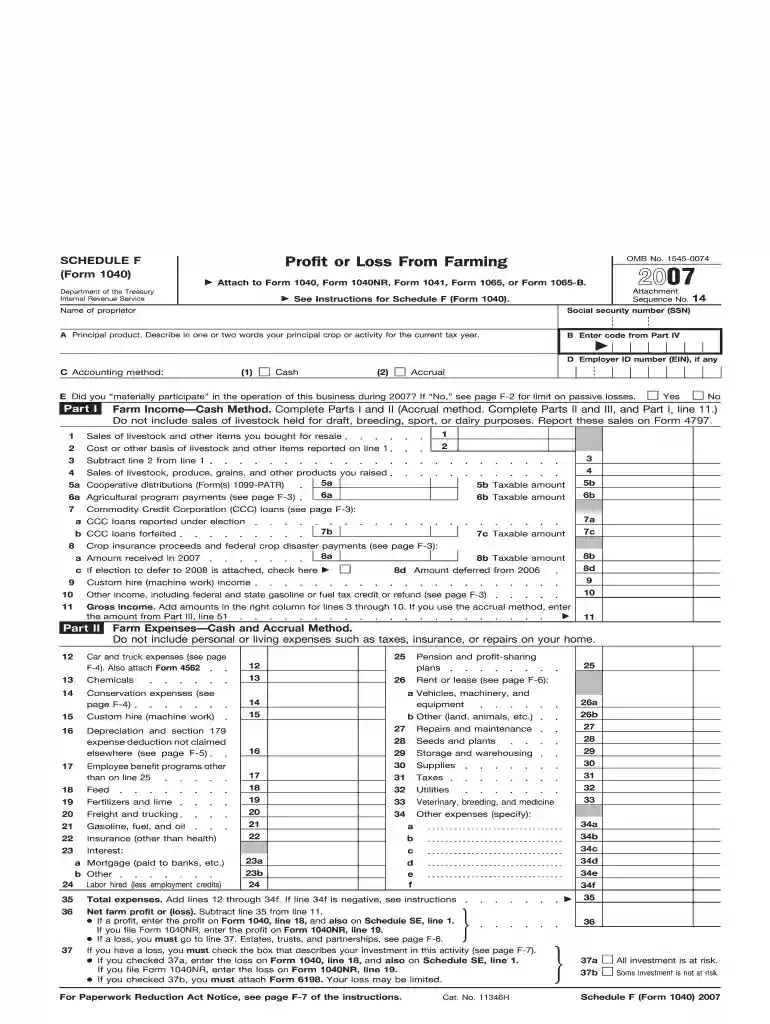
The 2007 Form 1040 (Schedule F) is a tax document used by U.S. farmers to report income and expenses related to farming activities. The main purpose of this form is to calculate the profit or loss from farming, which is then reported on the individual's Form 1040. This document is essential for individuals engaged in agriculture, as it helps in determining taxable income derived from farming. The form accommodates various types of farm activities, including the production of livestock, crops, and other agricultural products. By accurately completing Schedule F, farmers can ensure proper financial reporting and compliance with IRS regulations.
The primary users of the 2007 Form 1040 (Schedule F) are self-employed individuals or sole proprietors involved in farming operations. These can include farmers growing crops like wheat, corn, or vegetables, as well as those raising livestock such as cattle, sheep, or poultry. Additionally, fish farmers and those engaged in the production of farm-related products like honey or maple syrup may also use this form. The form is relevant for both large-scale farming operations and small family farms, providing a standardized way to report agricultural income to the IRS.


The 2007 Form 1040 (Schedule F) can be accessed in several ways. You can download it directly from the IRS website, ensuring you have the most accurate and up-to-date version. Alternatively, tax preparation software like TurboTax can automatically populate the form as part of the filing process. If you prefer physical documents, IRS publications are available at local IRS offices or can be requested by mail.
Schedule F requires a breakdown of various types of farm income, such as:
Each of these categories needs specific amounts reported to reflect total income accurately.
The form provides space to claim deductions for a range of allowable expenses, including:
Proper documentation of these expenses is crucial to substantiate claims in case of an audit.
The IRS sets forth detailed instructions for correctly completing the Schedule F. Filing deadlines align with the annual tax-filing period, typically April 15 of the following year. To meet compliance standards, keep detailed records supporting all reported figures for at least three years. Non-compliance or inaccuracies may result in penalties or additional tax assessments, emphasizing the importance of accuracy.
The 2007 Form 1040 (Schedule F) can be submitted alongside your full tax return either electronically or via mail. Electronic filing is often recommended for faster processing and confirmation of receipt by the IRS.
Compatibility with popular tax software such as QuickBooks and H&R Block can facilitate the completion and submission of Schedule F. These tools often include step-by-step guidance and can help minimize errors through automated calculations.

Different business entities, like sole proprietorships or LLCs, have unique tax obligations. Schedule F caters to individual farmers, but those operating as partnerships or corporations may require additional forms or schedules.
Eligibility for using Schedule F primarily ties to those whose principal business activity is farming. Unique scenarios, such as cooperative operations or joint ventures, may warrant consultation with a tax professional to ensure accurate filing and avoid any discrepancies with the IRS.
By understanding the intricate details and completing the 2007 Form 1040 (Schedule F) accurately, farmers and agricultural entrepreneurs can ensure compliance with tax laws while optimizing their fiscal health.
We've got more versions of the 2007 f form form. Select the right 2007 f form version from the list and start editing it straight away!
| Versions | Form popularity | Fillable & printable |
|---|---|---|
| 2025 | 4.4 Satisfied (58 Votes) | |
| 2024 | 4.2 Satisfied (21 Votes) | |
| 2023 | 4.4 Satisfied (45 Votes) | |
| 2022 | 4.5 Satisfied (43 Votes) | |
| 2021 | 4.8 Satisfied (100 Votes) | |
| 2020 | 4.4 Satisfied (191 Votes) | |
| 2019 | 4.3 Satisfied (60 Votes) | |
| 2018 | 4.4 Satisfied (171 Votes) | |
| 2017 | 4.3 Satisfied (97 Votes) | |
| 2016 | 4.3 Satisfied (135 Votes) | |
| 2015 | 4.3 Satisfied (145 Votes) | |
| 2014 | 4.2 Satisfied (54 Votes) | |
| 2012 | 4.4 Satisfied (39 Votes) | |
| 2010 | 4.8 Satisfied (23 Votes) | |
| 2007 | 4.4 Satisfied (70 Votes) |
At DocHub, your data security is our priority. We follow HIPAA, SOC2, GDPR, and other standards, so you can work on your documents with confidence.
Farmers will continue, as in the past, to compute and report their net farm profits on Form 1040F. They will also use Form 1040 (either the long or short form)Read more
Send the following information: (a) title and author (b) company name and Users. Code (c) time required for presentation (d) special equipment required (e) techRead more
Use Schedule F (Form 1040) to report farm income and expenses. File it with Form 1040,. 1040NR, 1041, 1065, or 1065-B. Profit or Loss.Read more


