




01. Edit your form online
Type text, add images, blackout confidential details, add comments, highlights and more.

Type text, add images, blackout confidential details, add comments, highlights and more.

Draw your signature, type it, upload its image, or use your mobile device as a signature pad.

Send it via email, link, or fax. You can also download it, export it or print it out.
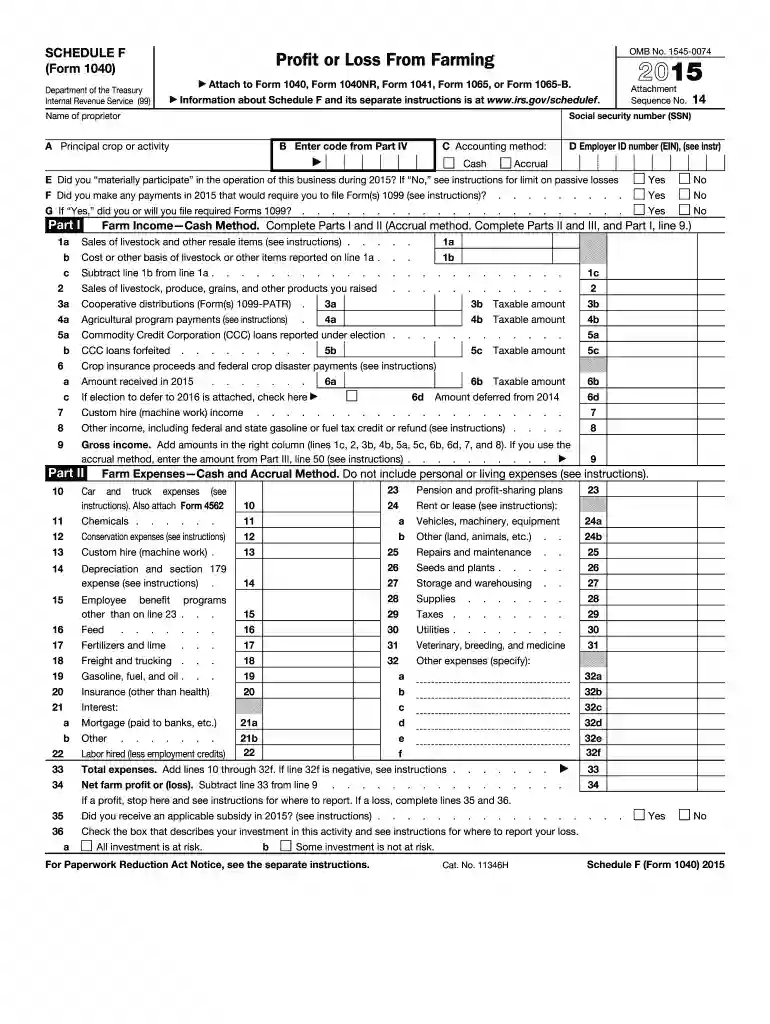
The 2015 F Form, known more formally as Schedule F (Form 1040), is a tax document used by farmers in the United States to report their annual income or loss from farming activities. Its primary purpose is to provide the Internal Revenue Service (IRS) with detailed information on a farmer's income from the sale of livestock, produce, grains, and other farm products. Additionally, it allows farmers to itemize their business expenses, helping to determine their overall taxable profit or loss. Farmers use this form to ensure they comply with federal tax obligations, capturing both income and expenses associated with their agricultural operations.
Completing the Schedule F involves several important steps:
Start with identifying information: Begin by filling in your name, Social Security number, and other personal details.
Report farm income: Include income from sales of livestock, produce, and other products, ensuring accuracy by referencing records such as sales invoices or receipts.
Itemize expenses: Record expenses associated with farming operations, divided into categories like feed, seeds, fertilizers, and machinery repairs.
Calculate net farm profit or loss: Subtract total expenses from total income to determine the net result, which will influence overall tax liability.
By completing these steps, farmers can accurately report their financial activities from farming, ensuring compliance with tax laws and potentially benefiting from deductions through allowed expenses.
Detailed steps to fill out Schedule F:
Gather necessary documents: Collect all relevant documents such as sales receipts, expense invoices, and previous tax returns.
Fill out Part I – Farm Income: Record all income generated from farm activities in Part I, ensuring each amount matches your records for accuracy.
Complete Part II – Farm Expenses: In Part II, detail every deductible expense related to farming. Cross-reference your entries with your collected expense records for precision.
Calculate totals and net profit or loss: Ensure the math checks out by double-checking totals in income and expense sections.
These comprehensive steps will help in accurately completing the 2015 F Form, ensuring full compliance with IRS requirements for farming income and expenses.
Schedule F must be used in compliance with federal tax laws, specifically by those engaged in farming. It's crucial for taxpayers to file this form accurately to avoid legal issues. Legal use means accurately reporting all farming income and claiming only legitimate business expenses. Misreporting can lead to penalties, audits, or other legal implications. Compliance with this requirement ensures farmers maintain good standing with the IRS and can potentially benefit from deductions specific to the agricultural industry.
Some primary components of Schedule F include:
Understanding these sections helps ensure precise and complete documentation of agricultural financial activity, aiding both compliance and financial management.
Gathering the right documents is crucial:
Having these documents readily available ensures that farmers can complete the Schedule F accurately, reflecting their true financial situation.
Farmers can obtain Schedule F from several sources:
These resources help ensure farmers have access to the necessary documentation to complete their taxes accurately and timely.
Consider a small farm business that grows and sells corn. In 2015, this farm documented $100,000 in sales revenue. It incurred $60,000 in total expenses, including costs for seeds, fertilizers, and labor. By accurately listing these on Schedule F, the farm recorded a net profit of $40,000, which became part of their overall tax return. This example illustrates important aspects of using Schedule F, primarily the precise recording of revenue and proper categorizing of expenses to determine net gains or losses for the tax year.
We've got more versions of the 2015 f form form. Select the right 2015 f form version from the list and start editing it straight away!
| Versions | Form popularity | Fillable & printable |
|---|---|---|
| 2025 | 4.4 Satisfied (58 Votes) | |
| 2024 | 4.2 Satisfied (21 Votes) | |
| 2023 | 4.4 Satisfied (45 Votes) | |
| 2022 | 4.5 Satisfied (43 Votes) | |
| 2021 | 4.8 Satisfied (100 Votes) | |
| 2020 | 4.4 Satisfied (191 Votes) | |
| 2019 | 4.3 Satisfied (60 Votes) | |
| 2018 | 4.4 Satisfied (171 Votes) | |
| 2017 | 4.3 Satisfied (97 Votes) | |
| 2016 | 4.3 Satisfied (135 Votes) | |
| 2015 | 4.3 Satisfied (145 Votes) | |
| 2014 | 4.2 Satisfied (54 Votes) | |
| 2012 | 4.4 Satisfied (39 Votes) | |
| 2010 | 4.8 Satisfied (23 Votes) | |
| 2007 | 4.4 Satisfied (70 Votes) |
At DocHub, your data security is our priority. We follow HIPAA, SOC2, GDPR, and other standards, so you can work on your documents with confidence.
Income from providing agricultural services such as soil preparation, veterinary, farm labor, horticultural, or management for a fee or on a contract basis.Read more
Do not include personal or living expenses (see instructions). 10. Car and truck expenses (see instructions). Also attach Form 4562. 23.Read more


