




01. Edit your form online
Type text, add images, blackout confidential details, add comments, highlights and more.

Type text, add images, blackout confidential details, add comments, highlights and more.

Draw your signature, type it, upload its image, or use your mobile device as a signature pad.

Send it via email, link, or fax. You can also download it, export it or print it out.
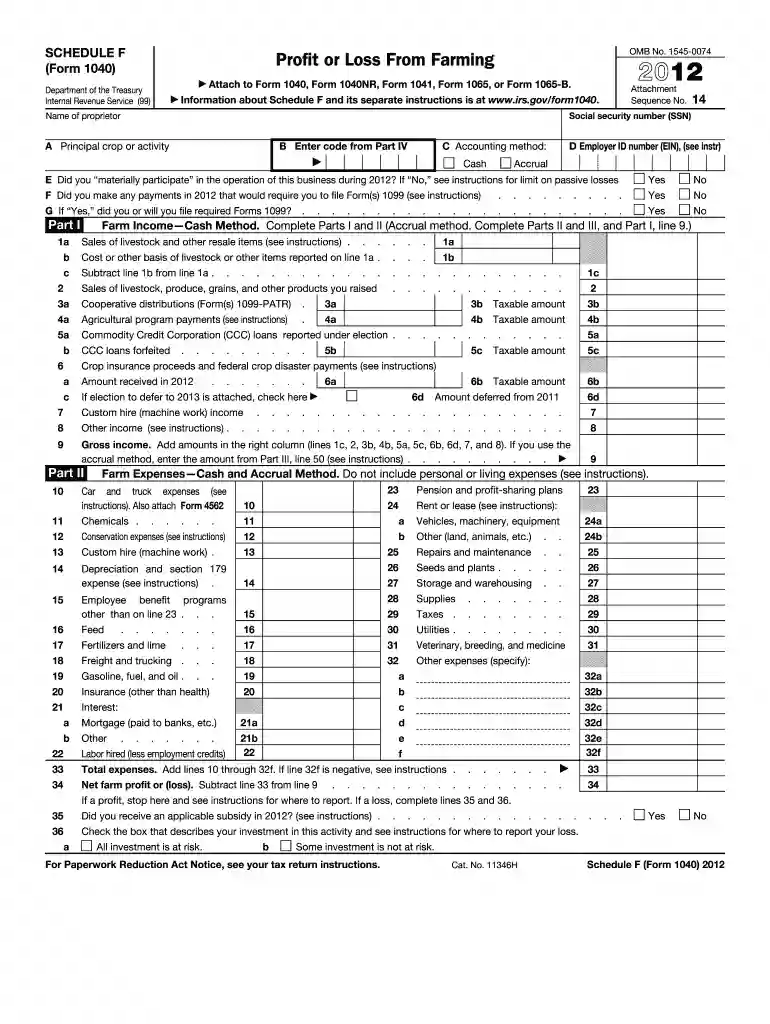
The Schedule F (Form 1040) is a tax document used by farmers to report profit or loss from their farming operations for the tax year 2012. This form analyses various aspects of agricultural income and expenses, helping farmers determine how much they owe in taxes or their potential refund. The North American Industry Classification System (NAICS) codes are embedded within the form to classify primary agricultural activities accurately. This ensures a standardized approach to reporting.
The Schedule F form functions as a tool for farmers to systematically report all facets of their agricultural business. It allows them to:
Farmers can acquire the Schedule F writeable form directly from the IRS website or through authorized tax software providers. The writeable form facilitates easy digital entry of data, which can be printed or electronically filed with the IRS.
Accurate completion of Schedule F requires meticulous documentation and attention to detail:
Predominantly utilized by individual farmers, this form is essential for:


Compliance with IRS standards is crucial, involving specific guidelines for form usage:
The Schedule F for the year 2012 required submission in alignment with Form 1040's due date, typically April 15 for most taxpayers. Extensions could be filed for additional time.
Understanding specific terminology enhances form completion accuracy:
Precise record-keeping ensures that all required documents are available at the time of filing. These typically include:
Providing a comprehensive and detailed overview of the Schedule F writeable form for 2012, this guide equips farmers with the crucial insights and steps necessary to efficiently manage their tax reporting obligations.
We've got more versions of the schedule f writeable form 2012 form. Select the right schedule f writeable form 2012 version from the list and start editing it straight away!
| Versions | Form popularity | Fillable & printable |
|---|---|---|
| 2025 | 4.4 Satisfied (58 Votes) | |
| 2024 | 4.2 Satisfied (21 Votes) | |
| 2023 | 4.4 Satisfied (45 Votes) | |
| 2022 | 4.5 Satisfied (43 Votes) | |
| 2021 | 4.8 Satisfied (100 Votes) | |
| 2020 | 4.4 Satisfied (191 Votes) | |
| 2019 | 4.3 Satisfied (60 Votes) | |
| 2018 | 4.4 Satisfied (171 Votes) | |
| 2017 | 4.3 Satisfied (97 Votes) | |
| 2016 | 4.3 Satisfied (135 Votes) | |
| 2015 | 4.3 Satisfied (145 Votes) | |
| 2014 | 4.2 Satisfied (54 Votes) | |
| 2012 | 4.4 Satisfied (39 Votes) | |
| 2010 | 4.8 Satisfied (23 Votes) | |
| 2007 | 4.4 Satisfied (70 Votes) |
At DocHub, your data security is our priority. We follow HIPAA, SOC2, GDPR, and other standards, so you can work on your documents with confidence.
by W Form Cited by 1 Purpose. Complete Form W-4 so that your employer can withhold the correct federal income tax from your pay. Consider completing a new Form.Read more
Attach Schedule F . . . . . . . . . . . . . . 18. 19. Unemployment Firms name ▷. Firms address ▷. Firms EIN ▷. Phone no. Form 1040 (2012)Read more


