




01. Edit your schedule f tax form online
Type text, add images, blackout confidential details, add comments, highlights and more.

Type text, add images, blackout confidential details, add comments, highlights and more.

Draw your signature, type it, upload its image, or use your mobile device as a signature pad.

Send it via email, link, or fax. You can also download it, export it or print it out.
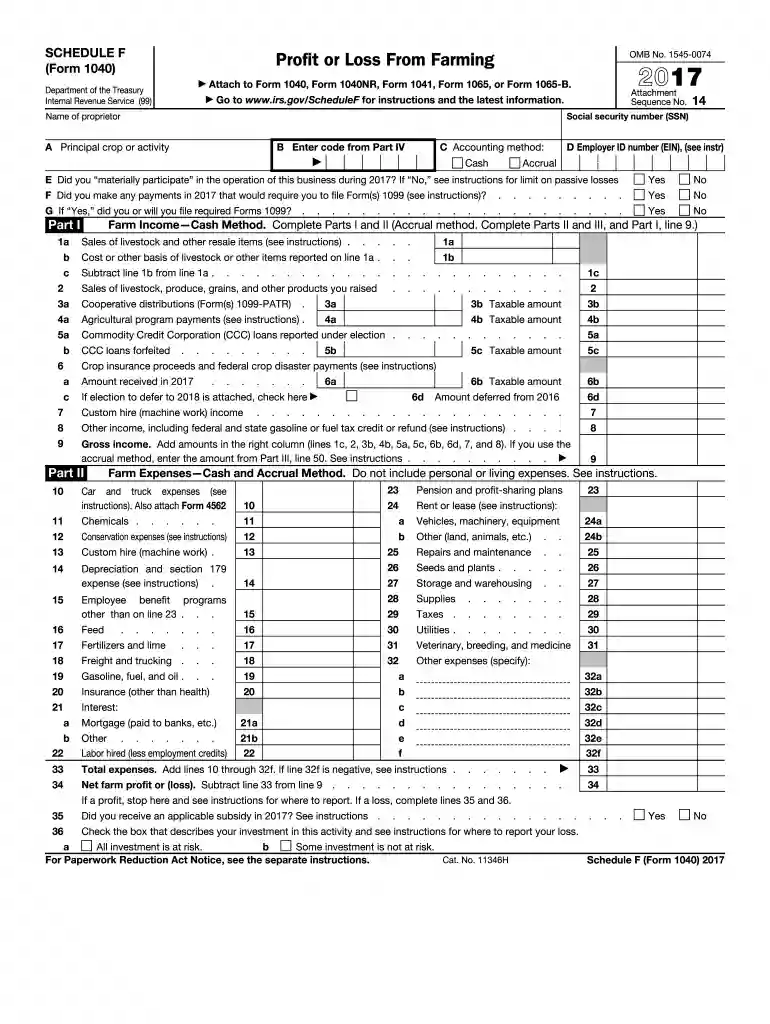
Schedule F (Form 1040) for 2017 is a vital component of the United States individual income tax return system, utilized specifically by farmers to report profits or losses derived from farming activities. It enables them to detail their income from the sale of livestock and agricultural products, and to account for various farming-related expenses. The form not only dictates the financial facets of the farm's operation but also serves as a record of participation in the business and compliance with tax regulations. This ensures that the agricultural activities are accurately reported for tax purposes, reflecting either a taxable income or a potential loss which may be deducted from other income sources.
Schedule F is essential for those participating in agricultural sectors, providing a structured approach to documenting earnings accurately. By itemizing expenses and revenues, farmers can ascertain their taxable income, ultimately impacting their financial planning and tax strategy. It also plays a crucial role in demonstrating eligibility for agricultural tax credits or deductions, influencing a farmer’s overall tax liability.
Utilizing Schedule F requires a clear understanding of the financial transactions related to farming operations. Users should:
Filing Schedule F involves a series of detailed steps:
Understanding specific terms ensures proper usage of Schedule F:
Essential components of the form include:
The IRS outlines strict requirements for completing Schedule F:
Taxpayers must note these key dates:
This form is predominantly used by:


We've got more versions of the schedule f tax form form. Select the right schedule f tax form version from the list and start editing it straight away!
| Versions | Form popularity | Fillable & printable |
|---|---|---|
| 2025 | 4.4 Satisfied (58 Votes) | |
| 2024 | 4.2 Satisfied (21 Votes) | |
| 2023 | 4.4 Satisfied (45 Votes) | |
| 2022 | 4.5 Satisfied (43 Votes) | |
| 2021 | 4.8 Satisfied (100 Votes) | |
| 2020 | 4.4 Satisfied (191 Votes) | |
| 2019 | 4.3 Satisfied (60 Votes) | |
| 2018 | 4.4 Satisfied (171 Votes) | |
| 2017 | 4.3 Satisfied (97 Votes) | |
| 2016 | 4.3 Satisfied (135 Votes) | |
| 2015 | 4.3 Satisfied (145 Votes) | |
| 2014 | 4.2 Satisfied (54 Votes) | |
| 2012 | 4.4 Satisfied (39 Votes) | |
| 2010 | 4.8 Satisfied (23 Votes) | |
| 2007 | 4.4 Satisfied (70 Votes) |
At DocHub, your data security is our priority. We follow HIPAA, SOC2, GDPR, and other standards, so you can work on your documents with confidence.
b Some investment is not at risk. For Paperwork Reduction Act Notice, see the separate instructions. Cat. No. 11346H. Schedule F (Form 1040) 2016.
Jan 31, 2018 This publication discusses the rules for deduct- ing home mortgage interest. Part I contains general information on home.Read more
Do not file Schedule F (Form 1040) to report the following. Income from providing agricultural services such as soil preparation, veterinary, farm labor,Read more


