




01. Edit your f 2020 online
Type text, add images, blackout confidential details, add comments, highlights and more.

Type text, add images, blackout confidential details, add comments, highlights and more.

Draw your signature, type it, upload its image, or use your mobile device as a signature pad.

Send schedule f 2020 via email, link, or fax. You can also download it, export it or print it out.
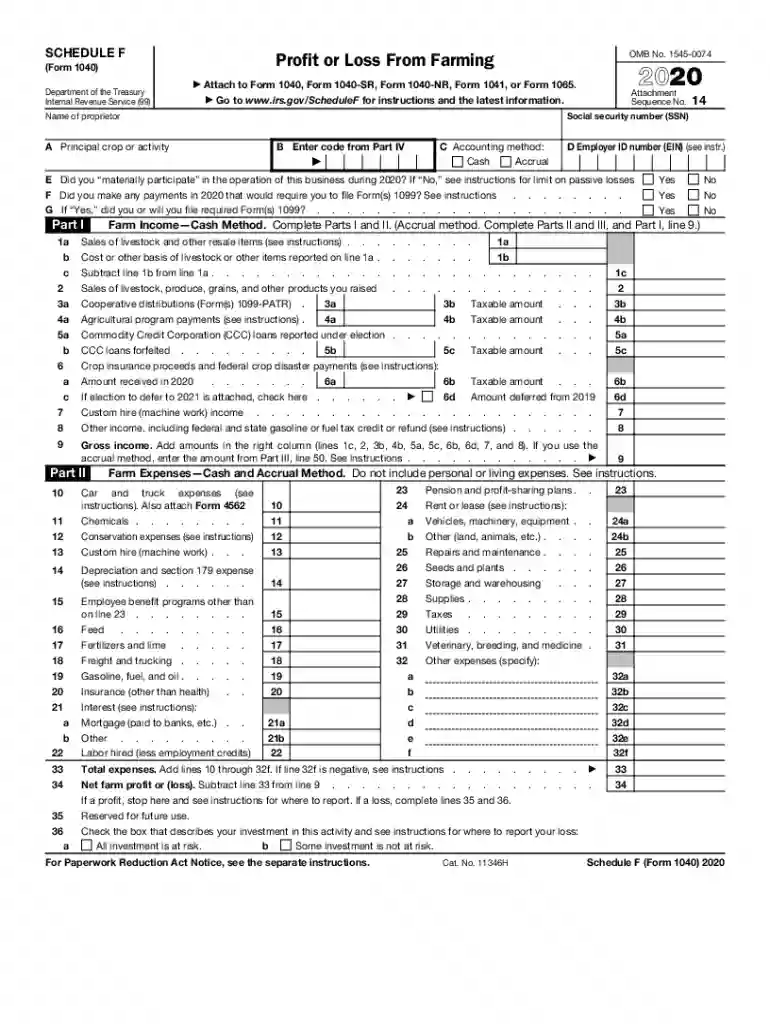
Schedule F is a form utilized by U.S.-based farmers and agricultural businesses to report their profit or loss associated with farming activities on their annual tax return. This form is an integral part of Form 1040 and is specifically designed to document income generated from the sales of agricultural products, as well as to track expenses incurred in the process of running a farming operation. It provides essential insights into the financial health of farming activities and helps in determining taxable income.
Using Schedule F effectively requires careful attention to detail and an understanding of tax regulations specific to agricultural activities. Accurate record-keeping throughout the year will simplify the process of completing this form.
Obtaining Schedule F can be done through several channels, ensuring that those in the farming industry have flexible access to this essential form.
Successfully completing Schedule F involves a series of structured steps to capture detailed financial information about farming activities.
Schedule F is not just a tax reporting tool; it is a critical component for managing a farming business’s financial health. Properly utilizing this form assists farmers in understanding their operational efficiency and allows for precise financial planning.
Primarily, Schedule F is used by individuals and entities engaged in farming activities who need to report their income and expenses as part of their federal tax filings.


Understanding and accurately completing key components of Schedule F is essential for ensuring precise financial reporting.
Schedule F involves a variety of terms unique to agriculture and taxation that users should familiarize themselves with.
Understanding these terms and how they apply to Schedule F will assist users in completing the form accurately and efficiently, facilitating better financial management.
We've got more versions of the f 2020 form. Select the right f 2020 version from the list and start editing it straight away!
| Versions | Form popularity | Fillable & printable |
|---|---|---|
| 2025 | 4.4 Satisfied (58 Votes) | |
| 2024 | 4.2 Satisfied (21 Votes) | |
| 2023 | 4.4 Satisfied (45 Votes) | |
| 2022 | 4.5 Satisfied (43 Votes) | |
| 2021 | 4.8 Satisfied (100 Votes) | |
| 2020 | 4.4 Satisfied (191 Votes) | |
| 2019 | 4.3 Satisfied (60 Votes) | |
| 2018 | 4.4 Satisfied (171 Votes) | |
| 2017 | 4.3 Satisfied (97 Votes) | |
| 2016 | 4.3 Satisfied (135 Votes) | |
| 2015 | 4.3 Satisfied (145 Votes) | |
| 2014 | 4.2 Satisfied (54 Votes) | |
| 2012 | 4.4 Satisfied (39 Votes) | |
| 2010 | 4.8 Satisfied (23 Votes) | |
| 2007 | 4.4 Satisfied (70 Votes) |
At DocHub, your data security is our priority. We follow HIPAA, SOC2, GDPR, and other standards, so you can work on your documents with confidence.







Information about Schedule F (Form 1040), Profit or Loss From Farming, including recent updates, related forms, and instructions on how to file.
This interactive resource explains and provides examples for each line of the farmers primary tax form, IRS Schedule F, Profit or Loss from Farming.Read more


