




01. Edit your 2023 schedule f form online
Type text, add images, blackout confidential details, add comments, highlights and more.

Type text, add images, blackout confidential details, add comments, highlights and more.

Draw your signature, type it, upload its image, or use your mobile device as a signature pad.

Send schedule f via email, link, or fax. You can also download it, export it or print it out.
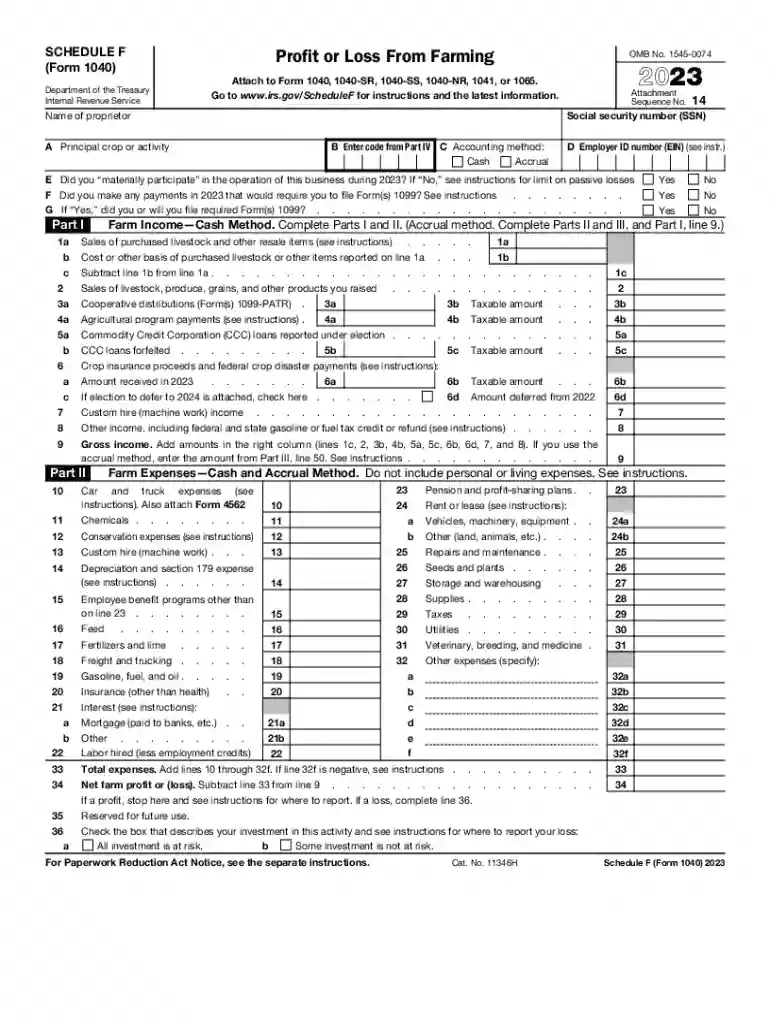
Schedule F (Form 1040) serves as a crucial tax document for individuals in the farming industry, allowing them to report their profits and losses for the tax year 2023. This form is specifically designed to detail all financial transactions related to agricultural operations. It includes sections to categorize income, sales, and expenses efficiently. The form also assists in establishing accountability regarding the farmer's participation and compliance with specific reporting requisites. Completing Schedule F properly ensures that farmers receive the optimal tax treatment for their farming activities, potentially allowing them to benefit from deductions unique to agricultural businesses.
Completing Schedule F requires precise information and attention to detail. The following steps provide a detailed guide:
Gather Financial Records: Collect all documents related to income, sales, and expenses from farming activities. This includes receipts, bank statements, and invoices.
Income Section: Enter the gross income from sales of livestock, produce, and any other farm products. It is important to ensure that all sources of income are accurately accounted for.
Expense Section: Record all deductible expenses incurred during the tax year. This should cover feed, seeds, fertilizer, animal purchases, and any hired labor.
Participation Details: Fill in details related to personal participation in the farming activity. The form requires information on your level of involvement, which can affect tax status.
Review and Submit: Carefully review the completed form to ensure all entries are accurate. Sign the form and submit it attached to your main tax return by the deadline.
Understanding the terminology associated with Schedule F is vital for accurate completion. Key terms include:
The standard deadline for submitting Schedule F, along with the Form 1040, is April 15th of the subsequent year. Missing this deadline can lead to penalties, including interest accrual on unpaid taxes and late filing fees. In some cases, farmers whose gross income involves over two-thirds from farming may qualify for extended deadlines if they meet specific conditions, highlighting the need to understand potential exceptions.
Popular tax preparation software like TurboTax and QuickBooks frequently support Schedule F, facilitating the form's completion, especially for those managing extensive transactions. These programs offer guided processes to ensure each section of the form is addressed comprehensively. Electronic filing via such software can further simplify submission, offering automated error-checking and immediate confirmation of receipt from the IRS.
Adhering to IRS guidelines ensures that the Schedule F form is completed accurately and accepted without issues. Key guidelines include:
For example, a dairy farmer may report profits from milk sales and deductions for feed expenses. A crop grower selling produce at a local market would record sales income and might claim vehicle expenses for transportation as deductions. These examples highlight the diverse ways farming professionals leverage Schedule F to accurately report financial standing and optimize taxable income.
The adequate completion of Schedule F (Form 1040) is vital for tax optimization in the farming sector. Familiarity with essential terms, precise record-keeping, utilizing technology solutions, and compliance with IRS guidelines are integral to achieving accurate and beneficial tax calculations. Especially in the U.S., where agriculture forms a backbone of many local economies, understanding and completing Schedule F proficiently supports sustainable farming business practices.
We've got more versions of the 2023 schedule f form form. Select the right 2023 schedule f form version from the list and start editing it straight away!
| Versions | Form popularity | Fillable & printable |
|---|---|---|
| 2025 | 4.4 Satisfied (58 Votes) | |
| 2024 | 4.2 Satisfied (21 Votes) | |
| 2023 | 4.4 Satisfied (45 Votes) | |
| 2022 | 4.5 Satisfied (43 Votes) | |
| 2021 | 4.8 Satisfied (100 Votes) | |
| 2020 | 4.4 Satisfied (191 Votes) | |
| 2019 | 4.3 Satisfied (60 Votes) | |
| 2018 | 4.4 Satisfied (171 Votes) | |
| 2017 | 4.3 Satisfied (97 Votes) | |
| 2016 | 4.3 Satisfied (135 Votes) | |
| 2015 | 4.3 Satisfied (145 Votes) | |
| 2014 | 4.2 Satisfied (54 Votes) | |
| 2012 | 4.4 Satisfied (39 Votes) | |
| 2010 | 4.8 Satisfied (23 Votes) | |
| 2007 | 4.4 Satisfied (70 Votes) |
At DocHub, your data security is our priority. We follow HIPAA, SOC2, GDPR, and other standards, so you can work on your documents with confidence.
Include only trade or business income and expenses. Net farm profit (loss) (attach Schedule F (Form 1040)) profit, loss, or capital of the partnership? Item F
This interactive resource explains and provides examples for each line of the farmers primary tax form, IRS Schedule F, Profit or Loss from Farming.Read more
Apr 1, 2026 Use Schedule F (Form 1040) to report farm income and expenses. Taxes (Including Fuel Tax Credits and Refunds)


