




01. Edit your form online
Type text, add images, blackout confidential details, add comments, highlights and more.

Type text, add images, blackout confidential details, add comments, highlights and more.

Draw your signature, type it, upload its image, or use your mobile device as a signature pad.

Send it via email, link, or fax. You can also download it, export it or print it out.
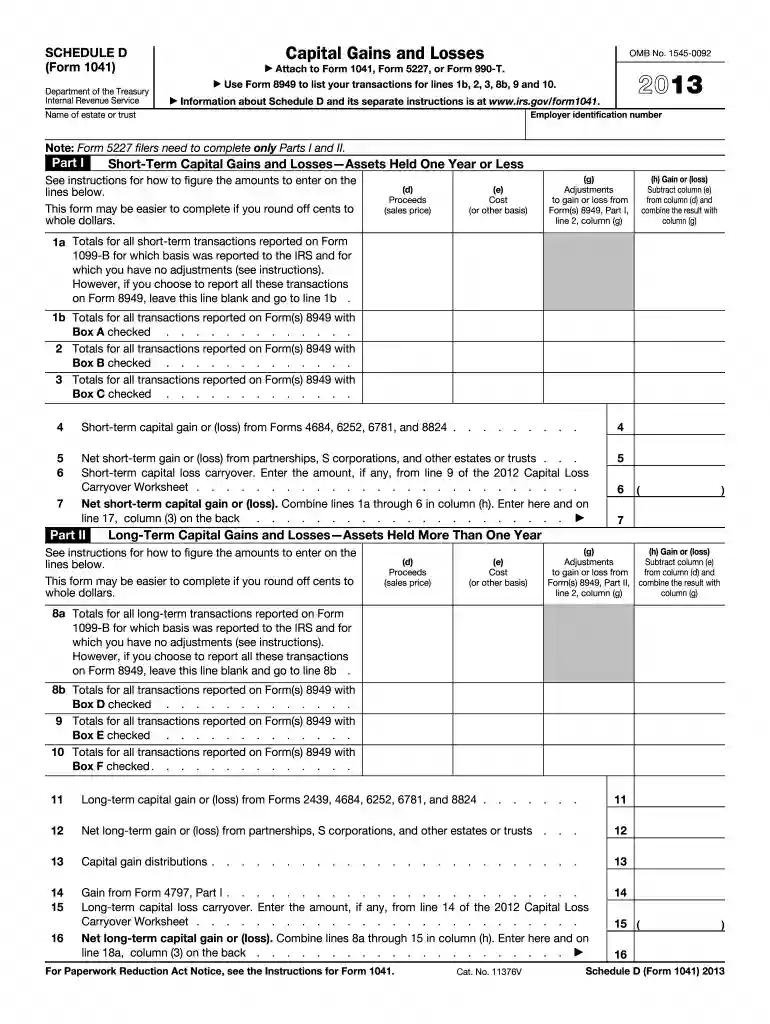
The 2013 IRS Capital Form primarily refers to Schedule D, used for reporting capital gains and losses. It is integral for individuals and entities to document their investment activities, which can encompass both short-term and long-term transactions. Short-term refers to assets held for less than a year, while long-term involves assets held for more than a year. Accurate reporting on this form ensures that taxpayers meet their obligations and can maximize potential deductions related to their investment losses.
To effectively use the 2013 IRS Capital Form, begin by gathering all relevant documentation related to your financial transactions, such as brokerage statements. This form requires you to list each capital asset sold during the year, including the proceeds, the date of acquisition, and the date of sale. This information is crucial as it helps in distinguishing between short-term and long-term gains or losses. Enter these details in Part I for short-term gains and in Part II for long-term gains. Complete the calculations according to IRS guidelines to determine your taxable gains or reportable losses.
Understanding key terminology is crucial for accurately completing the form. Some of these terms include:
Schedule D involves critical components necessary for accurate reporting:
The IRS provides extensive guidelines to assist taxpayers with the form's completion. It's essential to adhere to these instructions to ensure compliance. Guidelines cover aspects like conversion rates for foreign transactions and rules for special asset types, including collectibles and certain small business stocks. The purpose of these regulations is to ensure equitable tax assessment based on accurate reporting.
For the 2013 tax year, the deadline for filing the IRS Capital Form Schedule D was April 15, 2014. Taxpayers unable to meet this deadline could file for an extension, typically moving the deadline to October 15, 2014. Failing to file on time without an extension may result in penalties or interest on owed taxes.
The IRS Capital Form Schedule D can be submitted through various methods:
Failure to comply with the filing requirements of the 2013 IRS Capital Form can result in penalties. These may include additional fines for late filings and interest charges on any unpaid taxes. It's essential to maintain documentation and ensure all information is accurate to avoid any potential issues with the IRS.
We've got more versions of the 2013 irs capital form form. Select the right 2013 irs capital form version from the list and start editing it straight away!
| Versions | Form popularity | Fillable & printable |
|---|---|---|
| 2025 | 4.3 Satisfied (38 Votes) | |
| 2024 | 4.2 Satisfied (44 Votes) | |
| 2023 | 4.1 Satisfied (48 Votes) | |
| 2022 | 4.2 Satisfied (34 Votes) | |
| 2021 | 4.8 Satisfied (77 Votes) | |
| 2020 | 4.3 Satisfied (213 Votes) | |
| 2019 | 4.3 Satisfied (135 Votes) | |
| 2018 | 4.2 Satisfied (67 Votes) | |
| 2017 | 4 Satisfied (52 Votes) | |
| 2016 | 4.4 Satisfied (494 Votes) | |
| 2015 | 4 Satisfied (55 Votes) | |
| 2014 | 4.4 Satisfied (33 Votes) | |
| 2013 | 4.3 Satisfied (69 Votes) | |
| 2012 | 4 Satisfied (46 Votes) | |
| 2011 | 4 Satisfied (47 Votes) |
At DocHub, your data security is our priority. We follow HIPAA, SOC2, GDPR, and other standards, so you can work on your documents with confidence.
For Paperwork Reduction Act Notice, see your tax return instructions. Cat. No. 37768Z. Form 8949 (2013). Page 2. Form 8949 (2013). Attachment Sequence No. 12A.Read more
Feb 28, 2026 Indicate by check mark if the registrant is a well-known seasoned issuer, as defined in Rule 405 of the Securities Act. ☒ Yes ☐ No.Read more
Aug 26, 2012 Form 4797, Sales of Business Property, was first introduced for use in preparing 1971 income tax returns. It has remained.Read more


