




01. Edit your 2017 form 1041 schedule d online
Type text, add images, blackout confidential details, add comments, highlights and more.

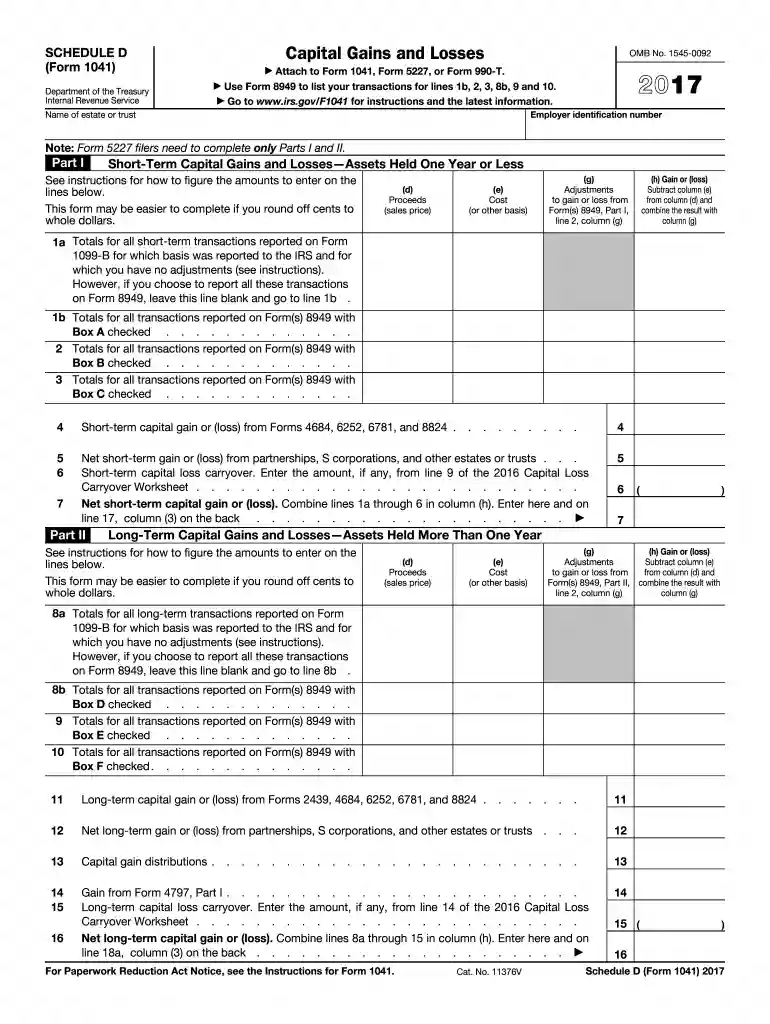
Type text, add images, blackout confidential details, add comments, highlights and more.

Draw your signature, type it, upload its image, or use your mobile device as a signature pad.

Send it via email, link, or fax. You can also download it, export it or print it out.
IRS Form 1041, also known as the U.S. Income Tax Return for Estates and Trusts, is used to report income, deductions, and tax liability on behalf of estates and trusts. This form is essential for fiduciaries responsible for managing the financial accounts of these entities during the 2017 tax year. The form ensures that any income generated by an estate or trust is reported correctly to the IRS, maintaining compliance with federal tax laws. It includes sections specific to income, deductions, tax liabilities, and schedules for additional details.
To acquire the 2017 version of IRS Form 1041, you can access it directly through the IRS website, which offers downloadable versions of past forms. Additionally, many tax preparation software packages like TurboTax or H&R Block include historical forms for seamless integration with their systems. Fiduciaries can also request a physical copy by contacting the IRS or visiting a local IRS office, ensuring access to the required forms based on preference for digital or traditional paper formats.
Completing IRS Form 1041 entails several steps to ensure accuracy and compliance:
Gather Necessary Documents: Collect all relevant financial records for the estate or trust, such as income statements, expense receipts, and prior tax forms.
Calculate Income: Use available data to calculate total income, including rental income, interest, dividends, and any other relevant earnings.
Deduct Expenses: Identify all allowable deductions, such as administrative expenses, charitable contributions, and trustee fees, and subtract them from the total income.
Complete the Form: Fill out all required sections with precise information, ensuring accuracy to prevent errors in reporting.
Review: Double-check the completed form for any potential discrepancies, focusing on figures and additional schedules.
Submit: File the form along with any supporting documentation by the designated deadline, either online or via mail, depending on personal preference.
Several core elements make up the structure of IRS Form 1041:
Understanding these elements ensures accurate form completion and compliance.
IRS Form 1041 is utilized by executors, administrators, or trustees managing an estate or trust, particularly those generating annual income exceeding $600. It is also relevant for beneficiaries of estates and trusts subjected to income distribution deduction provisions. This form is a key resource for fiduciaries across various types of estates, whether simple, complex, or grantor trusts, ensuring proper tax reporting obligations are met.
For the 2017 tax year, IRS Form 1041 must be filed by April 17, 2018, aligning with the tax filing deadline for individual returns. Fiduciaries should note this date to ensure timely submission and avoid penalties. If an extension is necessary, it must be requested using Form 7004 before the original due date, granting additional time to file until October 15, 2018, without incurring late fees pending the extension’s approval.
When preparing IRS Form 1041, having the following documents is essential:
These documents support accurate and comprehensive reporting for the relevant tax year.
Failure to file IRS Form 1041 on time or inaccurately can result in penalties. These may include fines for late filing, typically calculated as a percentage of unpaid taxes for each month or part of a month the form is late. Underpayment of taxes due to negligence may trigger additional penalties. Ensuring correct and timely filing is paramount to avoiding these financial consequences, with extensions available to mitigate potential delays in submission.
We've got more versions of the 2017 form 1041 schedule d form. Select the right 2017 form 1041 schedule d version from the list and start editing it straight away!
| Versions | Form popularity | Fillable & printable |
|---|---|---|
| 2025 | 4.3 Satisfied (38 Votes) | |
| 2024 | 4.2 Satisfied (44 Votes) | |
| 2023 | 4.1 Satisfied (48 Votes) | |
| 2022 | 4.2 Satisfied (34 Votes) | |
| 2021 | 4.8 Satisfied (77 Votes) | |
| 2020 | 4.3 Satisfied (213 Votes) | |
| 2019 | 4.3 Satisfied (135 Votes) | |
| 2018 | 4.2 Satisfied (67 Votes) | |
| 2017 | 4 Satisfied (52 Votes) | |
| 2016 | 4.4 Satisfied (494 Votes) | |
| 2015 | 4 Satisfied (55 Votes) | |
| 2014 | 4.4 Satisfied (33 Votes) | |
| 2013 | 4.3 Satisfied (69 Votes) | |
| 2012 | 4 Satisfied (46 Votes) | |
| 2011 | 4 Satisfied (47 Votes) |
At DocHub, your data security is our priority. We follow HIPAA, SOC2, GDPR, and other standards, so you can work on your documents with confidence.
Nov 16, 2020 The guidance of the Treasury Decision indicates it applies to tax years after December 31, 2017. If its practical, you may want to review 2018Read more
Dec 29, 2017 Additional Medicare Tax applies to. Medicare wages, RRTA compensation, and self-employment income that are more than: $125,000 if married filingRead more
Feb 27, 2018 Schedule K-1 (Form 1041) is used to notify the beneficiaries of the amounts to be included on their income tax returns. Before preparing FormRead more


