




01. Edit your 2021 1041 schedule d online
Type text, add images, blackout confidential details, add comments, highlights and more.

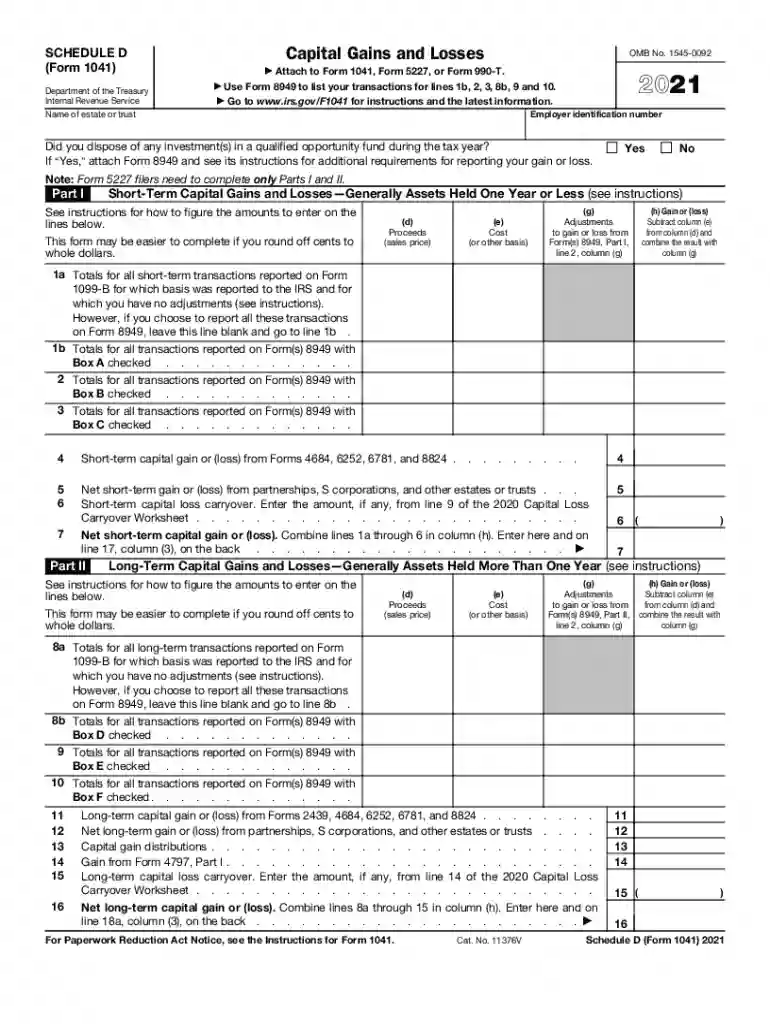
Type text, add images, blackout confidential details, add comments, highlights and more.

Draw your signature, type it, upload its image, or use your mobile device as a signature pad.

Send 2021 schedule d form 1041 via email, link, or fax. You can also download it, export it or print it out.
IRS Schedule D is a tax form used to report capital gains and losses from various investment transactions such as stocks, bonds, and property sales. The form is essential for individuals and entities filing Form 1040, Form 1040-SR, or Form 1041, providing a detailed summary of all capital asset sales or exchanges that occurred over the tax year. It breaks down transactions into short-term and long-term gains, helps in calculating the total net capital gain or loss, and determines taxable amounts subject to federal income tax. Proper completion of Schedule D ensures compliance with IRS regulations and allows taxpayers to report financial activities accurately.
Using IRS Schedule D involves systematically recording each capital transaction throughout the year, including the dates of acquisition and sale, the amount realized from the sale, and the cost or other basis of the asset. Taxpayers must categorize each transaction as either short-term or long-term to apply the appropriate tax treatments.
Completing IRS Schedule D requires precision and an understanding of tax rules for capital gains and losses. Here's a simplified step-by-step guide:
Various scenarios illustrate the use of IRS Schedule D, offering practical insights into handling the form:
Schedule D requires comprehensive data entry and includes several critical components:
The IRS provides specific guidelines for accurately completing Schedule D, which include:
Timely submission of IRS Schedule D is crucial to avoid penalties. Typically, the form is due with the taxpayer's annual tax return:
Failing to submit IRS Schedule D accurately or on time may lead to penalties, including:
We've got more versions of the 2021 1041 schedule d form. Select the right 2021 1041 schedule d version from the list and start editing it straight away!
| Versions | Form popularity | Fillable & printable |
|---|---|---|
| 2025 | 4.3 Satisfied (38 Votes) | |
| 2024 | 4.2 Satisfied (44 Votes) | |
| 2023 | 4.1 Satisfied (48 Votes) | |
| 2022 | 4.2 Satisfied (34 Votes) | |
| 2021 | 4.8 Satisfied (77 Votes) | |
| 2020 | 4.3 Satisfied (213 Votes) | |
| 2019 | 4.3 Satisfied (135 Votes) | |
| 2018 | 4.2 Satisfied (67 Votes) | |
| 2017 | 4 Satisfied (52 Votes) | |
| 2016 | 4.4 Satisfied (494 Votes) | |
| 2015 | 4 Satisfied (55 Votes) | |
| 2014 | 4.4 Satisfied (33 Votes) | |
| 2013 | 4.3 Satisfied (69 Votes) | |
| 2012 | 4 Satisfied (46 Votes) | |
| 2011 | 4 Satisfied (47 Votes) |
At DocHub, your data security is our priority. We follow HIPAA, SOC2, GDPR, and other standards, so you can work on your documents with confidence.
Schedule D should be used by a taxpayer who files either Forms 1120, 1120-A, 1120-IC-DISC,. 1120F, 1120-FSC, 1120-H, 1120L, 1120M,. 1120-POL, 990-C, or certainRead more
Apr 15, 1976 Increased section 179 deduction dollar limits. The maximum amount you can elect to deduct for most sec- tion 179 property you placed inRead more
Mar 30, 2026 Use Schedule D (Form 1040) to report the following: The sale or exchange of a capital asset not reported on another form or schedule.Read more


