




01. Edit your turbotax form 1041 online
Type text, add images, blackout confidential details, add comments, highlights and more.

Type text, add images, blackout confidential details, add comments, highlights and more.

Draw your signature, type it, upload its image, or use your mobile device as a signature pad.

Send form 1041 via email, link, or fax. You can also download it, export it or print it out.
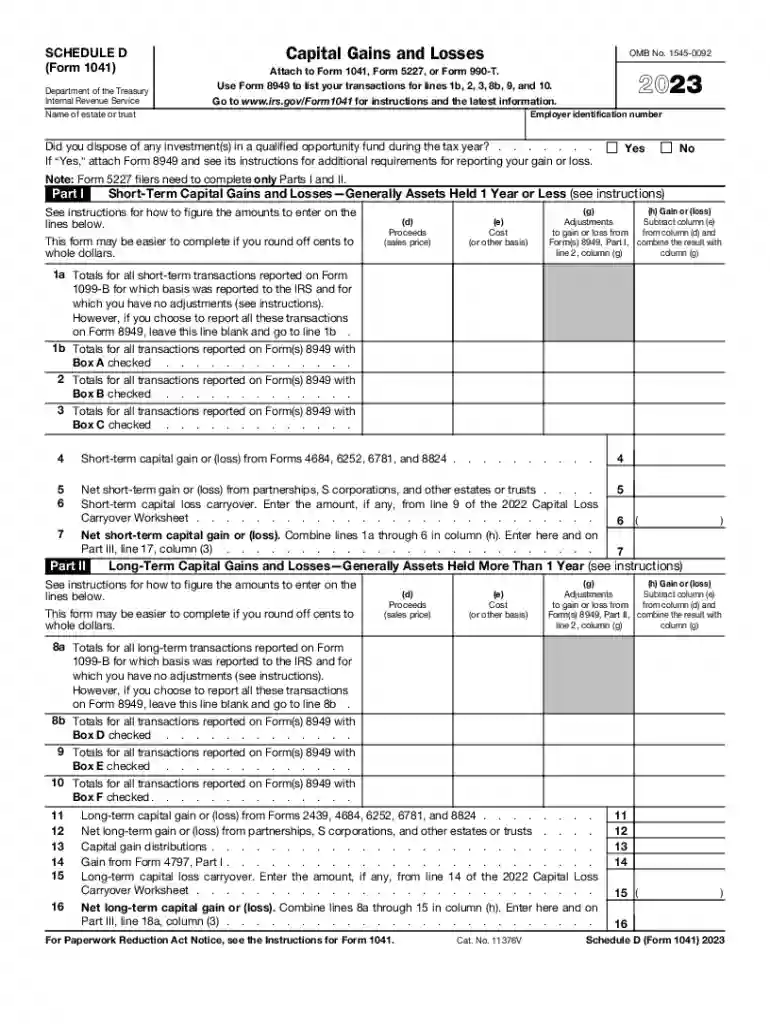
The IRS Schedule D is a crucial tax form used by individuals, estates, and trusts to report capital gains and losses from investments throughout the tax year. It helps track the proceeds received, the cost basis of assets, and any necessary adjustments needed to accurately compute gains or losses. Those using Schedule D (Form 1041) typically include various investment transactions and calculate short-term and long-term capital gains or losses according to specific IRS guidelines. Understanding this form is essential to ensure precise tax reporting and compliance, as it is a vital component of completing one's tax return accurately.
You can obtain a copy of the IRS Schedule D from the IRS website, where it is available for download in a PDF format. This allows taxpayers to fill it out manually or print it for later completion. Alternatively, many tax preparation software packages include the form and relevant instructions, automating parts of the reporting process. Tax professionals can also provide the form and assist taxpayers in accurately completing it. If you prefer paper forms, you can visit a local IRS office or contact the IRS to request that forms be mailed to your address, ensuring you have the resources needed for your tax activities.
Gather Required Documentation: Collect all relevant forms and documents, such as 1099-B forms, reflecting capital gains or losses from brokers or barter exchanges. This documentation should include transaction details, such as dates of acquisition and sale, proceeds, cost basis, and any other adjustments.
Enter Short-Term Transactions: On Part I of Schedule D, enter all transactions involving assets held for one year or less. For each transaction, provide the necessary details, and calculate the subtotal of the short-term gains or losses.
Enter Long-Term Transactions: Part II of Schedule D requires listing all transactions for assets held longer than one year. Follow similar steps, inputting details for each transaction to calculate long-term totals.
Summarize Gains and Losses: Combine totals from Parts I and II in Part III to determine the overall net capital gain or loss. This section allows for further adjustments as outlined in the instructions, ensuring the total is accurate.
Transfer Totals Appropriately: Finally, transfer the appropriate values to your primary tax return form (e.g., Form 1040), ensuring that the calculated gains or losses are integrated into your overall taxable income.
Typically, taxpayers who have realized capital gains or losses during the tax year must use Schedule D. This includes individuals who sell stocks, bonds, or real estate properties. Estates and trusts also commonly use Schedule D when these entities sell investment properties. Investors involved in trading activities and retirees managing portfolios need Schedule D to report fluctuations resulting from their investment decisions. Furthermore, those involved in partnerships and corporations that flow through income to individual returns will often find themselves required to file Schedule D to account for their proportional share of capital earnings or losses.


Short-Term Capital Gains and Losses: Transactions involving the sale of assets held for one year or less are classified here. It requires details such as the date acquired, the date sold, and the cost basis of the assets.
Long-Term Capital Gains and Losses: Transactions of assets held for more than a year belong here. As with short-term gains, similar details and calculations apply.
Adjustments and Exceptions: Specific rules govern adjustments, like those related to qualified dividends, collectibles, or capital losses carried over from previous years.
Summary: This is used to aggregate various sections of the form, resulting in the total tax impact of capital gains and losses, further applying to maximum tax rates where applicable.
While federal tax guidelines dictate how to complete Schedule D, state tax rules can vary significantly. Some states follow federal guidelines closely, whereas others might have different rates for capital gains or losses, or distinct calculation methods altogether. For instance, certain states may not tax capital gains at all, while others might have their own specialized worksheets or criteria that align partially with IRS instructions. Taxpayers should check their state's Department of Revenue website or consult a local tax professional to understand the specific implications for their state filings. State-specific tax software can also streamline the process by automatically applying these varying rules.
Filing deadlines for tax returns, including the Schedule D form, typically fall on April 15th of the year following the tax year being reported. However, if this date occurs on a weekend or public holiday, the deadline is usually extended to the next business day. Taxpayers may file for an extension if more time is needed; this provides an additional six months for completion. Despite these extensions, it's essential to remit any owed taxes by the original deadline to avoid penalties and interest. Staying aware of these critical dates ensures compliance and helps avoid unnecessary complications.
Failing to accurately complete and file Schedule D can result in penalties or additional interest charges. If gains or losses are understated, this may lead to an underpayment of taxes, prompting IRS scrutiny and potential fines. Deliberate inaccuracies or omissions are more severely penalized and could lead to charges of tax fraud. Moreover, late filing of Schedule D, similarly to other tax elements, can incur penalties that accrue until the taxpayer fulfills their obligations. To mitigate risks, taxpayers should meticulously report all relevant data and seek assistance if complex transactions or uncertainties arise.
We've got more versions of the turbotax form 1041 form. Select the right turbotax form 1041 version from the list and start editing it straight away!
| Versions | Form popularity | Fillable & printable |
|---|---|---|
| 2025 | 4.3 Satisfied (38 Votes) | |
| 2024 | 4.2 Satisfied (44 Votes) | |
| 2023 | 4.1 Satisfied (48 Votes) | |
| 2022 | 4.2 Satisfied (34 Votes) | |
| 2021 | 4.8 Satisfied (77 Votes) | |
| 2020 | 4.3 Satisfied (213 Votes) | |
| 2019 | 4.3 Satisfied (135 Votes) | |
| 2018 | 4.2 Satisfied (67 Votes) | |
| 2017 | 4 Satisfied (52 Votes) | |
| 2016 | 4.4 Satisfied (494 Votes) | |
| 2015 | 4 Satisfied (55 Votes) | |
| 2014 | 4.4 Satisfied (33 Votes) | |
| 2013 | 4.3 Satisfied (69 Votes) | |
| 2012 | 4 Satisfied (46 Votes) | |
| 2011 | 4 Satisfied (47 Votes) |
At DocHub, your data security is our priority. We follow HIPAA, SOC2, GDPR, and other standards, so you can work on your documents with confidence.
Form 1040 (Schedule D) gain or loss includes all collectibles gains and losses and up to 50% of the eligible gain on qualified small business stock
Mar 30, 2026 Use Schedule D (Form 1040) to report the following: The sale or exchange of a capital asset not reported on another form or schedule.Read more


