




01. Edit your 2016 schedule d online
Type text, add images, blackout confidential details, add comments, highlights and more.

Type text, add images, blackout confidential details, add comments, highlights and more.

Draw your signature, type it, upload its image, or use your mobile device as a signature pad.

Send it via email, link, or fax. You can also download it, export it or print it out.
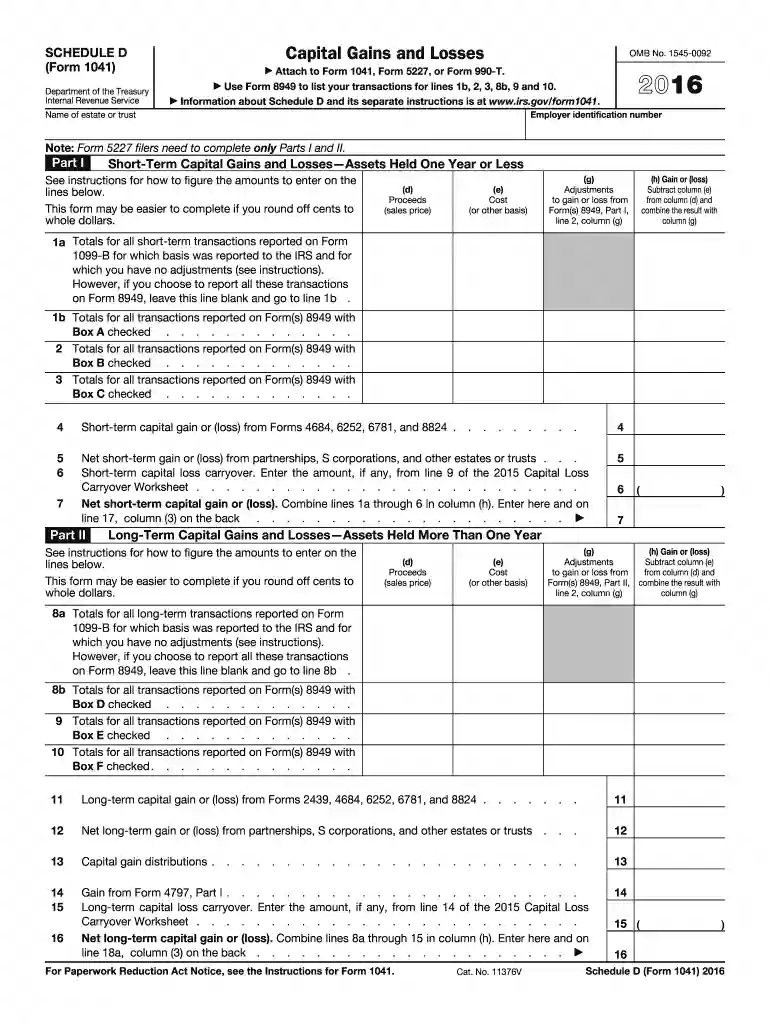
IRS Form Capital 2016, officially known as Schedule D (Form 1041), is utilized by estates and trusts in the United States to report capital gains and losses for the tax year 2016. This form provides a detailed breakdown of capital transactions, both short-term and long-term, and aids in calculating the net impact of these transactions for tax purposes. Filers must include data on the sales proceeds, cost, and any necessary adjustments, providing a comprehensive view of gains or losses.
Using IRS Form Capital 2016 involves a series of steps to properly document capital gains or losses. Users must:
Estates and trusts can obtain the IRS Form Capital 2016 through various methods:
Completing the form requires careful attention to detail:
The form consists of multiple critical parts:
The IRS provides specific guidelines for Schedule D (Form 1041), ensuring users accurately report capital gains and losses:
For the tax year 2016, the filing deadline for estates and trusts utilizing Schedule D was generally mid-April 2017, with extensions available under specific conditions:
To accurately complete the form, several documents are necessary:
Real-world examples can clarify the use:
Submit completed forms using one of the following methods:
We've got more versions of the 2016 schedule d form. Select the right 2016 schedule d version from the list and start editing it straight away!
| Versions | Form popularity | Fillable & printable |
|---|---|---|
| 2025 | 4.3 Satisfied (38 Votes) | |
| 2024 | 4.2 Satisfied (44 Votes) | |
| 2023 | 4.1 Satisfied (48 Votes) | |
| 2022 | 4.2 Satisfied (34 Votes) | |
| 2021 | 4.8 Satisfied (77 Votes) | |
| 2020 | 4.3 Satisfied (213 Votes) | |
| 2019 | 4.3 Satisfied (135 Votes) | |
| 2018 | 4.2 Satisfied (67 Votes) | |
| 2017 | 4 Satisfied (52 Votes) | |
| 2016 | 4.4 Satisfied (494 Votes) | |
| 2015 | 4 Satisfied (55 Votes) | |
| 2014 | 4.4 Satisfied (33 Votes) | |
| 2013 | 4.3 Satisfied (69 Votes) | |
| 2012 | 4 Satisfied (46 Votes) | |
| 2011 | 4 Satisfied (47 Votes) |
At DocHub, your data security is our priority. We follow HIPAA, SOC2, GDPR, and other standards, so you can work on your documents with confidence.
For detailed reporting and filing information, see the Instructions for Schedule K-1 (Form 1041) for a Beneficiary Filing Form 1040 and the instructions forRead more
Jan 30, 2018 Using the information on Form 8949, report on Schedule D (Form 1040) the gain or loss on your home as a capital gain or loss. Follow theRead more
Complete the Qualified Dividends and Capital Gain Tax Worksheet in the instructions for Form 1040, line 44 (or in the instructions for Form 1040NR, line 42).Read more


