




01. Edit your form online
Type text, add images, blackout confidential details, add comments, highlights and more.

Type text, add images, blackout confidential details, add comments, highlights and more.

Draw your signature, type it, upload its image, or use your mobile device as a signature pad.

Send it via email, link, or fax. You can also download it, export it or print it out.
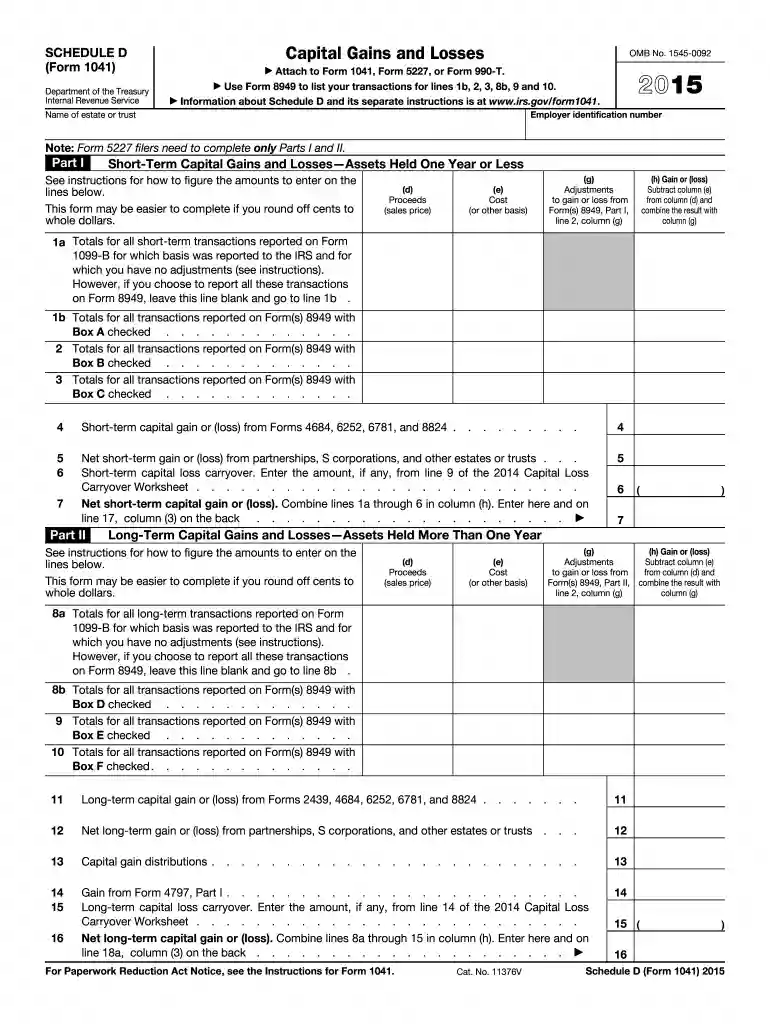
The 2015 Schedule D (Form 1041) is a tax document primarily used by estates and trusts to report their capital gains and losses for the year 2015. It serves as a detailed record, summarizing transactions involving both short-term and long-term capital assets. This form is integral for calculating the net gain or loss that affects the overall taxable income of an estate or trust.
Accessing the 2015 Schedule D form can be done through several methods:
Filling out the Schedule D form requires meticulous attention to detail:
The Schedule D form is primarily utilized by estates and trusts but can also be relevant for individuals and businesses involved in significant capital transactions. Entities that manage investments or receive benefits from investments often complete this form to ensure proper taxation.


Comprehending the legal aspects of the Schedule D form is crucial for compliance:
Failure to accurately file the Schedule D form can lead to penalties, such as fines or interest on underpaid taxes. Ensuring correct submission and understanding disclosure requirements mitigates this risk.
Practical examples of Schedule D usage enhance comprehension:
By providing comprehensive coverage and following these guidelines, the 2015 Schedule D form ensures adherence to IRS regulations and aids in accurate tax filing for entities with capital asset transactions.
We've got more versions of the 2015 d form form. Select the right 2015 d form version from the list and start editing it straight away!
| Versions | Form popularity | Fillable & printable |
|---|---|---|
| 2025 | 4.3 Satisfied (38 Votes) | |
| 2024 | 4.2 Satisfied (44 Votes) | |
| 2023 | 4.1 Satisfied (48 Votes) | |
| 2022 | 4.2 Satisfied (34 Votes) | |
| 2021 | 4.8 Satisfied (77 Votes) | |
| 2020 | 4.3 Satisfied (213 Votes) | |
| 2019 | 4.3 Satisfied (135 Votes) | |
| 2018 | 4.2 Satisfied (67 Votes) | |
| 2017 | 4 Satisfied (52 Votes) | |
| 2016 | 4.4 Satisfied (494 Votes) | |
| 2015 | 4 Satisfied (55 Votes) | |
| 2014 | 4.4 Satisfied (33 Votes) | |
| 2013 | 4.3 Satisfied (69 Votes) | |
| 2012 | 4 Satisfied (46 Votes) | |
| 2011 | 4 Satisfied (47 Votes) |
At DocHub, your data security is our priority. We follow HIPAA, SOC2, GDPR, and other standards, so you can work on your documents with confidence.
Complete the Qualified Dividends and Capital Gain Tax Worksheet in the instructions for Form 1040, line 44 (or in the instructions for Form 1040NR, line 42). DoRead more
It is designed to protect crops and households from harmful insects while fully respecting the environment by trapping pests. BIO Snare is an innovative trap inRead more


