




01. Edit your form online
Type text, add images, blackout confidential details, add comments, highlights and more.

Type text, add images, blackout confidential details, add comments, highlights and more.

Draw your signature, type it, upload its image, or use your mobile device as a signature pad.

Send it via email, link, or fax. You can also download it, export it or print it out.
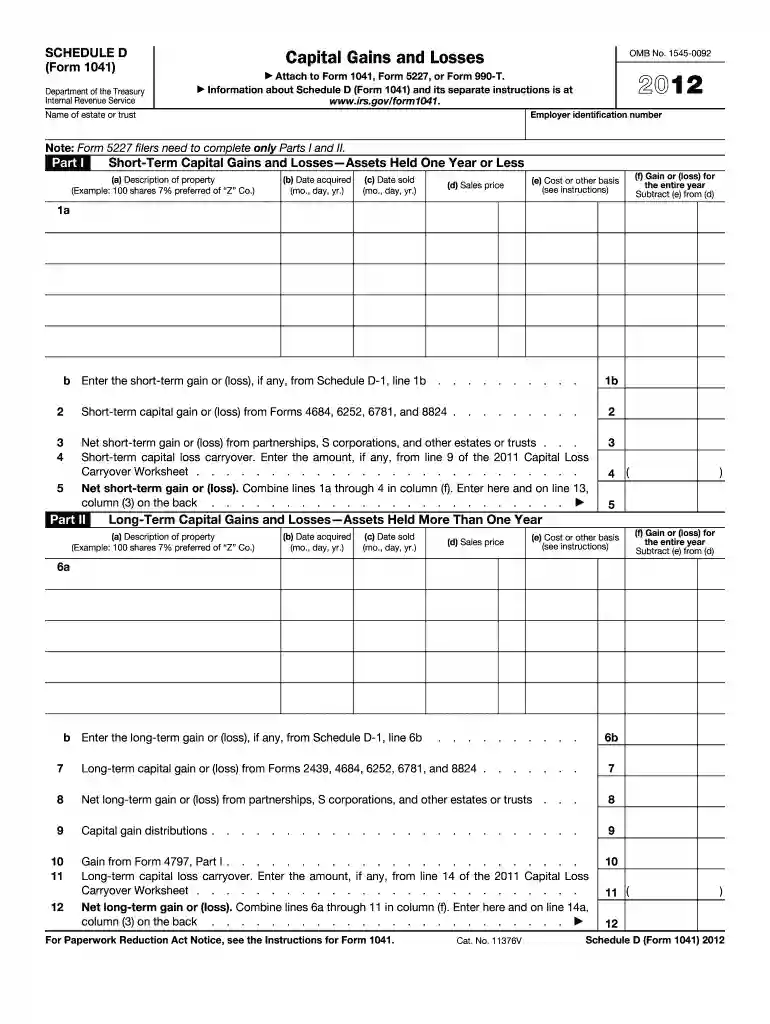
The 2012 Schedule D (Form 1041) serves as a critical tax document used specifically by estates and trusts to report capital gains and losses incurred during the tax year. It involves detailing transactions related to capital assets, such as securities, which were held, bought, or sold by the estate or trust. The form meticulously captures short-term and long-term capital gains, providing a framework to calculate the net capital gains or losses impacting the overall tax liability. A precise understanding of this document is essential for ensuring accurate tax calculations, and it plays a vital role in transparent reporting of financial activities pertaining to an estate or trust.
To utilize the 2012 Schedule D effectively, begin by organizing all records of financial transactions that involved the sale or exchange of capital assets. The form requires meticulous input of details like the description of the asset, acquisition date, sale date, purchase price, and selling price. These inputs are categorized into short-term and long-term sections, which assist in computing relevant gains or losses. After gathering the necessary information, carefully follow the IRS guidelines to fill out each part of the form, ensuring the correct reporting of the estate or trust's capital income. This systematic approach guarantees compliance with tax obligations and aids in the accurate computation of potential liabilities or refunds.
Prepare Documentation: Collect all necessary documentation related to capital transactions, including purchase and sale invoices, brokerage statements, and any relevant financial records.
Enter Short-Term Gains and Losses: In the designated section of Schedule D, enter details for each short-term transaction. This includes the asset description, purchase and sale dates, and transaction values.
Detail Long-Term Transactions: Following short-term entries, provide information on transactions held for more than one year. Utilizing separate lines for each transaction prevents errors and ensures clarity.
Calculate Totals: Summarize short-term and long-term capital gains and losses separately. Ensure arithmetic accuracy to avoid discrepancies in subsequent taxation calculations.
Net Gains or Losses: Use the form's instructions to calculate the net gains or losses. This step is essential for figuring out the estate’s taxable capital income.
Attach to Form 1041: Once completed, attach Schedule D to Form 1041. This consolidation provides the IRS with a comprehensive view of the estate’s or trust’s tax obligations.
Utilizing the 2012 Schedule D form is crucial for accurately reporting the estate's or trust's capital financial activities. The form not only ensures compliance with tax regulations but also aids in optimizing tax outcomes by distinguishing between short- and long-term gains and losses, which are often taxed differently. Moreover, it supports transparency and accountability in financial disclosures, providing an accurate reflection of the estate’s fiscal health. This precision aids estate executors or trustees in fulfilling fiduciary duties and mitigating potential penalties due to underreporting or errors.
Structured Sections: Distinct sections for short-term and long-term gains or losses enable detailed reporting based on asset holding periods.
Transaction Details: Requirements for detailed transaction inputs, including acquisition and disposition dates, assist in traceable record-keeping.
Summarized Totals: Summation spaces for gains and losses facilitate straightforward, error-free computation.
Netting Calculations: Clear instructions for calculating net capital gains or losses help ensure adherence to correct accounting principles.
The Internal Revenue Service provides specific instructions to assist taxpayers in filling out the 2012 Schedule D. These guidelines outline the criteria for reporting, calculation methods for gains or losses, and strategies for tax computations under maximum capital gains tax rates. Additionally, they offer clarification on the handling of wash sales and like-kind exchanges, which can impact the accurate representation of an estate’s financial activities. Adherence to these guidelines is paramount to maintaining compliance with federal tax laws.
The filing deadline for estates and trusts using the 2012 Schedule D aligns with the general deadline for Form 1041, typically April 15 of the following year, unless that date falls on a weekend or holiday. Extensions are available through Form 7004, providing additional time to gather accurate information without incurring penalties. Awareness of these crucial deadlines is necessary to prevent late filing fees or compounding interest on unpaid taxes, ensuring a smooth tax reporting process.
To accurately complete the 2012 Schedule D, maintain comprehensive records, such as:
Ensuring thorough documentation streamlines the completion process and aids in swiftly addressing any IRS inquiries that may arise.
We've got more versions of the 2012 1041 schedule d form form. Select the right 2012 1041 schedule d form version from the list and start editing it straight away!
| Versions | Form popularity | Fillable & printable |
|---|---|---|
| 2025 | 4.3 Satisfied (38 Votes) | |
| 2024 | 4.2 Satisfied (44 Votes) | |
| 2023 | 4.1 Satisfied (48 Votes) | |
| 2022 | 4.2 Satisfied (34 Votes) | |
| 2021 | 4.8 Satisfied (77 Votes) | |
| 2020 | 4.3 Satisfied (213 Votes) | |
| 2019 | 4.3 Satisfied (135 Votes) | |
| 2018 | 4.2 Satisfied (67 Votes) | |
| 2017 | 4 Satisfied (52 Votes) | |
| 2016 | 4.4 Satisfied (494 Votes) | |
| 2015 | 4 Satisfied (55 Votes) | |
| 2014 | 4.4 Satisfied (33 Votes) | |
| 2013 | 4.3 Satisfied (69 Votes) | |
| 2012 | 4 Satisfied (46 Votes) | |
| 2011 | 4 Satisfied (47 Votes) |
At DocHub, your data security is our priority. We follow HIPAA, SOC2, GDPR, and other standards, so you can work on your documents with confidence.
Part I. Accumulation Distribution in 2012. Note: See the Form 4970 instructions for certain income that minors may exclude and special rules for multipleRead more
Jan 22, 2013 Purpose of Form. Use Schedule D (Form 1041) to report gains and losses from the sale or exchange of capital assets by an estate or trust.Read more
Welcome to the growing family of new NISSAN owners. This vehicle is delivered to you with confidence. It was produced using the latest.Read more


