




01. Edit your form 1041 online
Type text, add images, blackout confidential details, add comments, highlights and more.

Type text, add images, blackout confidential details, add comments, highlights and more.

Draw your signature, type it, upload its image, or use your mobile device as a signature pad.

Send irs form 1041 v via email, link, or fax. You can also download it, export it or print it out.
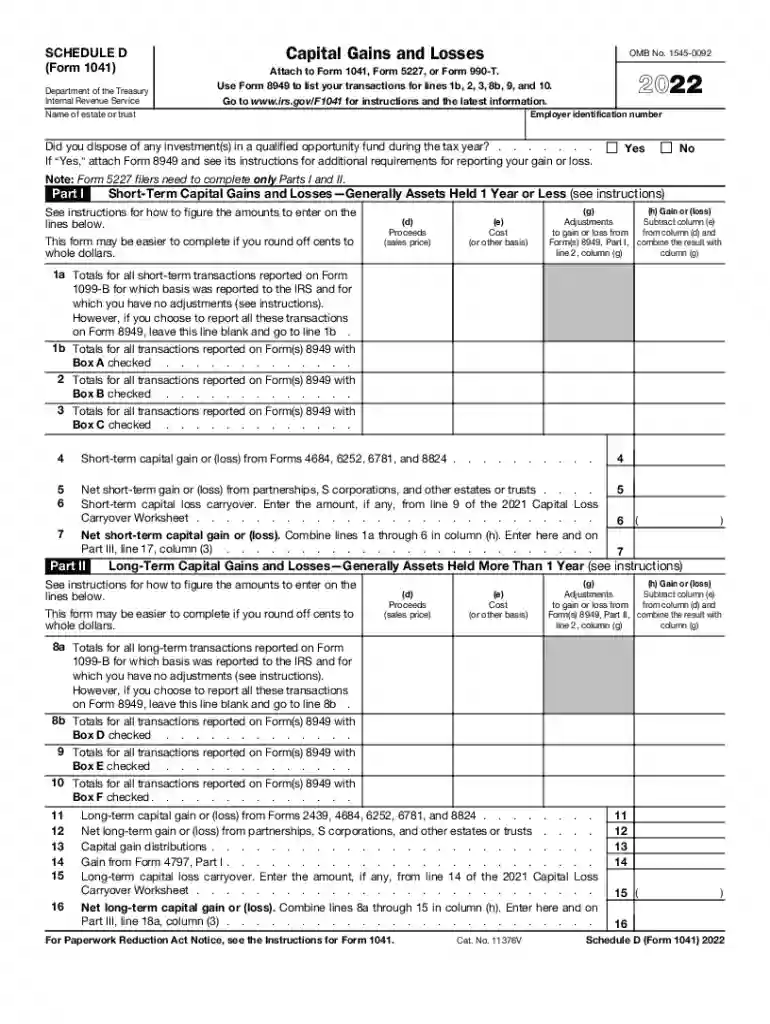
Schedule D (Form 1041) is a crucial document used by estates and trusts to report their capital gains and losses. Estates and trusts use this form to detail transactions involving the sale or exchange of capital assets, which can include stocks, bonds, and real estate. The form separates transactions into short-term and long-term categories, reflecting different holding periods and tax rates.
Understanding these elements is essential for accurately reflecting the tax implications of an estate or trust's investment activities.
To correctly fill out the Additional Items Related to Schedule D, one must:
Being meticulous in each step prevents discrepancies and ensures compliance with IRS requirements.
Proper completion involves:
Meticulous adherence to these steps ensures the form is completed accurately, avoiding processing delays.
The IRS provides detailed guidance on completing Schedule D, which highlights:
Refer to the IRS instructions booklet for Schedule D to ensure compliance with all federal requirements.
For estates and trusts using Schedule D (Form 1041), the critical filing deadline is typically:
Mark these dates carefully to avoid penalties for late filing.
Compiling the Additional Items Related to Schedule D requires:
Proper documentation facilitates smooth and accurate completion.
Failing to comply with IRS requirements can lead to:
Maintaining compliance is critical to avoid such negative outcomes.
Eligibility for filing Schedule D (Form 1041) includes any estate or trust with:
Understanding these criteria ensures proper adherence to IRS filing requirements.


We've got more versions of the form 1041 form. Select the right form 1041 version from the list and start editing it straight away!
| Versions | Form popularity | Fillable & printable |
|---|---|---|
| 2025 | 4.3 Satisfied (38 Votes) | |
| 2024 | 4.2 Satisfied (44 Votes) | |
| 2023 | 4.1 Satisfied (48 Votes) | |
| 2022 | 4.2 Satisfied (34 Votes) | |
| 2021 | 4.8 Satisfied (77 Votes) | |
| 2020 | 4.3 Satisfied (213 Votes) | |
| 2019 | 4.3 Satisfied (135 Votes) | |
| 2018 | 4.2 Satisfied (67 Votes) | |
| 2017 | 4 Satisfied (52 Votes) | |
| 2016 | 4.4 Satisfied (494 Votes) | |
| 2015 | 4 Satisfied (55 Votes) | |
| 2014 | 4.4 Satisfied (33 Votes) | |
| 2013 | 4.3 Satisfied (69 Votes) | |
| 2012 | 4 Satisfied (46 Votes) | |
| 2011 | 4 Satisfied (47 Votes) |
At DocHub, your data security is our priority. We follow HIPAA, SOC2, GDPR, and other standards, so you can work on your documents with confidence.
Aug 24, 1999 Schedule K-1 (Form. 1041) is used to notify the beneficiaries of the amounts to be included on their income tax returns. Before preparing FormRead more
Mar 30, 2026 Use Schedule D (Form 1041) to report gains and losses from the sale or exchange of capital assets by an estate or trust. Schedule D (From 1041)Read more


