Definition & Meaning
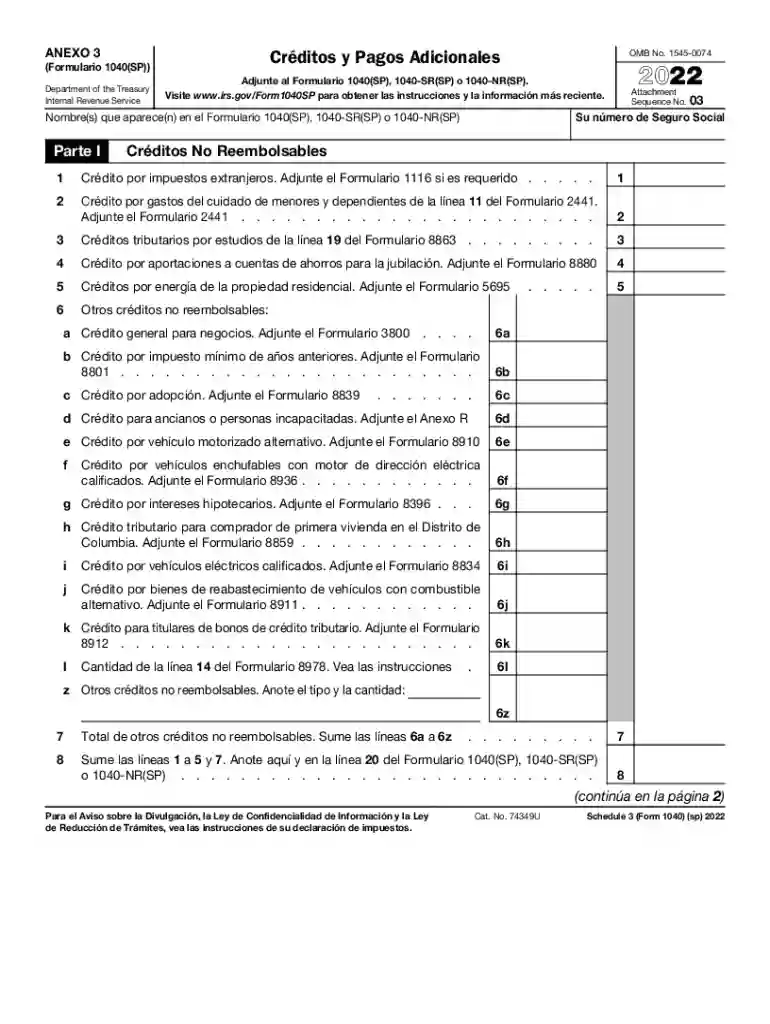
Anexo 3 Formulario 1040(SP) 2022, officially designated as "Schedule 3 – Additional Credits and Payments," is an attachment to the Form 1040(SP) used for declaring certain additional credits and payments on your tax return. The SP designation denotes the Spanish version of the document, tailored for Spanish-speaking taxpayers in the United States. This form is essential for taxpayers who are eligible for credits such as the Foreign Tax Credit, American Opportunity Credit, and the Credit for Excess Social Security and Railroad Retirement Tax. By including Anexo 3 in your tax filing, you ensure that you accurately report all relevant credits that might reduce your overall tax liability.
Context and Usage
- Purpose: To report additional credits and payments not covered directly in Form 1040(SP).
- Language Accessibility: Designed for Spanish-speaking taxpayers.
- Credits Covered: Includes non-refundable and refundable credits applicable under U.S. tax law.
Key Elements of the Anexo 3 Formulario 1040(SP) 2022
Understanding the fundamental components of Anexo 3 Formulario 1040(SP) 2022 aids in its correct completion. Each section of the form is dedicated to specific credits and payments that must be reported.
Component Breakdown
- Foreign Tax Credit: For U.S. taxpayers who pay or accrue foreign taxes during the tax year.
- Education Credits: Includes the American Opportunity Credit and Lifetime Learning Credit.
- General Business Credit: A compilation of various credits related to business operations.
- Other Payments: Such as estimated tax payments and amounts paid with an extension of time to file.
Practical Usage
- Individuals: Those eligible for the Education or Foreign Tax Credit.
- Businesses: Small business owners who qualify for the General Business Credit.
Steps to Complete the Anexo 3 Formulario 1040(SP) 2022
Proper completion of Schedule 3 is crucial to accurately report your finances. Here’s a systematic guide:
Step-by-Step Instructions
- Gather Necessary Documents: Collect all relevant forms and records that apply to the credits you intend to report.
- Identify Applicable Credits: Determine which sections of Anexo 3 pertain to your tax situation.
- Accurately Fill Out Each Section: Enter the amounts for each applicable credit or payment.
- Transfer Totals to Form 1040(SP): Ensure figures are accurately reflected in your main tax return.
- Review for Accuracy: Double-check entries for potential errors or omissions.
Practical Tips
- Use a Tax Software: Many programs can automatically complete Anexo 3 when you enter your credit information.
- Seek Professional Advice: Consultation with a tax professional can clarify complex credits.
IRS Guidelines
The Internal Revenue Service (IRS) offers comprehensive guidelines to help taxpayers complete Schedule 3 accurately. Adhering to these guidelines ensures compliance and minimizes the risk of errors.
Key Considerations
- Updated Instructions: Always refer to the latest IRS instructions for any changes or updates to the form.
- Commonly Asked Questions: The IRS website provides FAQs and detailed instructions for completing specific sections.
Benefits of Compliance
- Avoid Audits: Correctly completed forms reduce the likelihood of triggering an audit.
- Maximize Refunds: Ensures you’re claiming all eligible credits.
Filing Deadlines / Important Dates
Knowing crucial deadlines for submitting your tax documents, including Schedule 3, ensures compliance and avoids penalties.
Important Dates
- April 15: Standard deadline for filing Form 1040(SP) and its schedules.
- Extension Periods: October 15 is the extended deadline if filed for an extension.
Penalties for Late Filing
- Interest on Unpaid Taxes: Accrues from the original due date.
- Failure-to-File Penalty: Up to 5% of the unpaid taxes for each month the return is late.
Required Documents
Before beginning Anexo 3, ensure you have the necessary documentation to support the credits claimed.
Essential Documents
- Form 1099: For dividends, interest, or payments received related to credits.
- Education Tuition Receipts: For claiming education-related credits.
- Foreign Tax Payments: Detailed proof of any foreign taxes paid.
Document Tips
- Organize Chronologically: Keep documents in order of transactions for efficiency.
- Digital Copies: Maintain digital backups to prevent loss of important paperwork.
Form Submission Methods (Online / Mail / In-Person)
Choosing the right method to submit your tax documents, including Anexo 3, can impact processing time and accuracy.
Submission Options
- Online: Through IRS-approved e-file providers for faster processing.
- Mail: Physical submission for those more comfortable with paper filing.
- In-Person: Direct delivery at IRS locations or during tax assistance events.
Advantages of E-File
- Speed: Fastest method for processing and receiving refunds.
- Confirmation: Immediate notification and confirmation of receipt.
General Eligibility
- Earned or Paid Taxes: For those who have paid foreign or educational-related expenses.
- Non-Business Filers: Individuals without complex business engagements needing the General Business Credit.
Check Eligibility
- Review Income Levels: Certain credits have income thresholds.
- Dependents: Qualifying relative or dependent can influence certain education credits eligibility.