




01. Edit your form online
Type text, add images, blackout confidential details, add comments, highlights and more.

Type text, add images, blackout confidential details, add comments, highlights and more.

Draw your signature, type it, upload its image, or use your mobile device as a signature pad.

Send it via email, link, or fax. You can also download it, export it or print it out.
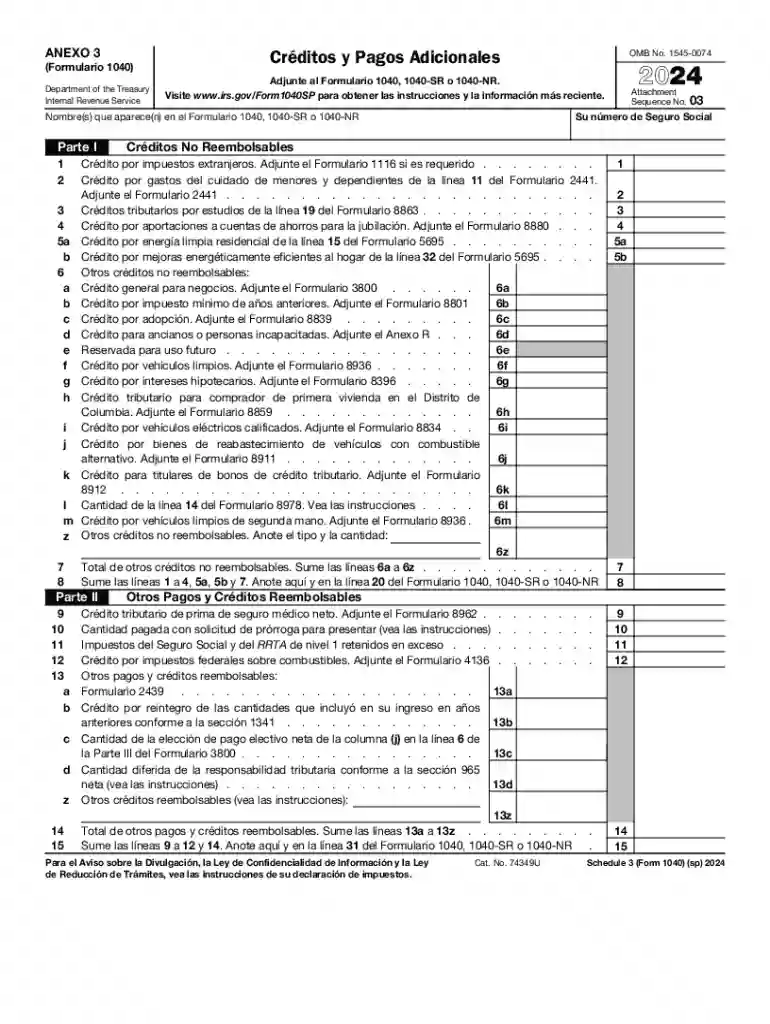
The 2024 Schedule 3 (Form 1040) (sp) Additional Credits and Payments (Spanish Version) is an attachment to the U.S. federal tax return, specifically detailing both non-refundable and refundable tax credits and payments. This form, essential for taxpayers, is used to claim a variety of tax credits not specifically listed on Form 1040 itself. Examples include education credits, foreign tax credits, retirement savings contributions, and clean energy credits. Additionally, it allocates space for other payments and refundable credits, such as those related to excess Social Security taxes and health insurance premiums.
Completing the 2024 Schedule 3 involves gathering all relevant documentation that supports your eligibility for the credits listed on the form. Each section corresponds to different types of credits or payments, and it's crucial to fill in the necessary fields accurately. For instance, if claiming the foreign tax credit, one must calculate the amount using Form 1116 and then transfer the totals accurately to Schedule 3. Following the provided instructions thoroughly ensures that your entries are precise, which minimizes errors that might lead to delays or audits.
Gather Necessary Documents: Before beginning, ensure you have all related forms and documentation, such as Form 8880 for retirement savings contributions or Form 5695 for residential energy credits.
Fill Out Personal Information: Enter your personal details at the top section of the form, ensuring consistency with Form 1040.
Calculate and Enter Each Credit: Carefully compute each applicable credit, using complementary forms where necessary, and input the figures accurately into Schedule 3's corresponding sections.
Double-Check Entries: Review all entries for accuracy to prevent miscalculations that might affect your overall tax return.
Attach to Form 1040: Finally, attach the completed Schedule 3 along with any other schedules or relevant documentation to your main Form 1040 before submission.
Schedule 3 is primarily used by taxpayers who qualify for additional credits not directly listed on the main Form 1040. This includes individuals claiming education credits, such as the American Opportunity Credit or the Lifetime Learning Credit, as well as those eligible for credits due to retirement savings contributions. It is also used by taxpayers needing to report payments made to counterbalance taxes due, including those associated with health insurance premiums under the Affordable Care Act.


The IRS mandates the use of Schedule 3 whenever a taxpayer is entitled to additional credits or reporting obligations that are necessary for accurate tax reporting and compliance. Adhering to IRS instructions is essential, which include guidelines on substantiating claims with proper documentation and maintaining records for the duration required by tax law. The IRS provides detailed instructions that accompany the form to assist taxpayers in accurately completing and filing it.
For the tax year 2024, Schedule 3 should be filed by the April 15, 2025 deadline, the same as Form 1040. If taxpayers require additional time, they should apply for an extension using Form 4868, which will extend the filing deadline to October 15, 2025. It is important to note that even with an extension, any taxes owed must still be paid by the original April deadline to avoid interest or penalties.
When submitting the 2024 Schedule 3, it's imperative to include all supporting documentation. This may encompass:
The IRS allows the filing of Schedule 3 both digitally and via paper, catering to different taxpayer preferences. Electronic filing, often done through platforms like TurboTax or via IRS Free File, provides an efficient and streamlined process that includes real-time verification for errors and immediate submission confirmation. Alternatively, the paper version is submitted via mail, which necessitates additional steps in ensuring accurate completion of all forms and attachments, but may be appealing to those less comfortable with electronic submissions.
Many popular tax software programs, including TurboTax and QuickBooks, facilitate the completion and submission of Schedule 3. These programs guide users through the process with prompts and checks to ensure all necessary sections are filled out correctly. They often have integrated features that import data from previous returns or other documents, reducing manual entry errors and ensuring consistency across forms.
We've got more versions of the 2024 SCHEDULE 3 (Form 1040) (sp) Additional Credits and Payments (Spanish Version) form. Select the right 2024 SCHEDULE 3 (Form 1040) (sp) Additional Credits and Payments (Spanish Version) version from the list and start editing it straight away!
At DocHub, your data security is our priority. We follow HIPAA, SOC2, GDPR, and other standards, so you can work on your documents with confidence.




Product Number Form 1040 (Schedule 3) (sp) Title Additional Credits and Payments (Spanish Version), Revision Date 2024 ; Product Number Form 1040 (Schedule 3)
Screen shots in this guide may depict last years version of the software. Follow the menus and prompts to enter current year tax information in the software.Read more


