



01. Edit your form online
Type text, add images, blackout confidential details, add comments, highlights and more.

Type text, add images, blackout confidential details, add comments, highlights and more.

Draw your signature, type it, upload its image, or use your mobile device as a signature pad.

Send it via email, link, or fax. You can also download it, export it or print it out.
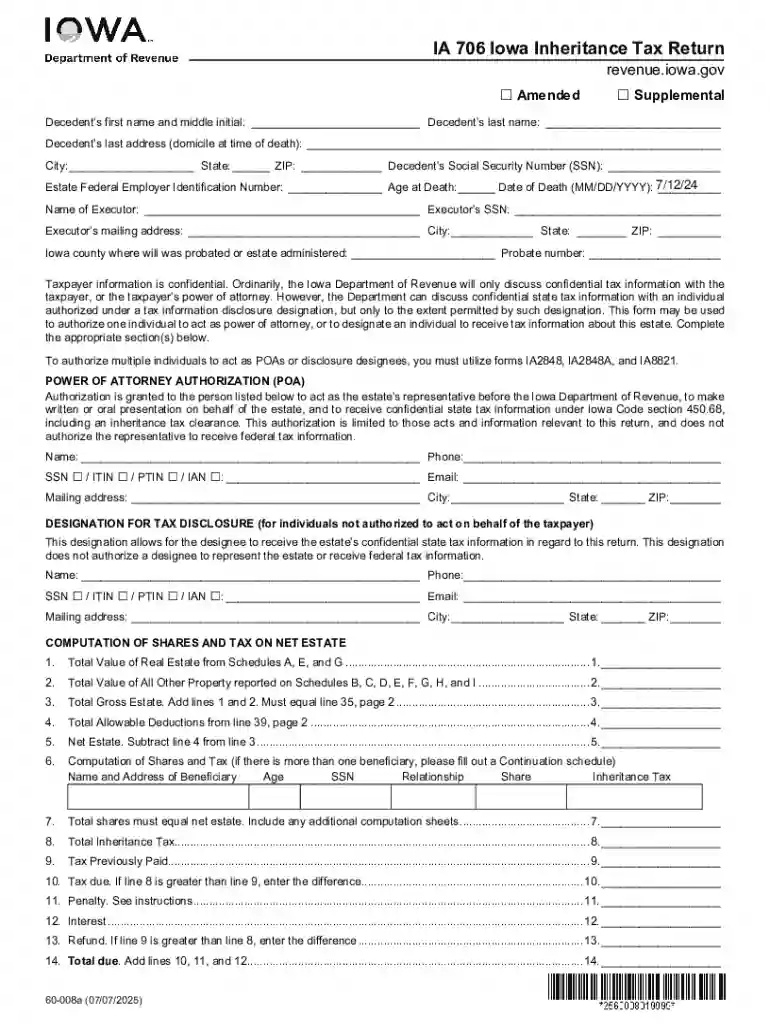
Forms related to inheritance tax are crucial legal documents used to report and calculate taxes owed on inherited assets following a person's death. These forms quantify the fair market value of the deceased person's estate, including monetary assets, property, and other forms of wealth. The tax itself ensures that beneficiaries pay a fair share of taxes on the wealth transferred to them, aligning with federal or state tax regulations.
While the term "Forms - Inheritance Tax" broadly references various forms across jurisdictions, its specific application can vary depending on local laws. For example, certain states in the U.S., like Iowa, have distinct inheritance tax return forms, such as the "IA 706 Iowa Inheritance Tax Return." It's essential to understand the guidelines of the particular form that applies under your jurisdiction.
To effectively utilize inheritance tax forms, follow these practical steps:
Identify the Applicable Form: Review federal and state requirements to determine which specific inheritance tax form you need to file. This may include forms specific to your state or the federal IRS Form 706.
Collect Necessary Information: Gather all relevant financial documents, including valuations of the decedent's estate and any related debts. This data will accurately reflect the estate's value and ensure precise tax calculations.
Complete the Form Accurately: Carefully fill out all sections of the form, ensuring each detail is accurate. Pay particular attention to dates, values, and the identities of beneficiaries and estate administrators.
Review Filing Instructions: Follow the instructions provided with the form for filing deadlines and submission methods. Some forms require supplementary documentation, such as copies of the will or court orders, to accompany the submission.
Submit the Form and Pay Any Tax Due: File the completed form, along with any due taxes, by the designated deadline. Confirm whether the form needs to be submitted electronically, by mail, or in person, and retain copies for your records.
Fulfilling the requirements of inheritance tax forms involves several detailed phases:
Compilation of Estate Information:
Asset Valuation:
Determine Tax Deductions and Exemptions:
Complete Each Section of the Form:
Review and Confirm Details:
Inheritance tax forms are primarily used by estate executors or personal representatives. These individuals are legally appointed to manage the decedent's estate, ensuring all assets are accounted for and taxes are filed and paid. Beneficiaries might also be involved, particularly in understanding their inheritance's tax implications.
Professionals, such as certified public accountants and tax attorneys, frequently assist with these forms to offer legal and financial expertise, reduce tax liability, and ensure the executor meets their fiduciary duty.


When preparing to submit inheritance tax forms, you must collect:
Submitting inheritance tax forms can differ based on jurisdictional regulations, but generally includes several methods:
Failure to comply with filing requirements can incur substantial penalties, which may include:
Understanding the core components of inheritance tax forms ensures accurate completion:
By following these guidelines, executors and other stakeholders can efficiently navigate the complexity inherent in inheritance tax forms, ensuring compliance and preventing future legal complications.
We've got more versions of the Forms - Inheritance Tax form. Select the right Forms - Inheritance Tax version from the list and start editing it straight away!
| Versions | Form popularity | Fillable & printable |
|---|---|---|
| 2025 | 4.1 Satisfied (42 Votes) | |
| 2024 | 4.2 Satisfied (50 Votes) | |
| 2023 | 4.8 Satisfied (24 Votes) | |
| 2022 | 4.9 Satisfied (33 Votes) | |
| 2021 | 4.8 Satisfied (237 Votes) | |
| 2020 | 4.3 Satisfied (178 Votes) | |
| 2019 | 4 Satisfied (59 Votes) | |
| 2018 | 4.3 Satisfied (99 Votes) | |
| 2017 | 4.2 Satisfied (62 Votes) | |
| 2014 | 4.3 Satisfied (104 Votes) | |
| 2013 | 4.3 Satisfied (44 Votes) | |
| 2012 | 4 Satisfied (49 Votes) | |
| 2011 | 4 Satisfied (48 Votes) |
At DocHub, your data security is our priority. We follow HIPAA, SOC2, GDPR, and other standards, so you can work on your documents with confidence.






Aug 4, 2025 Form 8971, along with a copy of every Schedule A, is used to report values to the IRS. One Schedule A is provided to each beneficiary receivingRead more
Jan 26, 2017 Information for Beneficiaries Receiving. Schedule A (Form 8971). Form 8971. Form 8971, Information Regarding Beneficiaries Acquiring.Read more


