Iowa form 706 2026

Get Form
ia 706 Preview on Page 1

Here's how it works

01. Edit your ia 706 online
Type text, add images, blackout confidential details, add comments, highlights and more.
02. Sign it in a few clicks
Draw your signature, type it, upload its image, or use your mobile device as a signature pad.
03. Share your form with others
Send iowa form 706 via email, link, or fax. You can also download it, export it or print it out.

How to use or fill out Iowa Form 706 with our platform

Form edit decoration
9.5
Ease of Setup
DocHub User Ratings on G2
9.0
Ease of Use
DocHub User Ratings on G2
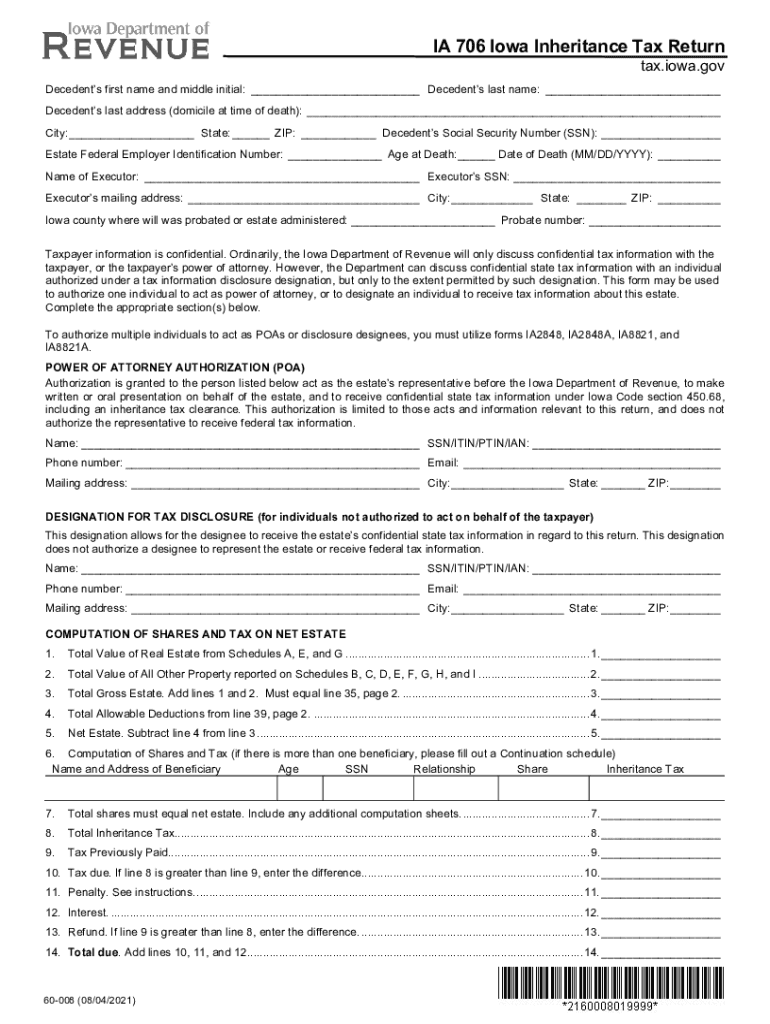
  1. Click ‘Get Form’ to open Iowa Form 706 in the editor.
  2. Begin by entering the decedent’s first and last name, along with their last address and Social Security Number (SSN). This information is crucial for identifying the estate.
  3. Fill in the executor's details, including their name, SSN, and mailing address. Ensure accuracy as this person will manage the estate's tax matters.
  4. Complete the 'Computation of Shares and Tax on Net Estate' section. Start by entering the total value of real estate and all other property from relevant schedules.
  5. Calculate the net estate by subtracting allowable deductions from the total gross estate. Make sure to double-check your calculations for accuracy.
  6. In the 'Power of Attorney Authorization' section, designate an individual if necessary. Fill in their details to authorize them to act on behalf of the estate.
  7. Review all entries for completeness and correctness before submitting. Use our platform’s features to save your progress or make edits as needed.

Start using our platform today to fill out Iowa Form 706 online for free!

See more iowa form 706 versions

We've got more versions of the iowa form 706 form. Select the right iowa form 706 version from the list and start editing it straight away!
Versions Form popularity Fillable & printable
2023 4.8 Satisfied (24 Votes)
2022 4.9 Satisfied (33 Votes)
2021 4.8 Satisfied (237 Votes)
2020 4.3 Satisfied (178 Votes)
2019 4 Satisfied (59 Votes)
2018 4.3 Satisfied (99 Votes)
2017 4.2 Satisfied (62 Votes)
2014 4.3 Satisfied (104 Votes)
2013 4.3 Satisfied (44 Votes)
2012 4 Satisfied (49 Votes)
2011 4 Satisfied (48 Votes)
be ready to get more

Complete this form in 5 minutes or less

Get form

Got questions?

We have answers to the most popular questions from our customers. If you can't find an answer to your question, please contact us.
Contact us
The personal representative is responsible for filing any final individual income tax return(s) and the estate tax return of the decedent when due. You may need to file Form 56, Notice Concerning Fiduciary Relationship to notify the IRS of the existence of a fiduciary relationship.
The executor of a decedents estate uses Form 706 to figure the estate tax imposed by Chapter 11 of the Internal Revenue Code. Form 706 is also used to compute the generation-skipping transfer (GST) tax imposed by Chapter 13 on direct skips.
The executor of a decedents estate uses Form 706 to figure the estate tax imposed by chapter 11 of the Internal Revenue Code. This tax is levied on the entire taxable estate and not just on the share received by a particular beneficiary.
An estate tax return (Form 706) must be filed if the gross estate of the decedent (who is a U.S. citizen or resident), increased by the decedents adjusted taxable gifts and specific gift tax exemption, is valued at more than the filing threshold for the year of the decedents death, as shown in the table below.
What is the Average Cost of Filing Taxes by Form and Service Tax FormCost per FormAverage Hourly Fees for Filing Tax Form 990 (Exempt Organization) $735 $171.48 Form 1120-S (S Corporation) $903 $179.81 Form 1120 (Corporation) $913 $181.57 Form 706 (Estate) $1,289 $188.6310 more rows Jul 10, 2025

Security and compliance

At DocHub, your data security is our priority. We follow HIPAA, SOC2, GDPR, and other standards, so you can work on your documents with confidence.

Learn more
ccpa2
pci-dss
gdpr-compliance
hipaa
soc-compliance

People also ask

In the United States, we have two types of taxes as they relate to deathForm 706, often referred to as an estate tax return, and Form 1041, an income tax return for estates and trusts. These two forms serve different purposes and both, one, or neither may need to be filed when someone passes away.
At our firm, we frequently encounter these errors that can put families at risk: Not filing Form 706 because the estate falls below the exemption threshold. Incomplete or inaccurate asset valuations that trigger IRS audits. Missing critical deadlines for filing or requesting extensions.
Property passing to parents, grandparents, great-grandparents, and other lineal ascendants is also exempt from inheritance tax. Property passing to children (biological and legally-adopted children), stepchildren, grandchildren, great- grandchildren, and other lineal descendants is exempt from inheritance tax.

Related links