




01. Edit your form online
Type text, add images, blackout confidential details, add comments, highlights and more.

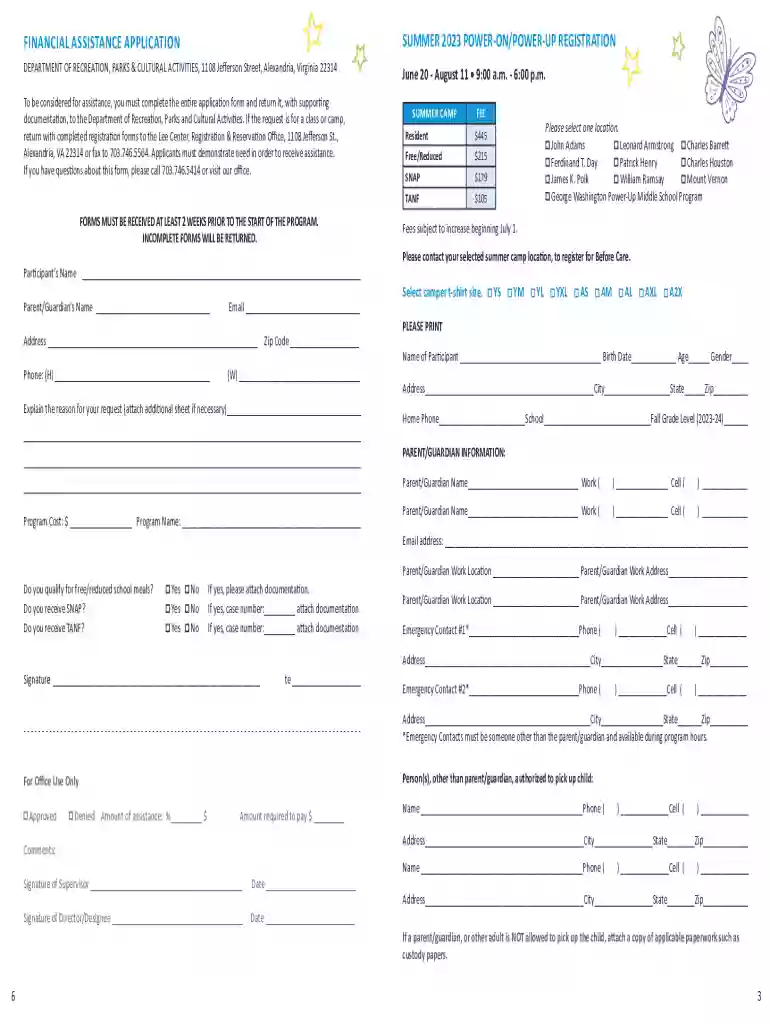
Type text, add images, blackout confidential details, add comments, highlights and more.

Draw your signature, type it, upload its image, or use your mobile device as a signature pad.

Send it via email, link, or fax. You can also download it, export it or print it out.
The "2023 Summer Out of School Time Program" refers to a set of programs designed to provide children with structured activities during the summer months when school is not in session. Typically administered by local recreation departments, these programs focus on recreational and educational activities aimed at children aged six to fifteen. The aim is to offer engaging experiences that promote physical activity, social interaction, and continued learning outside of the traditional school environment.
To make the most of the program, participants should familiarize themselves with the schedule and types of activities offered. Parents and guardians can work closely with program coordinators to ensure their children are enrolled in activities that match their interests and developmental needs.
Activity Selection: Choose from various recreational and educational activities. Consider focusing on areas where the child can develop new skills or enhance existing ones.
Attendance and Participation: Ensure consistent attendance and active participation to maximize the benefits of the program. Attendance policies may vary by location, so it's essential to check with the program coordinator.
Feedback and Evaluation: Engage in program evaluations and provide feedback to help improve the quality of services offered.
Acquiring access to the 2023 Summer Out of School Time Program involves several straightforward steps. Typically, these programs are advertised through local government websites, community centers, or schools. Registration details, including eligibility criteria and required documentation, should be reviewed carefully.
Inquiry and Information Gathering: Contact the local recreation department or visit their website to acquire detailed information about the program offerings and enrollment dates.
Registration Process: Complete any necessary registration forms. This might involve online registration or completing physical forms available at local community centers.
Submission of Required Documents: Some programs might require specific documents such as proof of residency, age verification, or income documents for fee adjustments.
Completing the program successfully requires adhering to certain guidelines and procedures, ensuring that participants gain the most from the experience.
Initial Preparation: Review the program rules and guidelines with your child to establish clear expectations.
Continuous Engagement: Encourage active participation in all selected activities. Engagement boosts skills development and social interaction.
Regular Communication: Maintain open lines of communication with program staff for updates or to address any concerns.
Completion Evaluation: At program's end, encourage your child to reflect on the experience and assess learnings or changes in interests.
Several key elements underpin the success of the 2023 Summer Out of School Time Program, ensuring it fulfills its mission to engage youth during school breaks.
Structured Activities: These include sports, arts and crafts, science projects, and field trips tailored to various age groups.
Safety Protocols: Implementation of robust health and safety measures, including supervision ratios and emergency procedures.
Skill Development: Emphasis on building social, cognitive, and physical skills in a supportive environment.
Cultural and Educational Diversity: Programs often incorporate diverse cultural activities and educational components to enhance learning.
Eligibility for the 2023 Summer Out of School Time Program may vary depending on the specific program:


Collecting and submitting the necessary documentation is a crucial part of enrolling a child in the program:
The application process typically involves a series of steps designed to ensure compliance and eligibility.
Health and safety are priorities in the 2023 Summer Out of School Time Program, encompassing various measures:
The application and implementation of the program may vary across states due to different regional regulations and guidelines:
We've got more versions of the 2023 Summer Out of School Time Program form. Select the right 2023 Summer Out of School Time Program version from the list and start editing it straight away!
| Versions | Form popularity | Fillable & printable |
|---|---|---|
| 2025 | 4 Satisfied (34 Votes) | |
| 2025 | 4.8 Satisfied (31 Votes) | |
| 2025 | 4.3 Satisfied (34 Votes) | |
| 2025 | 4.2 Satisfied (34 Votes) | |
| 2025 | 4.6 Satisfied (55 Votes) | |
| 2025 | 4.5 Satisfied (44 Votes) | |
| 2025 | 4.2 Satisfied (37 Votes) | |
| 2025 | 4.7 Satisfied (34 Votes) | |
| 2024 | 4.3 Satisfied (21 Votes) | |
| 2024 | 4.6 Satisfied (51 Votes) | |
| 2024 | 4.5 Satisfied (23 Votes) | |
| 2024 | 4.8 Satisfied (29 Votes) | |
| 2024 | 4.1 Satisfied (28 Votes) | |
| 2024 | 4.9 Satisfied (51 Votes) | |
| 2024 | 4.4 Satisfied (31 Votes) |
At DocHub, your data security is our priority. We follow HIPAA, SOC2, GDPR, and other standards, so you can work on your documents with confidence.





Registration fees for the full day, 9 a.m.-6 p.m. program is $445 per child. Financial Assistance is available for families who receive Free/Reduced School
Mar 21, 2023 This exciting summer school focuses on various types of seafarers in ancient Greece, from pirates to sailors and colonizers.
This is a list of our schools programs, including clubs, extracurricular activities, academic programs, sports, health and wellness, and tutoring


