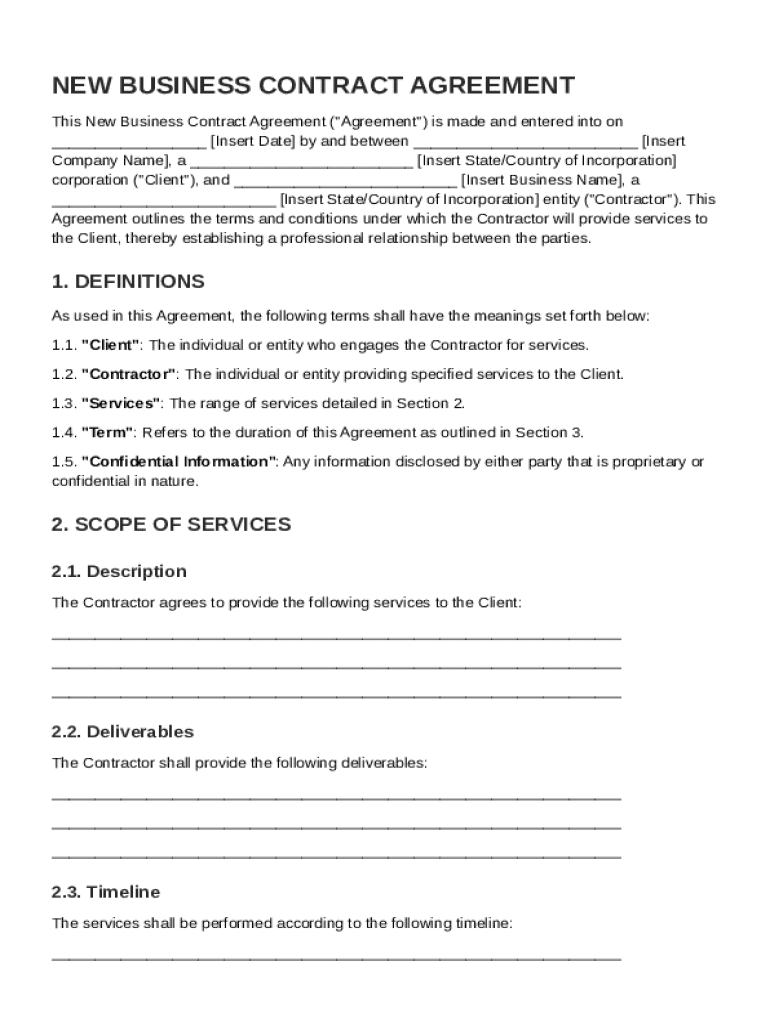







Key Elements of the New Business Contract Template
A New Business Contract Template serves as a foundational document to establish terms between a client and contractor. It typically encompasses several crucial sections to ensure comprehensive coverage of obligations, expectations, and rights. Each section is tailored to address specific aspects crucial for the smooth operation of the business relationship.
-
Definitions: This section clarifies critical terms used throughout the contract, ensuring that both parties have a mutual understanding. Definitions provide clear meanings to terms such as "services," "effective date," and "deliverables," which are pivotal for interpreting the contract accurately.
-
Scope of Services: Outlining the duties and responsibilities of the contractor and the delivery expectations, this section sets the parameters for the work to be done. It includes specifics on what services will be provided, any deliverables required, and timelines necessary for completion.
-
Compensation: This segment details the payment terms, including how much the contractor will be paid, payment schedules, and methods. This ensures clarity on financial transactions, including milestones for progress payments or conditions for payment release.
-
Term and Termination: Length of the contract, renewal options, and conditions under which the contract can be terminated are defined here. Provisions for early termination or renewal procedures provide a structured pathway for contract continuation or cessation.
-
Confidentiality: Maintaining data privacy is crucial. This section covers how confidential information will be handled and safeguarded, setting expectations for nondisclosure of sensitive information exchanged during the course of the contract.
-
Intellectual Property Rights: Specifies ownership rights concerning any intellectual property created by the contractor. This ensures that there are clear distinctions between what is owned by the contractor and what becomes the property of the client.
-
Liability and Indemnification: Outlines circumstances under which parties will be held liable and includes indemnity clauses to protect against claims and losses. This section minimizes potential legal exposure by clearly allocating risk and responsibilities.
-
Dispute Resolution: Provides mechanisms for resolving conflicts that may arise, such as mediation, arbitration, or litigation. This establishes a roadmap for addressing disagreements efficiently and professionally while minimizing disruption.
Steps to Complete the New Business Contract Template
Filling out a New Business Contract Template effectively involves a step-by-step process to ensure both parties' needs are reflected accurately. Completing the template meticulously minimizes miscommunication and potential disputes.
-
Gather Information: Collect all relevant details about the parties involved, scope of services, compensation terms, and any specific clauses that need inclusion.
-
Define Scope and Responsibilities: Clearly outline the expected services, deliverables, completion timelines, and the contractor's roles and responsibilities. Ensure both parties agree on these parameters.
-
Establish Payment Terms: Specify payment amounts, schedules, and conditions. Include terms for late payments, adjustments, and situations warranting payment withholding or bonuses.
-
Set Contract Duration and Termination Clause: Determine the contract start and end dates, renewal conditions, and situations leading to premature termination. Clarify the notice period required for termination.
-
Incorporate Confidentiality and IP Provisions: Ensure clauses concerning the protection of confidential information and intellectual property rights are addressed, specifying ownership and usage permissions.
-
Address Liability and Indemnification: Clearly outline responsibilities and protections for each party to limit legal exposure. Include insurance requirements and indemnity terms.
-
Practical Review and Signatures: Conduct a thorough review and provide opportunities for both parties to suggest amendments before obtaining signatures. Validate that all sections are completed and reflect agreed terms.
Reviewing and Amending the Document
- Review each section for accuracy and completeness.
- Allow both parties to propose amendments; ensure these are captured and agreed upon before finalizing.
- Confirm that any legislative or jurisdictional requirements are fulfilled.
Important Terms Related to the New Business Contract Template
Using a New Business Contract Template effectively involves understanding several key terms. These terms provide legal and technical precision necessary for the proper interpretation and enforcement of the contract.
-
"Effective Date": The date on which the contract terms begin to apply. Clarity here prevents misunderstandings about when obligations start.
-
"Force Majeure": Refers to unforeseen events that may prevent a party from fulfilling their contractual obligations, like natural disasters or legislative changes.
-
"Injunction": A court order that either restricts or requires a party to perform specific acts, often used in intellectual property disputes or breaches of confidentiality.
-
"Waiver": The voluntary relinquishment of a contract right that could otherwise be enforced, often requiring written confirmation to ensure clarity.
-
"Breach of Contract": Occurs when one party fails to perform any of their contractual duties, specified within the contract, offering potential legal remedies or termination rights for the breached party.
Understanding these terms ensures that parties engage with the contract from an informed position, enhancing comprehension and compliance.
Legal Use of the New Business Contract Template
The New Business Contract Template bears certain legal ramifications when used. Adhering to legal standards ensures enforceability in disputes and compliance with regulatory requirements within the United States.
-
Validity and Enforceability: Contracts must include lawful subject matter, mutual consent, a legitimate offer, and acceptance, along with an exchange of value (consideration), to be enforceable in court.
-
Compliance with Local Laws: Make adjustments for compliance with state-specific laws, such as terms around restrictive covenants, to ensure the contract aligns with jurisdictional variations.
-
Electronic Signatures: Under the ESIGN Act, electronic signatures on documents hold the same legal weight as handwritten signatures, facilitating greater flexibility in executing contracts digitally with platforms like DocHub.
-
Contractual Rights and Obligations: Clearly outlining these ensures both parties understand their legal rights and duties, minimizing potential breaches and fostering a professional relationship.
State-Specific Rules for the New Business Contract Template
Different states may impose unique requirements or restrictions on business contracts. Accounting for these regional variations ensures that the contract remains valid and enforceable no matter where it is executed or enforced.
-
California: Enforcement of non-compete clauses is restricted, emphasizing the need for compliant alternative mechanisms like nondisclosure agreements to protect business interests.
-
New York: Contracts must conform with general laws but can include specific mandates regarding employment verification and wage reporting.
-
Texas: Strong support for employment at will may affect termination clauses; contracts must be clear on what constitutes grounds for firing to avoid disputes.
Consideration of such state-specific elements in drafting the New Business Contract Template prevents legal conflicts and promotes clarity in administration.
Examples of Using the New Business Contract Template
Application of the New Business Contract Template demonstrates its flexibility to accommodate various business relationships, tailor-made to cater to unique industry requirements.
-
Freelancer Engagements: Outlining project-specific tasks, expected delivery timings, and payment terms ensures that freelancers and businesses interact smoothly, minimizing disputes over deliverables.
-
Consulting Services: For consultancy arrangements, clearly defining the scope, purpose, and outcome expectations aids in achieving targeted consulting goals, providing measurable success criteria.
-
Construction Projects: Detailed specifications around milestones, progress payments, and penalties for delays structure complex project execution methods, mitigating risks associated with time and budget overruns.
These practical examples showcase the utility and adaptability of the New Business Contract Template, ensuring orderly transactions across diversified sectors.
Software Compatibility and Digital Integration
Using a New Business Contract Template digitally involves ensuring compatibility with various platforms that support streamlined document management and execution.
-
DocHub Integration: As a versatile tool supporting formats such as PDF, DOC, and XLS, DocHub allows efficient editing and signing of business contracts. Its cloud integrations with Google Drive and Dropbox facilitate easy document storage and retrieval.
-
Compatibility with Business Management Software: Platforms like QuickBooks or TurboTax can be synchronized to automate financial recording, ensuring consistent financial terms adherence within business contracts.
-
Version Control Systems: Employing software supporting version control increases accountability and ensures that parties are collaborating on the latest document version, reducing errors or misinterpretations.
Digital compatibility fosters efficient workflow, providing users unmatched flexibility and accuracy in managing contract lifecycles.
Who Typically Uses the New Business Contract Template
The New Business Contract Template primarily sees use by various professional entities, each looking to establish a clear, legally binding agreement between parties.
-
Small Businesses: Entrepreneurs and start-ups in the initial growth stages use contracts to formalize service engagements with local freelancers or vendors, achieving scalability without misunderstandings.
-
Corporations: Large businesses leverage contracts to define ongoing service arrangements with consultants or third-party providers, ensuring uninterrupted operation via predefined terms.
-
Independent Contractors: Freelancers and contractors seeking consistent, protected engagements with businesses, ensuring a transparent understanding of expectations and payment conditions.
The New Business Contract Template supports a broad range of users, enhancing clarity and fostering trustworthy relationships within contracted engagements.