
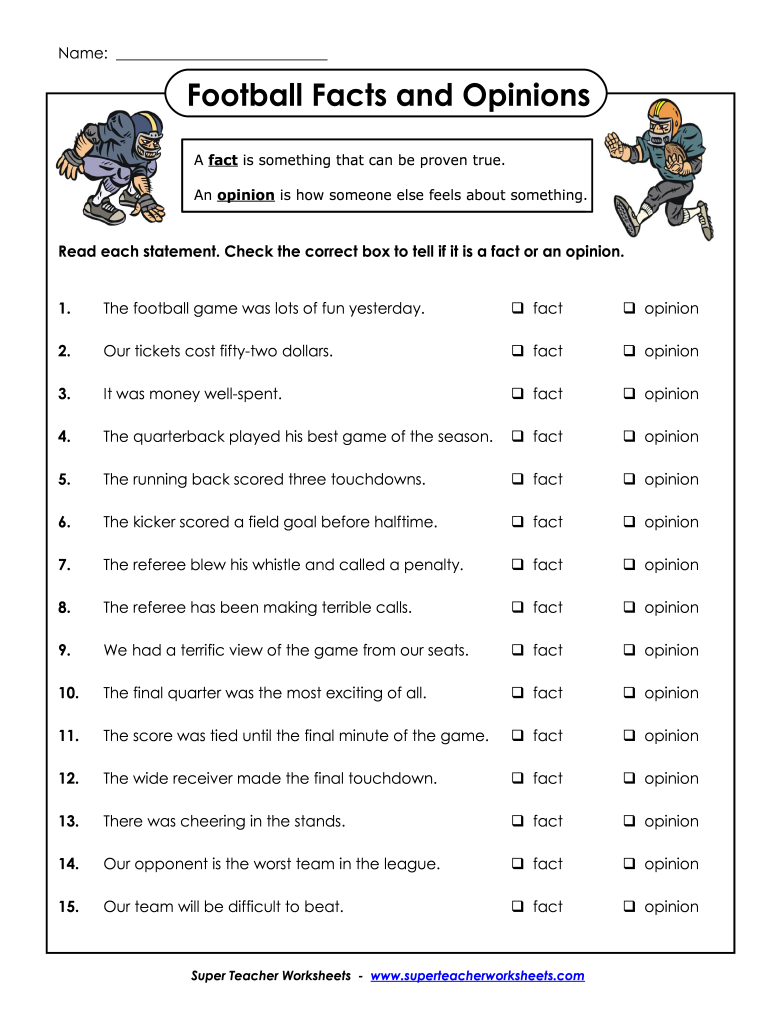







Definition and Meaning of Fact and Opinion
Understanding the distinction between facts and opinions is crucial, especially in academic and analytical contexts. A fact is an objective statement that can be verified or proven true, while an opinion is a subjective belief or judgment that reflects personal feelings or thoughts. For example, the statement "The Chicago Bears won the 1985 Super Bowl" is a fact, as it can be verified through historical records. In contrast, the statement "The Chicago Bears are the best team in NFL history" is an opinion, as it reflects personal belief and cannot be universally proven true.
Importance of Distinguishing Facts and Opinions
- Critical Thinking: Recognizing facts and opinions fosters critical thinking skills, enabling individuals to analyze information more objectively.
- Informed Decision-Making: Understanding the difference helps avoid misinformation and supports more informed decision-making based on factual data rather than subjective viewpoints.
- Effective Communication: Knowledge of these distinctions enhances communication, ensuring the clarity and precision of discussions, debates, and written expressions.
How to Use the Fact to Opinion Converter
Using the fact to opinion converter is an intuitive process designed to streamline the transition from factual statements to opinion-based analyses. The converter typically involves several steps, allowing users to identify facts and develop corresponding opinions.
Steps to Effectively Use the Converter
- Input Facts: Begin by entering a factual statement into the converter. Ensure the statement is clear and unambiguous.
- Analyze the Output: The tool will generate several opinion interpretations based on the input. Review the options presented.
- Select or Adapt an Opinion: Choose an opinion from the generated examples or adapt one to better align with your interpretation of the fact.
Example of Usage
- Factual Input: “The average temperature in July in Miami is 82 degrees Fahrenheit.”
- Generated Opinions:
- “Miami has the most pleasant summer weather.”
- “Summer vacations in Miami are ideal due to the warm temperatures.”
Examples of Using the Fact to Opinion Converter
The following examples illustrate how factual statements can be converted into opinions, showcasing the variability and subjectivity of interpretations.
Sample Statements
-
Fact: “The U.S. population reached 331 million in 2020.”
- Opinion: “The growing U.S. population signifies a thriving nation with endless opportunities.”
-
Fact: “The War of 1812 occurred between the U.S. and Britain.”
- Opinion: “The War of 1812 was a turning point that shaped America's identity.”
-
Fact: “The average American spends 6.5 hours per day on a digital device.”
- Opinion: “Excessive screen time is detrimental to overall well-being and mental health.”
Benefits of Using the Converter
- Clarifies distinctions between objective truths and personal beliefs.
- Encourages thoughtful engagement with material by forcing critical evaluation of each statement.
- Allows students and professionals to articulate reasoned arguments that are backed by factual evidence.
Key Elements of the Fact to Opinion Converter
Several core elements define the functionality and effectiveness of a fact to opinion converter, making it a valuable tool for users.
Features of the Converter
- User-Friendly Interface: The design is typically straightforward, allowing for easy navigation and input.
- Multiple Opinion Outputs: A well-designed converter generates various opinions for each fact, catering to different perspectives.
- Educational Resources: Many converters provide explanations and resources to help users understand the distinctions and implications of facts versus opinions.
Importance of Features
These elements not only enhance usability but also enrich the educational experience, fostering a deeper understanding of critical thinking skills.
Legal Use of the Fact to Opinion Converter
The fact to opinion converter can be utilized in various legal contexts, especially in drafting documents or analyzing testimony. Understanding how to frame facts and opinions is essential for legal professionals.
Applications in Legal Settings
- Witness Testimonies: Distinguishing between a witness's factual observations and their opinions can significantly impact case outcomes.
- Contract Drafting: Ensuring that statements in legal documents are factual rather than opinion-based helps maintain clarity and enforceability.
- Legal Research: Lawyers often need to differentiate between legal provisions (facts) and interpretations (opinions) in case law.
Conclusion on Legal Implications
Proper use of a fact to opinion converter in legal contexts supports accurate, effective communication that upholds the integrity of legal processes.
Examples of Fact and Opinion in Different Contexts
Understanding the applications of facts and opinions in various sectors can enhance one’s analytical skills.
Everyday Examples
-
News Articles:
- Fact: “The unemployment rate was 4.2% in January 2022.”
- Opinion: “The economy is recovering, but many still struggle to find jobs.”
-
Sports Analysis:
- Fact: “Team A won the championship last season.”
- Opinion: “Team A is the best team of the decade.”
-
Scientific Research:
- Fact: “Water freezes at 0 degrees Celsius.”
- Opinion: “Living in colder climates significantly influences lifestyle choices.”
Benefits of Recognizing Contexts
- Enhanced Critical Analysis: Evaluating facts within contexts helps articulate more nuanced opinions.
- Consumer Awareness: Understanding this differentiation promotes better consumption of media and advertising.
Why Should You Use the Fact to Opinion Converter
Utilizing the fact to opinion converter offers numerous advantages, particularly in educational settings and professional environments.
Reasons to Consider the Converter
- Educational Utility: Students benefit from understanding how to transform factual knowledge into opinions, aiding in essay writing and debate preparation.
- Professional Relevance: In business and marketing, being able to construct persuasive narratives from facts enhances communication strategies.
- Personal Development: Individuals can refine their ability to articulate thoughts and arguments by practicing the conversion process.
Outcome of Using the Converter
The effective use of the converter fosters a more sophisticated approach to analyzing situations, leading to better-informed discussions and decisions across various fields.


