




Definition & Meaning
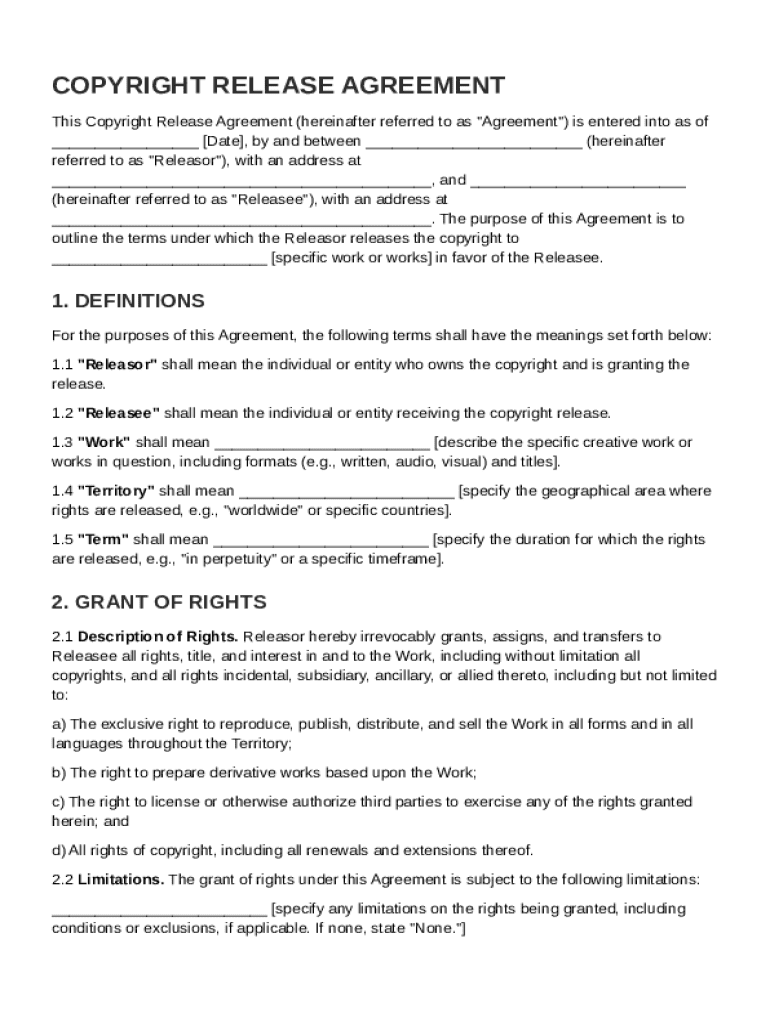
A Copyright Release Agreement Template is a legal document that outlines the conditions under which the Releasor assigns specific rights of a creative work to another party, known as the Releasee. These rights can include reproduction, distribution, modification, and more. The agreement provides a framework that ensures both parties are clear on the expectations and limitations of the copyright transfer. It aims to balance the Releasor's interests in their intellectual property with the Releasee's need to utilize the work within set parameters.
Key Components of the Agreement
- Releasor and Releasee Identification: Clearly defines the parties involved in the agreement.
- Description of Work: A detailed specification of the creative work being released.
- Transferred Rights: Outlines which rights are being granted, such as reproduction or modification.
- Indemnification Clauses: Protects both parties from legal claims related to the agreement.
- Termination Conditions: Specifies circumstances under which the agreement can be terminated.
How to Use the Copyright Release Agreement Template
Using the copyright release agreement template involves several essential steps to ensure that all legal conditions are properly addressed. The template is a tool for unifying diverse interests and making sure that both parties understand their rights and obligations under the agreement.
Step-by-step Process
- Download and Review: Obtain the template and familiarize yourself with its sections and language.
- Fill in Party Details: Enter the names and contact details of the Releasor and Releasee.
- Outline the Work: Clearly describe the creative work to ensure there is no ambiguity.
- Specify Rights Granted: List the specific rights being transferred to the Releasee.
- Set Terms and Conditions: Include any restrictions or conditions for usage.
- Seek Legal Advice: It may be beneficial to have a legal expert review the document before signing.
Practical Examples
- An author granting a publisher rights to distribute their book globally.
- A photographer releasing rights to a client for marketing use.
Steps to Complete the Copyright Release Agreement Template
Completing a copyright release agreement template requires careful attention to detail to ensure all aspects of the copyright release are correctly addressed.
Detailed Instructions
-
Preparation:
- Gather all necessary information related to the creative work.
- Clarify which rights are to be transferred and any associated limitations.
-
Document Drafting:
- Use the template to fill in details about the rights transfer.
- Explicitly state the scope of usage allowed for the Releasee.
-
Review and Revise:
- Verify all details for accuracy and completeness.
- Make any necessary adjustments for clarity or legal compliance.
-
Finalization:
- Both parties should sign the document to make it legally binding.
- Consider notarizing the agreement for additional legal reinforcement.
Common Pitfalls
- Vague descriptions of the work or rights.
- Omitting the duration of the rights transfer.
Legal Use of the Copyright Release Agreement Template
The template serves as a legally binding contract that formalizes the transfer of rights from one party to another under specific conditions. Its proper use ensures compliance with copyright laws and minimizes potential legal disputes.
Legal Considerations
- Compliance with Copyright Laws: The agreement must align with the U.S. copyright regulations to be enforceable.
- Protection of Interests: Secures both the Releasor's rights to their creative work and the Releasee's right to use it under the agreed conditions.
- Dispute Resolution: Includes provisions for handling disagreements, typically through arbitration or mediation.
Examples
- A musician licensing their song for use in a commercial campaign.
- A graphic designer allowing a client to alter original artwork for different formats.
Important Terms Related to Copyright Release Agreement Template
Understanding key terms is crucial for any party involved in a copyright release to ensure clarity and mutual understanding.
- Exclusive vs. Non-Exclusive Rights: Exclusive rights prevent the Releasor from granting the same rights to others, while non-exclusive rights allow for multiple grantings.
- Moral Rights: Pertains to the Releasor's right to attribution and protection from derogatory treatment of the work.
- Royalty Fees: Payments made to the Releasor for use of the work, if applicable.
Clarification of Terms
- Releasor: The original owner or creator of the work.
- Releasee: The party receiving the rights to use the work.
Key Elements of the Copyright Release Agreement Template
The structure and components of the agreement ensure that all necessary details are captured accurately.
Essential Sections
- Introduction and Definitions: Sets the stage with clear definitions.
- Scope of Rights: Details what rights are transferred and under what conditions.
- Payment Terms: Outlines any compensation for rights, if applicable.
- Limitations and Conditions: Any restrictions on how the work can be used.
Examples of Implementation
- Including a clause that restricts the modification of a work to ensure it remains in its original form.
- Specifying that payment must be received before any rights transfer takes place.
State-Specific Rules for the Copyright Release Agreement Template
Different states can have unique requirements or interpretations regarding copyright release agreements, which may affect enforcement and validity.
Variability Across States
- Governing Law Clause: Select which state's laws will apply to the agreement.
- Registration Requirements: Some states might require official registration of agreements for enforcement.
- Witness and Notarization: Requirements can vary concerning whether notarization or witness signatures are needed.
Practical Scenario
- A filmmaker in California might need different provisions compared to someone in Texas due to differences in state legislations affecting copyright law.
Examples of Using the Copyright Release Agreement Template
Providing real-life illustrations of how the agreement is used can demystify its application and show its practicality in different industries.
Case Studies
- Publishing: An indie author signs an agreement allowing an online distributor to sell their e-book exclusively on a platform.
- Advertising: A designer authorizes a brand to use an illustration on a product line under a non-exclusive arrangement, allowing them to sell the same rights to other entities.
- Entertainment: A scriptwriter allows a production company to adapt their script into a film, contingent upon receiving royalties from box office sales.
Who Typically Uses the Copyright Release Agreement Template
While the template is widely applicable, certain professionals and industries rely more heavily on copyright release agreements.

Typical Users
- Freelancers: Artists, designers, photographers, and writers who provide creative content.
- Businesses: Companies acquiring content for branding, marketing, or product development.
- Educational Institutions: Licensing academic materials for wider distribution.
- Nonprofits: Seeking rights to use creative works in campaigns or educational materials.
Industry Applications
- Publishing houses securing rights to manuscripts.
- Corporations acquiring rights for marketing campaigns.
These sections provide a comprehensive understanding of the Copyright Release Agreement Template.