




Definition & Meaning
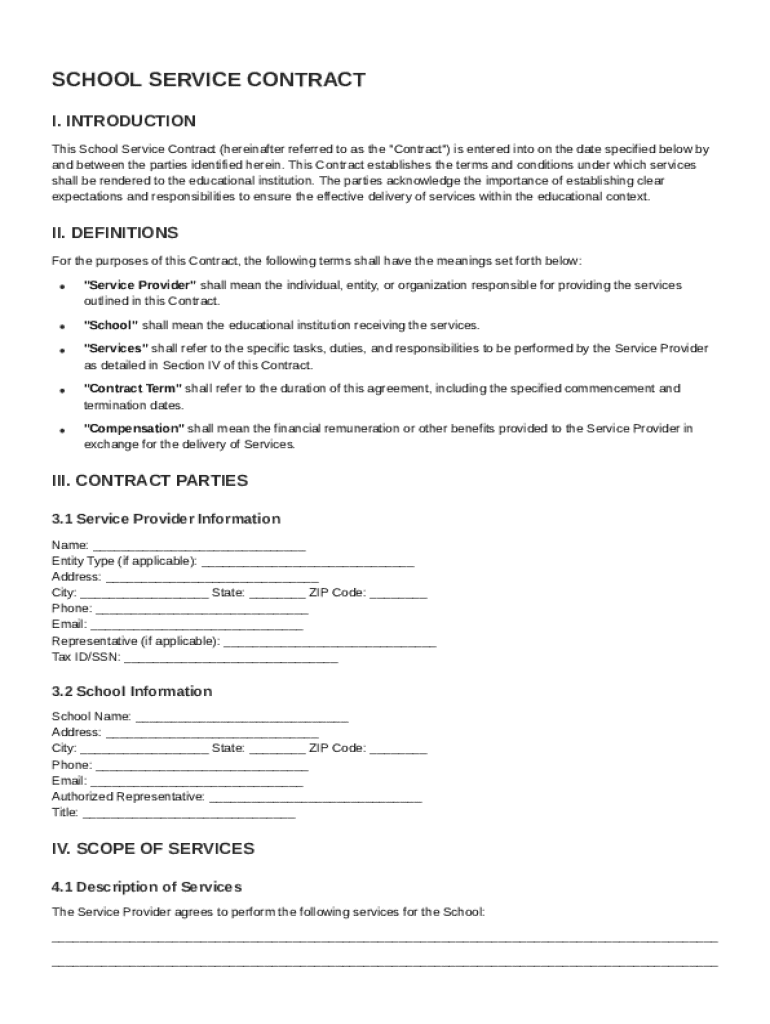
The School Service Contract Template is a comprehensive framework used to establish clear agreements between educational institutions and service providers. The primary purpose of this template is to outline the terms and conditions for services being provided, setting expectations, and ensuring effective service delivery within the educational context. This document typically includes definitions of key terms such as "Service Provider" and "Institution," providing clarity for both parties involved.
The contract may also specify the nature of the services, whether they pertain to maintenance, IT support, food services, or any other specialized service that a school might require. By defining these elements, the template serves as a detailed guide to prevent misunderstandings and disputes.
Key Elements of the School Service Contract Template
The School Service Contract Template consists of several critical sections to ensure thorough coverage and understanding:
-
Parties Involved: Clearly identifies the service provider and the educational institution, including their respective roles and responsibilities.
-
Scope of Services: Details the exact services to be provided, project timelines, and deliverables, ensuring both parties have the same expectations.
-
Compensation Structure: Explains how the service provider will be compensated, including rates, payment schedules, and conditions for payment.
-
Confidentiality Obligations: Outlines the necessity to protect sensitive information, stating which data must remain confidential.
-
Termination Clauses: Provides conditions under which the contract can be terminated by either party, including notice requirements and any penalties.
-
Dispute Resolution: Includes mechanisms for resolving disputes, such as mediation or arbitration, to encourage amicable solutions without litigation.
By covering these essential areas, the template ensures comprehensive understanding and agreement between parties.
How to Use the School Service Contract Template
To effectively use the School Service Contract Template, follow these steps:
-
Identify Both Parties: Clearly mention the names and contact information of the educational institution and the service provider.
-
Define the Scope: Explicitly delineate the scope of the services to avoid any ambiguity or future disputes.
-
Specify Terms and Conditions: Include terms regarding timelines, payment conditions, confidentiality, and deliverables.
-
Review and Customize: Adapt the template to specific state regulations or unique requirements of the service being contracted.
-
Consult with Legal Experts: Ensure that the contract complies with relevant legal requirements by seeking advice from legal professionals.
Using this structured approach can ensure that all critical aspects are adequately covered, minimizing the potential for conflicts.
Important Terms Related to School Service Contract Template
Several key terms are associated with the school service contract that users need to understand for effective utilization:
-
Service Provider: The party responsible for delivering the agreed-upon services.
-
Institution: The educational body receiving the services.
-
Compensation: The agreed payment for services rendered.
-
Deliverables: The tangible or intangible output expected as the outcome of the service.
-
Confidentiality: The requirement to keep certain information disclosed during the contract private.
-
Arbitration: A method of resolving disputes outside the judicial process.
Grasping these terms can aid in the correct completion and interpretation of the contract.
Who Typically Uses the School Service Contract Template
The School Service Contract Template is primarily utilized by educational institutions ranging from primary schools to universities. It is commonly employed by:
-
School Administrators: Responsible for acquiring and managing external services.
-
Service Providers: Companies or individuals offering products or services to schools, including caterers, IT firms, or maintenance suppliers.
-
Legal Advisors: Assisting in reviewing and customizing contracts to ensure compliance with legal standards.
Use of the template ensures that all parties have a clear understanding of their roles and responsibilities, fostering efficient collaboration.

Legal Use of the School Service Contract Template
The School Service Contract Template is legally binding, aiming to protect the interests of both parties. Its structure ensures:
-
Legal Compliance: Adheres to state-specific and federal laws relevant to contractual agreements in the educational sector.
-
Enforceable Provisions: Contains terms that are enforceable under law, providing recourse in the case of a breach.
-
Liability Limitation: Clearly sets forth limitations to protect parties from overreaching claims.
Legal consultation is recommended to make sure all local legal nuances are appropriately addressed.
State-Specific Rules for the School Service Contract Template
Education-related contracts often need tailoring to comply with state-specific regulations, such as differing educational laws or labor standards. Significant considerations may include:
-
State Education Laws: Requirements for service provision in schools may vary, such as certifications or background checks.
-
Labor Standards: Laws regarding wage, working conditions, and employee rights can impact contract terms.
-
Public Records: Some contracts may be subject to public record laws.
It's crucial to review these state-specific rules to customize the template appropriately and legally.
Examples of Using the School Service Contract Template
Real-world scenarios illustrate the utility of the School Service Contract Template:
-
IT Services: Schools contract an IT firm for regular maintenance and support of computer systems. The template outlines the frequency of service, support provisions, and confidentiality concerning student data.
-
Catering Services: A school uses the template to define meal provision standards, pricing, and hygiene requirements for a caterer servicing the school cafeteria.
-
Transportation Contracts: A bus service provider uses the template to establish terms for transporting students, detailing schedules, routes, and safety expectations.
Such examples demonstrate the template's versatility across different types of services and contracts.