




01. Edit your form online
Type text, add images, blackout confidential details, add comments, highlights and more.

Type text, add images, blackout confidential details, add comments, highlights and more.

Draw your signature, type it, upload its image, or use your mobile device as a signature pad.

Send it via email, link, or fax. You can also download it, export it or print it out.
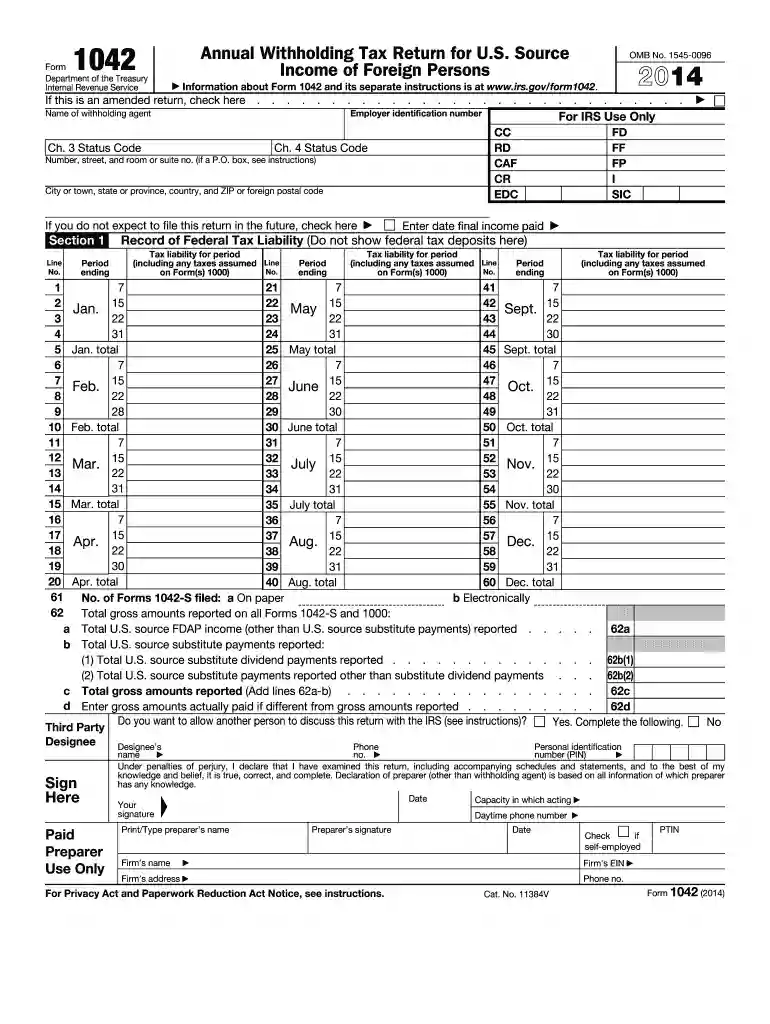
The 2014 Form 1042, also known as the Annual Withholding Tax Return for U.S. Source Income of Foreign Persons, is primarily used by withholding agents in the United States to report tax withheld on certain types of U.S. source income paid to foreign persons. This includes interest, dividends, royalties, and other types of income that fall under the jurisdiction of U.S. tax laws. The form plays a critical role in ensuring compliance with the Foreign Account Tax Compliance Act (FATCA), introduced to improve tax compliance and combat tax evasion.
The form is divided into several essential sections, each requiring detailed information:
Completing the form involves a methodical approach:
The IRS provides detailed guidance on completing and filing the form, including:
Adhering to legal requirements involves:
Timely filing is critical:
Form 1042 can be managed using various platforms:
Non-compliance entails significant risks:
Examples of usage include:
These sections provide a comprehensive understanding of the 2014 Form 1042, highlighting its importance, requirements, and applications within the context of ensuring tax compliance for foreign income paid by U.S. withholding agents.
We've got more versions of the 2014 form 1042 form. Select the right 2014 form 1042 version from the list and start editing it straight away!
| Versions | Form popularity | Fillable & printable |
|---|---|---|
| 2025 | 4.9 Satisfied (28 Votes) | |
| 2024 | 4.2 Satisfied (34 Votes) | |
| 2023 | 4.7 Satisfied (30 Votes) | |
| 2022 | 4.1 Satisfied (53 Votes) | |
| 2021 | 4.8 Satisfied (53 Votes) | |
| 2020 | 4.3 Satisfied (113 Votes) | |
| 2019 | 4.3 Satisfied (86 Votes) | |
| 2018 | 4.2 Satisfied (99 Votes) | |
| 2017 | 4 Satisfied (36 Votes) | |
| 2016 | 4.4 Satisfied (282 Votes) | |
| 2015 | 4.4 Satisfied (198 Votes) | |
| 2014 | 4.4 Satisfied (46 Votes) | |
| 2011 | 4.3 Satisfied (30 Votes) | |
| 2010 | 4.4 Satisfied (26 Votes) |
At DocHub, your data security is our priority. We follow HIPAA, SOC2, GDPR, and other standards, so you can work on your documents with confidence.
Explanation of Codes. Box 1. Income code. Code. Types of Income. Interest. 01. Interest paid by U.S. obligors-general.Read more
You file Form(s) 1042-S to report to a recipient tax withheld by your withholding agent. You pay gross investment income to foreign private foundations that are.Read more
The suggested citation for this document is as follows: ITRC (Interstate Technology Regulatory Council). 2014. Petroleum Vapor Intrusion: Fun- damentals ofRead more


