
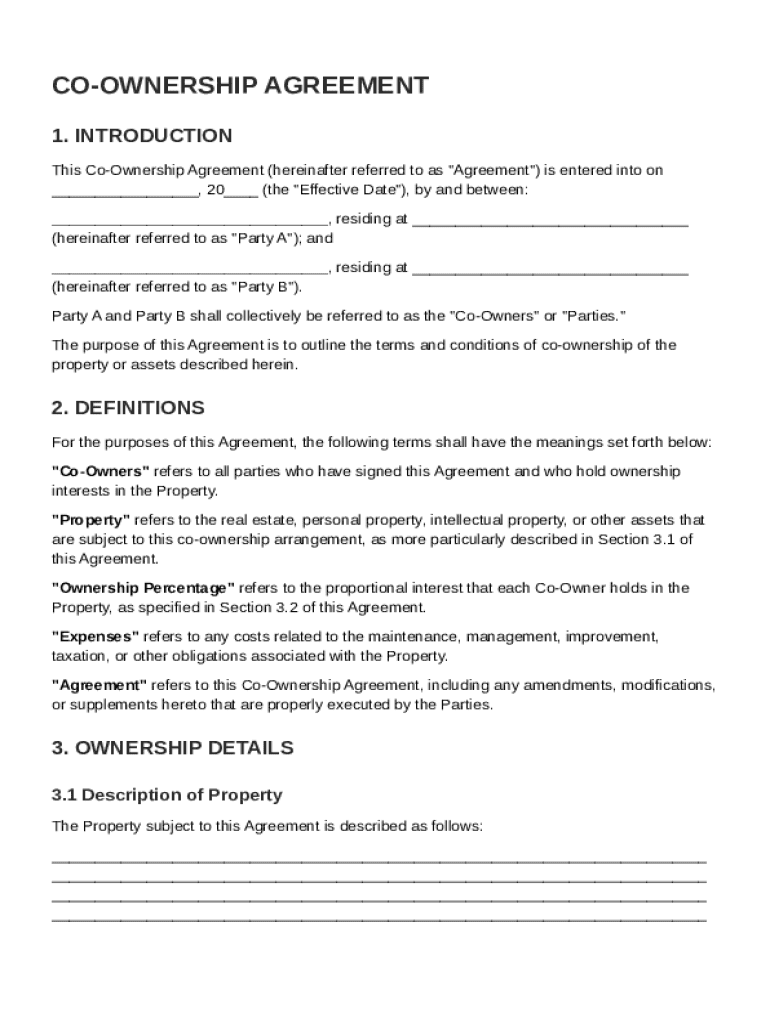







Definition & Meaning
A Co-Ownership Agreement Template is a legal document designed to outline the rights and responsibilities of two or more parties sharing ownership of a property. This agreement provides clarity on how the property will be managed, divides financial obligations, and details decision-making processes among the co-owners. This template helps ensure transparent communication and prevents disputes by clearly documenting terms such as ownership percentages, financial contributions, and maintenance duties.
Key Elements of the Co-Ownership Agreement Template
Each Co-Ownership Agreement typically includes several vital components to protect and clarify the interests of all parties involved:
- Identification of Co-Owners: Clearly stating the names and contact information for each co-owner.
- Property Description: Providing a comprehensive description of the property, including location and specific details.
- Ownership Percentages: Defining the ownership share each party holds in the property.
- Financial Contributions: Specifying how expenses such as mortgage payments, taxes, and maintenance costs will be divided among the co-owners.
- Management and Decision-Making: Outlining the process for making decisions regarding property management and any required consensus.
- Transfer of Ownership: Detailing the procedure for selling or transferring ownership and any rights of first refusal for existing co-owners.
- Dispute Resolution: Describing mechanisms for resolving conflicts, such as mediation or arbitration.
- Termination Conditions: Conditions under which the agreement can be terminated or modified.
How to Use the Co-Ownership Agreement Template
To effectively utilize a Co-Ownership Agreement Template, follow these steps:
- Gather Information: Collect all necessary information regarding the co-owners and the property.
- Customize the Template: Adjust the template to reflect specific arrangements and conditions agreed upon by the parties involved.
- Consult Legal Counsel: Have an attorney review the customized agreement to ensure it complies with relevant laws and adequately protects all parties.
- Negotiate and Refine: Discuss any needed amendments with co-owners to ensure mutual satisfaction with the agreement terms.
- Execute the Agreement: Have all parties sign the document in the presence of a notary public to ensure its enforceability.
- File the Document: Keep copies of the executed document securely stored for future reference.
State-Specific Rules for the Co-Ownership Agreement Template
Co-Ownership Agreements can be subject to state-specific regulations. Here are some variations you might encounter:
- Community Property States: In states like California and Texas, property purchased during a marriage may be considered community property unless otherwise stated.
- Tenancy in Common vs. Joint Tenancy: The legal distinctions between these types of holdings can impact the right of survivorship and transfer processes.
- Judicial Requirements: Some states may require agreements to be notarized or filed with local government offices to be legally binding.
Who Typically Uses the Co-Ownership Agreement Template
The template is beneficial for a wide range of users:
- Friends or Family Members: Often used when relatives or friends decide to jointly invest in real estate.
- Business Partners: Vital for partners looking to co-own business property and ensure clear operational agreements.
- Investors: Helpful for investors pooling resources to purchase a property for rental or resale.
- Unmarried Couples: Provides an agreement framework to manage property purchased together without getting married.


Important Terms Related to Co-Ownership Agreement Template
Understand these legal terms related to the Co-Ownership Agreement:
- Tenancy in Common: Ownership form allowing co-owners to possess unequal shares and pass their shares to heirs.
- Joint Tenancy: Co-owners have equal shares and the right of survivorship.
- Right of First Refusal: An agreement that gives existing co-owners the opportunity to purchase a fellow owner’s share before any external sale.
- Partition Action: A legal remedy to divide property among co-owners, often leading to a sale in complicated disputes.
Legal Use of the Co-Ownership Agreement Template
The Co-Ownership Agreement Template serves various legal purposes, including:
- Dispute Prevention: Facilitates the prevention of legal disputes by specifying roles and responsibilities.
- Interest Protection: Protects individuals’ interests by clearly outlining financial contributions and ownership stakes.
- Transfer Facilitation: Eases property transfer by detailing rights and procedural agreements.
Examples of Using the Co-Ownership Agreement Template
Consider these real-world scenarios where co-ownership agreements prove indispensable:
- Vacation Homes: Friends sharing ownership of a vacation property can prevent disputes over usage schedules and maintenance costs.
- Rental Investments: Business partners can explicitly define their roles and profit-sharing expectations for a rental property investment.
- Ancestral Properties: Siblings inheriting a family home may use the document to record their shares and manage the upkeep and potential sale.
Through the Co-Ownership Agreement Template, co-owners can establish a harmonious and legally sound relationship, safeguarding interests and promoting cooperation.




