01. Edit your form online
Type text, add images, blackout confidential details, add comments, highlights and more.

Type text, add images, blackout confidential details, add comments, highlights and more.

Draw your signature, type it, upload its image, or use your mobile device as a signature pad.

Send it via email, link, or fax. You can also download it, export it or print it out.
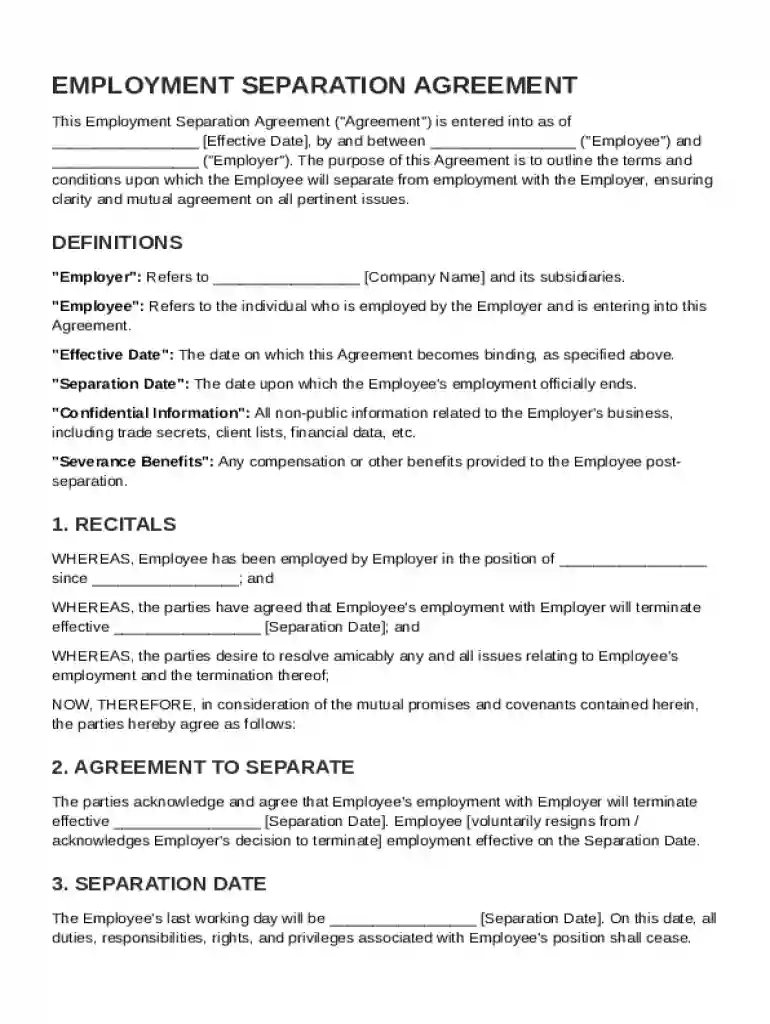
An Employment Separation Agreement Template is a legal document that delineates the terms and conditions under which an employee will part ways with their employer. Typically used when an amicable separation occurs, the agreement ensures clarity for both parties. It covers aspects such as the effective date of separation, any final compensation due, confidentiality agreements, return of company property, and provisions like non-disparagement. This template helps prevent future disputes by establishing mutual understanding and agreement.
The Employment Separation Agreement Template comprises several fundamental elements:
Separation Terms: Specifies the voluntary or involuntary nature of the separation and the effective date.
Final Compensation: Details any severance pay, unused vacation payout, or bonuses owed to the employee.
Confidentiality Obligations: Describes employee obligations concerning company information post-separation.
Release of Claims: Requires the employee to waive any potential legal claims against the employer.
Non-Disparagement Clause: Prevents either party from making defamatory statements about the other.
Return of Property: Ensures that the employee returns all company property, such as laptops or access cards.
Governing Law: Establishes which state's laws will govern the agreement.
These components are crucial for protecting both parties' interests and ensuring a smooth transition.
Review the Template: Carefully read through the entire document to understand each section's purpose.
Customize the Details: Fill in specific details such as names, dates, and compensation amounts that are unique to your scenario.
Negotiate Terms: Discuss and resolve any disagreements with the other party to achieve mutually acceptable terms.
Add Signatures: Both parties must sign the agreement, often witnessed by a third party or notarized for authenticity.
Distribute Copies: Ensure both the employer and employee receive a signed copy for their records.
These steps ensure that the agreement meets your specific needs while remaining legally sound.
Understanding certain legal terms is essential when dealing with Employment Separation Agreements:
Severance Pay: Compensation offered to an employee upon termination, beyond what is owed for unpaid work.
Non-Compete Clause: Restricts the employee from joining competing businesses within a specific time frame after termination.
Consideration: Refers to any incentive or benefit provided to the employee in exchange for signing the agreement.
Waiver of Claims: A provision where the employee agrees not to pursue any legal claims against the employer.
Familiarity with these terms helps in comprehending the document's intentions and obligations.
The document serves to legally formalize the end of employment under clear, agreed-upon terms. It protects both employee and employer from future litigation by resolving potential disputes beforehand. Compliance with labor laws and understanding of state-specific legislation are crucial, as violations can invalidate the agreement. Consulting an employment attorney is often recommended to ensure enforceability and legality.
The template is widely utilized by:
HR Managers and Recruiters: Ensures standardized exits for employees, minimizing legal risks.
Employers: Provides clarity and protection against future claims from former employees.
Employees: Offers an opportunity to negotiate final compensation and post-employment obligations.
These parties benefit from clearly articulated terms and reduced potential for misunderstandings.


Layoffs: Companies initiate agreements during large-scale layoffs to finalize terms with multiple employees simultaneously.
Mutual Separations: When both parties agree on the separation, this document outlines terms to maintain professionalism.
Contract Endings: Non-renewal of a contract signals the need for a separation agreement to close employment formally.
Each scenario demonstrates the agreement's adaptability to different employment termination conditions.
Various versions cater to different employment situations:
Simple Version: Covers basic terms for amicable separations.
Comprehensive Version: Includes detailed clauses on compensation, confidentiality, and post-employment obligations.
Customizable Templates: Offer greater flexibility, allowing modification of provisions to match specific company policies or legal requirements.
Selecting the right version ensures that all pertinent details and eventualities are addressed.
Employment laws vary across states, impacting the agreement's enforceability:
Non-Compete Clauses: Some states, like California, impose restrictions on these clauses, affecting their inclusion.
Severance Pay Regulations: May differ in terms of calculation and statutory requirements.
Governing Law Clauses: Must align with the jurisdiction where the agreement is executed.
Researching state-specific laws or consulting with a legal expert is advisable to ensure compliance.
Using the DocHub platform streamlines managing these documents, offering features such as:
PDF Editing and Annotation: Modify and comment on agreements without conversion hassles.
Secure Signature Collection: Gather legally binding signatures from parties involved.
Integration with Cloud Services: Save and share completed agreements via Google Drive or Dropbox.
These tools enhance document management efficiency, ensuring legal and procedural compliance.
At DocHub, your data security is our priority. We follow HIPAA, SOC2, GDPR, and other standards, so you can work on your documents with confidence.