
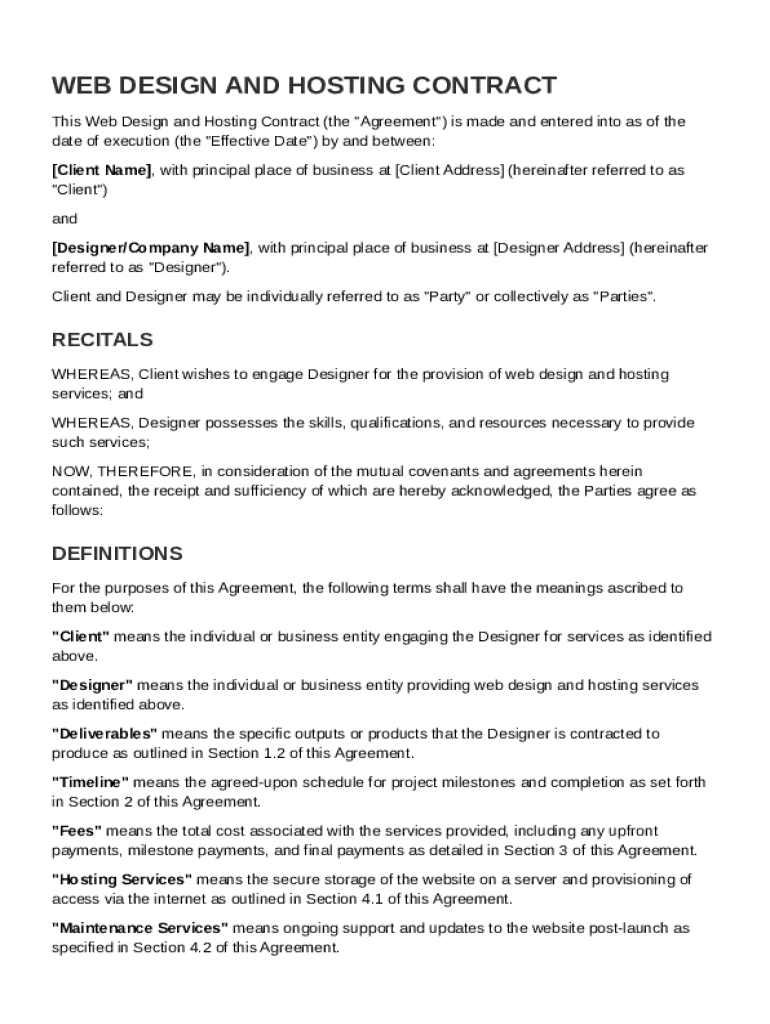







Definition and Purpose of the Web Design and Host Contract Template
The Web Design and Host Contract Template is a legal document designed to formalize the relationship between a client and a designer. It delineates the terms for web design and hosting services, encapsulating the project's scope, timelines, and responsibilities. This contract is quintessential for establishing transparency and mutual understanding between parties, minimizing the risk of disputes.
- Terminology: Defines key terms like "Client," "Designer," "Deliverables," and "Scope of Work" to ensure all parties have a unified understanding of responsibilities.
- Purpose: Used to outline expectations, safeguard intellectual property, and set out payment terms. It is a binding document intended to provide legal recourse if obligations are not met.
How to Use the Web Design and Host Contract Template
Utilizing the Web Design and Host Contract Template effectively requires attention to detail and a thorough understanding of the project requirements.
- Customization: Tailor the template to reflect specific project needs. Include unique deliverables and individual designer qualifications.
- Review with Stakeholders: Engage both client and designer in a review process to clarify expectations and agree on terms.
- Legal Review: While templates provide a foundation, consulting with legal counsel ensures compliance and adaptability to specific client needs.
Steps to Complete the Web Design and Host Contract Template
Completing the template involves several critical stages that help ensure all necessary information is captured accurately.
- Identify Parties Involved: Clearly specify the details of the client and designer, including contact information and roles.
- Define the Scope of Work: Detail project components such as design elements, functionalities, and deadlines.
- Set Payment Terms: Outline fees, payment schedules, and methods.
- Agree on Revisions and Approvals: Establish limits on revisions and the process for client approvals.
- Incorporate Hosting Services: If applicable, detail hosting terms such as server specifications and maintenance.
- Finalize and Sign: Both parties review and sign to validate the contract.
Important Terms Related to the Web Design and Host Contract Template
A deep understanding of the terminology used in the Web Design and Host Contract Template is essential for all involved parties.
- Intellectual Property Rights: Defines ownership of the design and any creative works resulting from the project.
- Confidentiality Obligations: Details the commitment of both parties to protect sensitive information.
- Termination Clauses: Conditions under which the contract can be dissolved by either party, typically due to non-compliance or unexpected circumstances.
Key Elements of the Web Design and Host Contract Template
Several core elements are integral to the Web Design and Host Contract Template, ensuring comprehensive coverage of obligations and rights.
- Project Timeline and Milestones: Specifies phases of the project and expected completion dates for each stage.
- Revisions and Feedback Mechanism: Allows for structured client feedback and iterative improvements.
- Limitation of Liability: Outlines the extent to which each party is responsible for issues arising during the project's execution.
Legal Use of the Web Design and Host Contract Template
The legal implications of using the Web Design and Host Contract Template are significant, ensuring the enforceability of the contract.
- ESIGN Act Compliance: Signatures are legally accepted if done electronically, adhering to the ESIGN Act guidelines.
- Enforceability: As a legally binding document, the contract is enforceable in court, providing recourse in cases of breach.
Examples of Using the Web Design and Host Contract Template
Examples provide clarity on how the template can be adapted to various scenarios, helping users understand practical application.
- Startup Company: An emerging tech startup seeking to create a dynamic, responsive website may use this template to ensure qualitative work within a set budget.
- Freelance Designer: A freelance designer outlines terms and conditions with multiple clients to maintain consistency and protect intellectual rights.
Who Typically Uses the Web Design and Host Contract Template
Various entities and individuals utilize the Web Design and Host Contract Template, capitalizing on its flexibility and comprehensive framework.
- Freelance Designers: Independent professionals who need to formalize relationships with multiple clients.
- Agencies: Web design agencies that manage several projects simultaneously benefit from the standardized terms provided in the template.


State-Specific Rules for the Web Design and Host Contract Template
Legal requirements can vary significantly across different states. Therefore, adapting the Web Design and Host Contract Template to comply with local laws is paramount.
- Governing Law: The contract should specify which state’s laws govern the agreement, influencing dispute resolution.
- State-specific Provisions: Include clauses specific to industry regulations that may affect the enforceability of the contract within certain jurisdictions.




