




01. Edit your form online
Type text, add images, blackout confidential details, add comments, highlights and more.

Type text, add images, blackout confidential details, add comments, highlights and more.

Draw your signature, type it, upload its image, or use your mobile device as a signature pad.

Send it via email, link, or fax. You can also download it, export it or print it out.
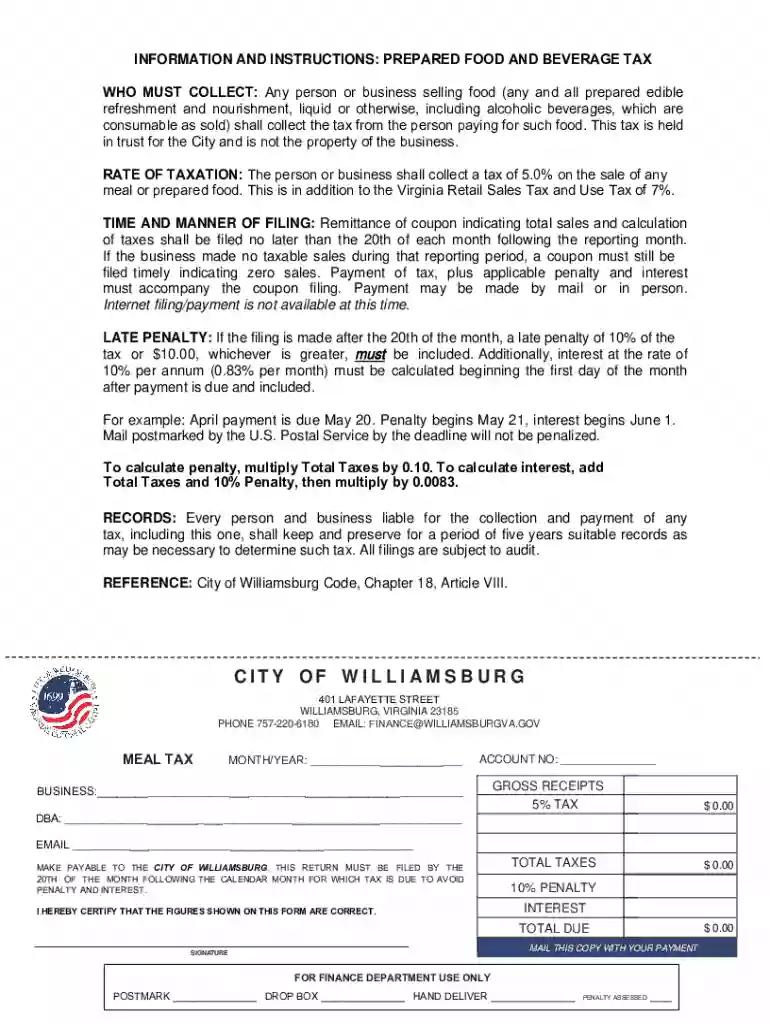
The "INFORMATION AND INSTRUCTIONS: PREPARED FOOD AND BEVERAGE TAX" form is a crucial document for businesses engaged in selling prepared foods and beverages. This form outlines the regulations and requirements for collecting and remitting taxes applicable to these sales. Typically used by local businesses, the form ensures that companies comply with the law by collecting the mandated percentage of tax from their customers, which is then remitted to the local government.
Businesses can typically obtain the "INFORMATION AND INSTRUCTIONS: PREPARED FOOD AND BEVERAGE TAX" form through the local municipal government’s website or their tax office. Some jurisdictions may offer downloadable PDFs, while others might provide online forms that can be filled and submitted electronically.
Completing the "INFORMATION AND INSTRUCTIONS: PREPARED FOOD AND BEVERAGE TAX" form entails precise calculations and accurate data entry to ensure compliance.
The form is primarily used by entities engaged in the food service industry. This includes:


Understanding the terminology associated with the "INFORMATION AND INSTRUCTIONS: PREPARED FOOD AND BEVERAGE TAX" is essential for accurate compliance.
Timely submission of the "INFORMATION AND INSTRUCTIONS: PREPARED FOOD AND BEVERAGE TAX" form is critical.
Failure to comply with the requirements or deadlines of the "INFORMATION AND INSTRUCTIONS: PREPARED FOOD AND BEVERAGE TAX" can result in penalties.
Though the "INFORMATION AND INSTRUCTIONS: PREPARED FOOD AND BEVERAGE TAX" form provides a general framework, individual states may have specific rules that alter how the form is completed or filed.
We've got more versions of the INFORMATION AND INSTRUCTIONS: PREPARED FOOD AND BEVERAGE TAX form. Select the right INFORMATION AND INSTRUCTIONS: PREPARED FOOD AND BEVERAGE TAX version from the list and start editing it straight away!
At DocHub, your data security is our priority. We follow HIPAA, SOC2, GDPR, and other standards, so you can work on your documents with confidence.





You earn 10 points for every $1 you spent. Points can be used to redeem over 20 menu items. You can only use EBT and Jack Cash gift cards for in-store
Get more information on the Prepared Food and Beverage Tax collected by our department. Learn how to set up an account and the filing requirements.
Mar 27, 2023 Each local act extends a taxat a rate of 1.0%to the sales price of prepared food. must collect state sales tax upon the sale of prepared


