




01. Edit your form online
Type text, add images, blackout confidential details, add comments, highlights and more.

Type text, add images, blackout confidential details, add comments, highlights and more.

Draw your signature, type it, upload its image, or use your mobile device as a signature pad.

Send it via email, link, or fax. You can also download it, export it or print it out.
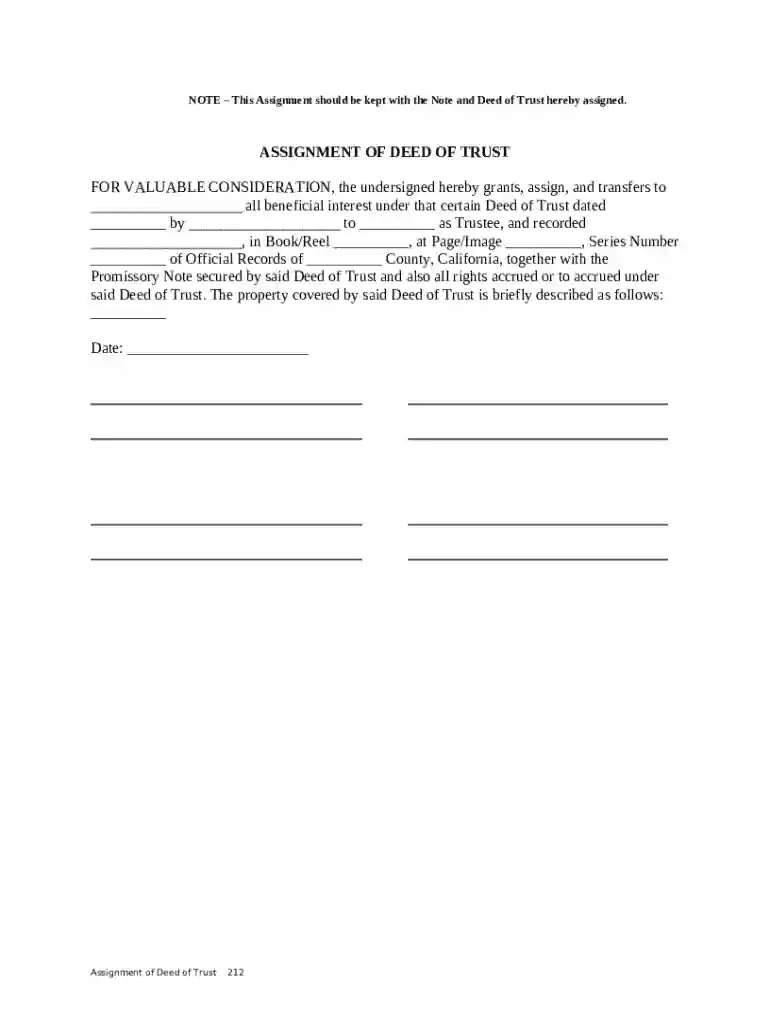
An Assignment of Deed of Trust is a legal document used to transfer beneficial interest in a deed of trust from one party to another. Typically, this document is part of real estate transactions where the original lender transfers their interest to another lender or party. In essence, it allows the new party, known as the assignee, to assume the legal rights and obligations associated with the property. This document is crucial in maintaining a clear chain of title, ensuring that all stakeholders in the loan agreement are correctly identified and legally recognized.
The assignment typically involves key information, including the names of the involved parties, details of the original Deed of Trust, and the property in question. It must also specify any consideration or value paid for the transfer, confirming that the transaction is valid and enforceable. Generally, notarization is required to verify the identity of the signer and validate the document, ensuring it meets legal standards.
There are several critical elements that must be included in an Assignment of Deed of Trust for it to be legally effective:
Identifying Information: Includes the names and contact details of the original trustee, the original beneficiary, and the new beneficiary (the assignee).
Reference to the Original Deed of Trust: The document must clearly refer to the original Deed of Trust, including the date, recording information, and any other pertinent details to avoid confusion.
Property Description: A comprehensive legal description of the property involved is essential to identify the specific property subject to the Deed of Trust.
Transfer Details: The assignment document must outline the consideration or compensation given for transferring the interest, confirming the legitimacy of the assignment.
Notarization and Signatures: The document must be signed by the assignor in the presence of a notary public, who will then notarize it to ensure its legality and authenticity.
The Assignment of Deed of Trust is commonly used in several legal contexts:
Mortgage Companies: When mortgage companies sell loans to other financial institutions, they use this document to transfer rights associated with the Deed of Trust.
Loan Servicing Transfers: When a loan servicer transfers the servicing rights to another servicer, an assignment document formalizes the transfer.
Collateral Transfers: In some situations, a lender might use this document to transfer a Deed of Trust as collateral to secure a different loan.
Each use case requires careful adherence to legal protocols to ensure the assignment is legally valid and enforceable, maintaining the rights of all parties involved.
Completing an Assignment of Deed of Trust involves several critical steps:
Gather Necessary Information: Collect all relevant information, including the original Deed of Trust, property description, and details of all parties involved.
Draft the Document: Prepare the document with all required elements, ensuring accuracy and clarity in descriptions and legal references.
Review the Document: Verify that all details are correct and comply with legal requirements for a valid assignment.
Sign and Notarize: The assignor must sign the document in the presence of a notary public, who will then notarize it.
Record the Assignment: Submit the document to the appropriate county recorder’s office to officially update the property's title records. This step ensures that the assignment is public record and provides notice to other parties.
Different states may have varying regulations regarding the assignment of a Deed of Trust. Key differences can include:
Recording Requirements: Some states have strict requirements regarding the timing and manner of recording assignments.
Notarization Standards: Notarization practices can vary, with certain states requiring additional authentication procedures.
Form and Language Requirements: States might prescribe specific forms or language that must be included for the assignment to be considered legally binding.
Understanding state-specific rules is crucial for executing a valid Assignment of Deed of Trust, avoiding legal pitfalls, and ensuring compliance with local property laws.
Understanding key terms related to the Assignment of Deed of Trust is essential for navigating this process:
Assignor: The original beneficiary or lender transferring their interest in the Deed of Trust.
Assignee: The new party receiving the interest and rights under the Deed of Trust.
Beneficial Interest: The rights and advantages that the holder of a Deed of Trust has concerning the property.
Consideration: The compensation or value paid in exchange for the assignment of interest.
Each of these terms constitutes fundamental elements of the nearly ubiquitous documentation surrounding real estate loans.
Practical scenarios where an Assignment of Deed of Trust may be utilized include:
Refinancing Situations: When a borrower refinances and the new lender takes over the original lender's interest, an assignment is necessary.
Secondary Market Sales: Mortgage loans often are sold and resold in the secondary market. Each sale requires a new assignment to the purchasing entity.
Company Restructures: In cases where a lender undergoes structural changes, such as mergers or acquisitions, assignments might need to be executed to reflect these changes legally.
These examples illustrate the versatile applications of the Assignment of Deed of Trust within the real estate and financial sectors.
At DocHub, your data security is our priority. We follow HIPAA, SOC2, GDPR, and other standards, so you can work on your documents with confidence.




Assignment of Deed of Trust prepared by the Deming Investment Company transferring the tract of land described in Frederick R. Kempffs deed of trust to Central
May 14, 1992 meeting the minimum trust or capital and surplus requirements of AS 21.34.040(c). deed restrictions, specific deed restriction;


