




01. Edit your form online
Type text, add images, blackout confidential details, add comments, highlights and more.

Type text, add images, blackout confidential details, add comments, highlights and more.

Draw your signature, type it, upload its image, or use your mobile device as a signature pad.

Send it via email, link, or fax. You can also download it, export it or print it out.
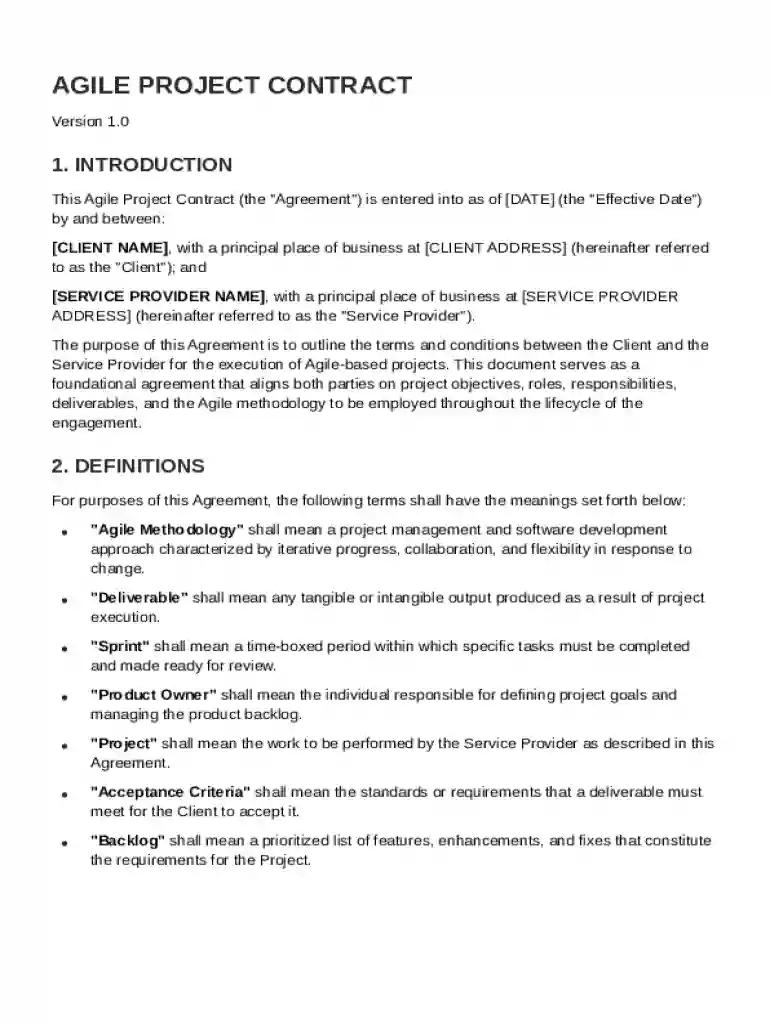
The Agile Contract Template is a comprehensive document used to outline the terms and conditions between a client and a service provider for Agile-based projects. This contract is vital in creating a mutual understanding of roles, responsibilities, deliverables, and the Agile methodologies to be used throughout the project lifecycle. These methodologies emphasize iterative development, flexibility, and collaboration. The template serves as a guide to ensure that both parties have clarity on project objectives, facilitating smooth cooperation.
An Agile Contract Template typically includes several critical sections:
Project Scope: Clearly defines the boundaries, objectives, and deliverables of the project. This section ensures that both parties have a shared understanding of what will be achieved.
Roles and Responsibilities: Assigns key roles and delineates the duties of each party involved in the project. This is crucial for maintaining accountability and ensuring effective collaboration.
Agile Methodologies: Outlines the specific Agile frameworks or practices (e.g., Scrum, Kanban) that will be implemented, ensuring consistent project execution.
Payment Terms: Specifies the financial arrangements, including rates, payment schedules, and terms of invoicing. Clarity in this section helps prevent disputes and ensures timely payments.
Change Management: Details the process for handling modifications to the project scope, timelines, or objectives. This is vital in Agile projects, where adaptability is key.
Confidentiality and Intellectual Property: Protects sensitive information and outlines the ownership of project outputs. This section safeguards the interests of both parties.
Termination Conditions and Dispute Resolution: Explains the circumstances under which the contract can be terminated and the mechanisms for resolving conflicts, ensuring that the partnership can be ended smoothly if necessary.
Using an Agile Contract Template involves several steps to ensure it aligns with the specific needs of the project:
Customize the Template: Adapt the template to fit the project’s unique requirements. This includes tailoring sections such as project scope, Agile methodologies, and specific roles.
Review and Revise: Collaboratively review the document with all stakeholders. Ensure that each section reflects the understanding and agreement of both parties.
Finalize and Sign: After making all necessary revisions, both parties should sign the document to formalize the agreement. Ensure that signatures are obtained using a legally binding method, such as electronic signatures supported by platforms like DocHub.
Distribute Copies: Provide copies of the signed contract to all relevant stakeholders. This ensures everyone involved has a reference document to guide project execution.
To effectively complete the Agile Contract Template, follow these detailed steps:
Gather Project Information: Collect all necessary project details, including objectives, timelines, and key stakeholders.
Define Terms and Conditions: Clearly articulate the terms for each section of the contract, ensuring mutual agreement.
Integrate Legal Clauses: Incorporate necessary legal clauses to address confidentiality, intellectual property rights, and dispute resolution.
Assign Roles and Responsibilities: Specify the roles for each party involved in the project, detailing their respective responsibilities.
Review and Revise Collaboratively: Engage all stakeholders in reviewing the draft to ensure clarity and completeness.
Obtain Approval and Signatures: Secure approval from both parties and proceed with obtaining signatures.
Legally using the Agile Contract Template involves adhering to relevant laws and standards. This ensures that the contract is enforceable and compliant:
Adherence to the ESIGN Act: Ensure that electronic signatures comply with legal standards. This is especially applicable when using platforms like DocHub for obtaining digital signatures.
Confidentiality and Intellectual Property Rights: Protect sensitive project information with appropriate clauses. Ensure that ownership rights of any deliverables are clearly stated.
Compliance with Contract Law: The contract must adhere to general principles of contract law in the United States, ensuring it is legally valid.
Several key terms are often associated with the Agile Contract Template:
Sprint: A set period during which specific work has to be completed and made ready for review.
Backlog: A list of tasks required for project completion, prioritizing them based on deadlines and importance.
Burndown Chart: A visual representation that displays the amount of work remaining in a project over time.
User Story: A short, simple description of a feature from the perspective of the end user.
Understanding these terms is essential for any stakeholder involved in an Agile project to effectively use and navigate the contract.
The Agile Contract Template is most commonly used by:
IT and Software Development Firms: These entities often employ Agile methodologies to enhance flexibility and collaboration.
Consultants and Service Providers: Professionals providing specialized services use the template to outline deliverables and expectations clearly.
Startups and Small Businesses: These organizations benefit from the adaptability and iterative nature of Agile contracts to scale their operations efficiently.
By leveraging this template, these users can ensure a structured yet flexible approach to project management.


An Agile Contract Template can be adapted to various scenarios:
Software Development Projects: Teams can specify deliverables and iterations for building a new software application.
Marketing Campaigns: Agile contracts can manage iterative feedback and adjustments in marketing strategies.
Product Design and Innovation: Organizations developing new products can utilize Agile contracts to facilitate continuous innovation and adaptation based on market feedback.
In each case, the use of an Agile Contract Template streamlines collaboration and aligns project goals between service providers and clients effectively.
At DocHub, your data security is our priority. We follow HIPAA, SOC2, GDPR, and other standards, so you can work on your documents with confidence.


A work package can be a formal document or contract. Each work package serves as a mini-contract or formal agreement in such cases.
For an example of how to set up an RFQ for agile developing using a firm-fixed-price contract type, visit our Resources page and refer to Templates Samples.Read more


