




01. Edit your form online
Type text, add images, blackout confidential details, add comments, highlights and more.

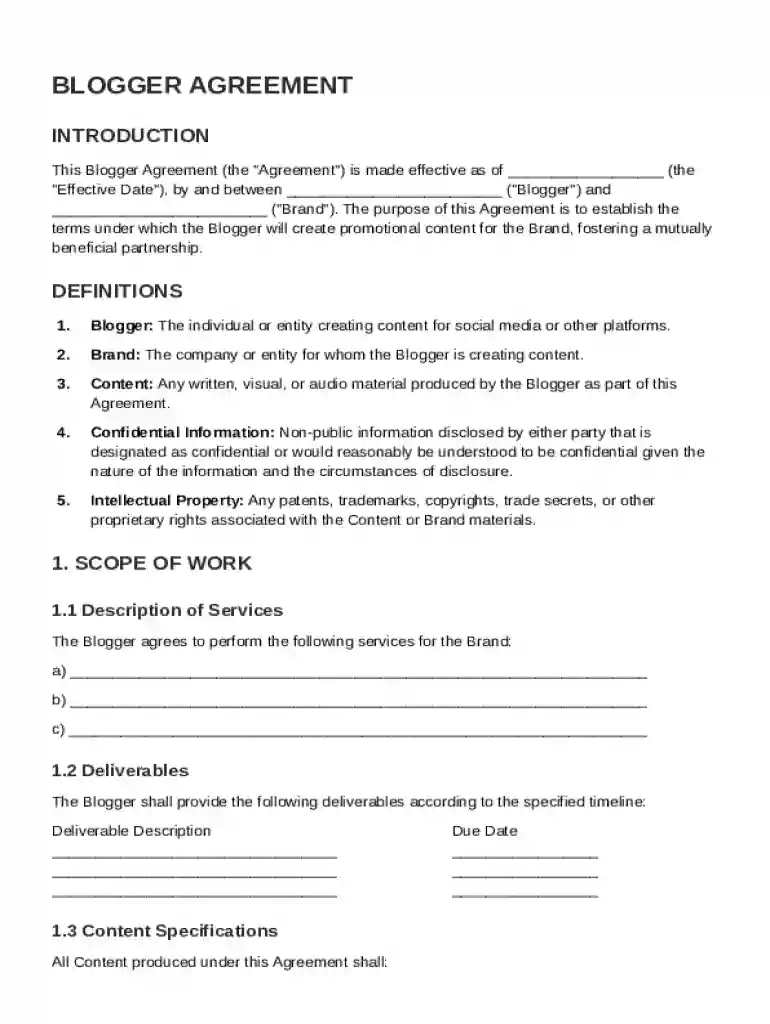
Type text, add images, blackout confidential details, add comments, highlights and more.

Draw your signature, type it, upload its image, or use your mobile device as a signature pad.

Send it via email, link, or fax. You can also download it, export it or print it out.
A Blogger Agreement Template is designed to outline the specific terms and conditions under which a blogger and a brand engage in a professional relationship. At its core, the agreement details roles, responsibilities, and compensation.
Roles and Responsibilities: Clearly define the blogger's duties, such as content creation, deadlines, and promotional activities. Include the brand's obligations, such as providing resources or promotional materials.
Compensation Structures: Specify payment terms, including monetary compensation, product exchanges, or affiliate commission structures. Clearly outline payment schedules and methods to ensure mutual understanding.
Intellectual Property Rights: Address ownership of content created by the blogger. Clarify whether the brand gains full rights, a license, or if the blogger retains ownership. Include terms on content usage duration and scope.
Confidentiality Obligations: Protect sensitive information shared during collaboration. Include clauses that prevent the disclosure of proprietary information or trade secrets acquired through the partnership.
Filling out a Blogger Agreement Template requires careful attention to detail to ensure clarity and legal compliance.
Enter Parties' Information: Begin with the names and contact details of both the blogger and the brand. This identifies the legal entities entering the agreement.
Define Scope of Work: Clearly outline the expected content creation duties, including the type of content, platforms for publishing, and any relevant deadlines.
Compensation Details: Specify how and when compensation will be provided. Include any performance metrics that might impact payment, like audience engagement rates.
Set Intellectual Property Terms: Declare who owns the content post-creation. Address permissions for content reproduction and required attributions.
Include Confidentiality Agreements: Ensure clauses are present to protect sensitive information. Amend the agreement to reflect any unique confidentiality requirements.
Using a Blogger Agreement Template legally requires adherence to applicable laws and both parties’ understanding of the agreement's binding nature.
Ensuring Compliance: Templates should comply with federal and state laws, including advertising standards and disclosure requirements. Legal advice may be necessary to tailor the agreement to specific jurisdictions.
Binding Nature: The agreement becomes legally binding once signed, indicating that both parties consent to the outlined terms. Ensure that all signatures are dated and stored for future reference.
Dispute Resolution: Include a mechanism for resolving disagreements, such as mediation or arbitration. Specify how disputes will be handled to avoid future complications.
Understanding key terms within a Blogger Agreement is crucial for both legal clarity and mutual understanding between parties.
Deliverables: Specific outputs that the blogger is expected to produce, such as blog posts, videos, or social media content.
Exclusivity: Terms that may restrict the blogger from working with competing brands, either during or after the contract term.
Term and Termination: The duration of the agreement and conditions under which it can be terminated. This includes notice periods required for early termination.
Effectively utilizing a Blogger Agreement Template ensures streamlined collaborations between brands and bloggers.
Customize the Template: Adjust the template to reflect the unique aspects of the collaboration. Include any specific requirements or expectations.
Review Legal Implications: Consult a legal professional to ensure compliance with relevant laws and to address any unique legal nuances of the arrangement.
Distribute for Signatures: Share the completed agreement with all involved parties. Ensure that each party understands and agrees to the terms.
Store Signed Copies: Keep an organized record of the signed agreement for future reference and potential audits or evaluations.
While primarily utilized by bloggers and brands, this template also serves a broader range of users.
Marketing Agencies: Agencies may use agreements to formalize interactions between their clients and bloggers.
Freelancers: Independent bloggers who engage in various sponsorships may use these templates to protect their interests and define roles with clarity.
Brands and Businesses: Companies looking to expand their digital presence through influencer partnerships typically employ these agreements to ensure professional engagement.


Even though blog agreements are generally standard across the U.S., some state-specific rules might impact these documents.
Employment Laws: Some states have unique employment standards that might impact how freelance or contract work is defined and compensated.
Data Protection Laws: Compliance with state data privacy laws, such as the California Consumer Privacy Act (CCPA), may require additional rights and obligations regarding personal data handling.
Various versions and alternatives ensure flexibility in meeting different legal and business needs.
Short-Form Agreements: Simplified versions for single-use collaborations that require minimal legal obligations and less formal structure.
Custom Contracts: Fully tailored contracts developed from scratch, often necessary for complex arrangements involving multiple parties and platforms.
Industry-Specific Agreements: Contracts tailored to specific blogging niches or industries, like fashion or technology, which can address unique requirements or standards of those sectors.
By understanding these elements and approaches, users can create efficient and legally compliant agreements that protect all parties involved.
At DocHub, your data security is our priority. We follow HIPAA, SOC2, GDPR, and other standards, so you can work on your documents with confidence.




This Virtual Private Network Agreement is entered into between the User and (^Company^), effective the date this agreement is executed by (^Company^)sRead more
Jul 9, 2009 The key to drafting better contracts, though, is to step away from the templates. Good contract drafters didnt start their careers by drafting


