




01. Edit your form online
Type text, add images, blackout confidential details, add comments, highlights and more.

Type text, add images, blackout confidential details, add comments, highlights and more.

Draw your signature, type it, upload its image, or use your mobile device as a signature pad.

Send it via email, link, or fax. You can also download it, export it or print it out.
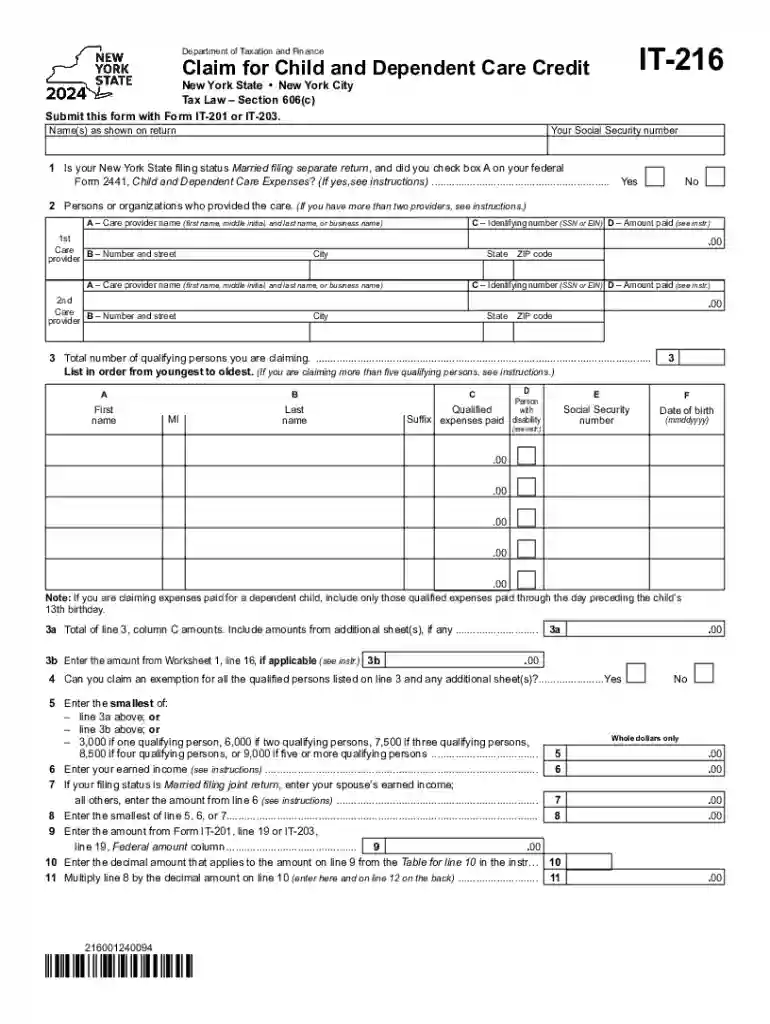
The IT-216 is a form issued by the New York State Department of Taxation and Finance. This document is specifically designed to facilitate the claiming of the Child and Dependent Care Credit. By utilizing this form, taxpayers can provide the necessary information to report childcare expenses and determine their eligibility for the credit. The form addresses both full-year and part-year residents and includes specifics for New York City residents, which makes it a critical component of tax filings for families incurring dependent care costs.
Understanding the eligibility criteria is essential for taxpayers who wish to claim the Child and Dependent Care Credit through the IT-216. To qualify:


Several critical elements must be accurately reported and documented in the IT-216:
Completing the IT-216 requires a systematic approach to ensure all necessary information is included:
Taxpayers can obtain the IT-216 in several ways:
Understanding key terms related to the IT-216 is crucial for accurate completion:
New York State has specific guidelines that impact how the IT-216 is completed:
Taxpayers must adhere to all requirements specified in the IT-216 to avoid penalties:
We've got more versions of the It-216 form. Select the right It-216 version from the list and start editing it straight away!
| Versions | Form popularity | Fillable & printable |
|---|---|---|
| 2025 | 4.6 Satisfied (35 Votes) | |
| 2024 | 4.5 Satisfied (35 Votes) | |
| 2023 | 4.1 Satisfied (61 Votes) | |
| 2022 | 4.1 Satisfied (55 Votes) | |
| 2021 | 4.8 Satisfied (131 Votes) | |
| 2020 | 4.3 Satisfied (108 Votes) | |
| 2019 | 4.3 Satisfied (170 Votes) | |
| 2018 | 4.3 Satisfied (138 Votes) | |
| 2016 | 4 Satisfied (43 Votes) | |
| 2015 | 4.3 Satisfied (184 Votes) | |
| 2014 | 4.2 Satisfied (45 Votes) | |
| 2013 | 4.4 Satisfied (59 Votes) | |
| 2010 | 4 Satisfied (28 Votes) |
At DocHub, your data security is our priority. We follow HIPAA, SOC2, GDPR, and other standards, so you can work on your documents with confidence.
Students survey and apply techniques in analyzing and modeling information systems. Requirements are derived in various domains and abstracted at conceptual,Read more
Nov 5, 2025 Form IT-216, Claim for Child and Dependent Care Credit, and its instructions New York City Child and Dependent Care Credit


