01. Edit your form online
Type text, add images, blackout confidential details, add comments, highlights and more.

Type text, add images, blackout confidential details, add comments, highlights and more.

Draw your signature, type it, upload its image, or use your mobile device as a signature pad.

Send it via email, link, or fax. You can also download it, export it or print it out.
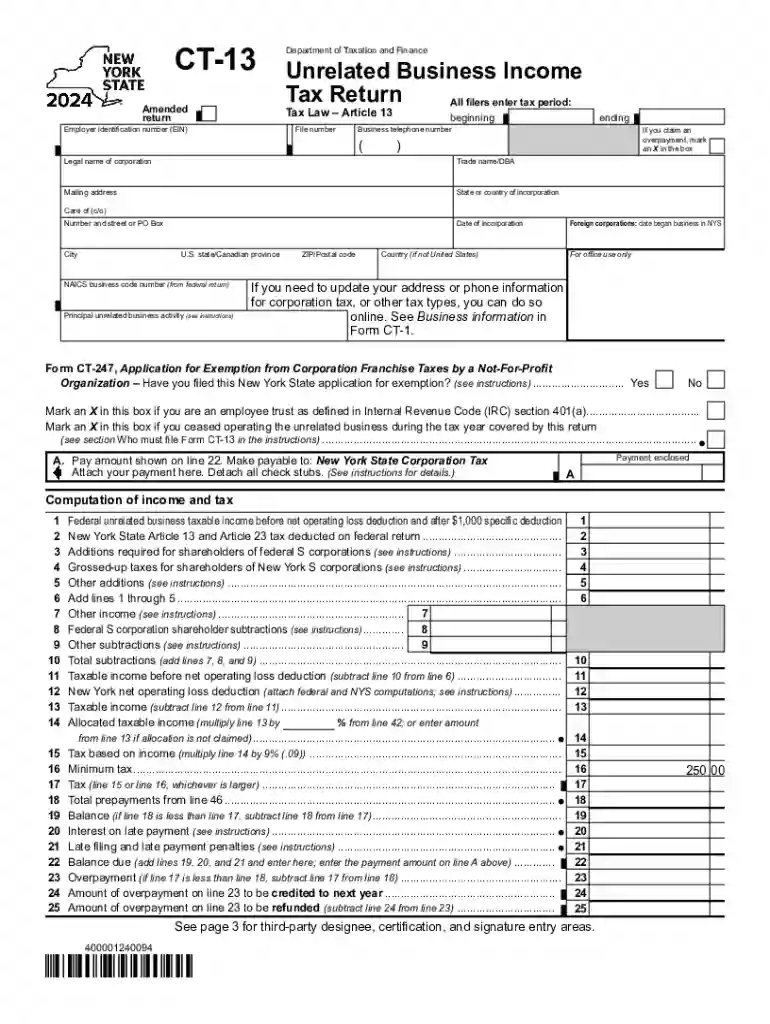
Form CT-13, officially referred to as the "Unrelated Business Income Tax Return" for Tax Year 2024, is a document issued by the New York State Department of Taxation and Finance. It is designed for corporations that need to report income derived from unrelated business activities. These activities are defined as those not substantially related to the organization's tax-exempt purpose. Understanding this form is pivotal for corporations as it outlines the necessary computations, deductions, and exemptions relevant to unrelated business income.
By filing this form, corporations ensure compliance with state tax regulations and avoid potential penalties associated with non-disclosure of such income.
Completing Form CT-13 effectively requires meticulous adherence to the specified steps:
Adhering to these steps will enhance accuracy and compliance with the tax regulations set forth by the state.
Certain terms are crucial when dealing with Form CT-13:
Understanding these key terms is essential for accurately filling out the form and ensuring that all sections are completed properly.
When preparing to file Form CT-13, ensure you gather and attach the following documents:
Having these documents ready will facilitate a smoother filing process and help prevent delays due to incomplete submissions.
Form CT-13 is specifically utilized by:
These organizations must carefully monitor and report their unrelated income to avoid tax complications.
For the tax year 2024:
Meeting these deadlines is essential to avoiding penalties and ensuring compliance with state tax obligations.
Failing to file Form CT-13 or misreporting unrelated business income can result in several penalties:
To prevent these consequences, it is vital for corporations to complete and submit the form correctly and on time.
Form CT-13 serves a crucial legal function:
By using this form, corporations maintain their integrity and sustain their tax-exempt status according to state laws.
While Form CT-13 is specific to New York State, understanding its unique requirements is crucial:
These state-specific features emphasize the importance of accessing and understanding current form instructions to ensure accurate compliance.
We've got more versions of the Form CT-13 Unrelated Business Income Tax Return Tax Year 2024 form. Select the right Form CT-13 Unrelated Business Income Tax Return Tax Year 2024 version from the list and start editing it straight away!
| Versions | Form popularity | Fillable & printable |
|---|---|---|
| 2025 | 4.7 Satisfied (44 Votes) | |
| 2024 | 4.6 Satisfied (29 Votes) | |
| 2023 | 4.2 Satisfied (25 Votes) | |
| 2022 | 4.6 Satisfied (20 Votes) | |
| 2021 | 4.8 Satisfied (139 Votes) | |
| 2020 | 4.2 Satisfied (37 Votes) | |
| 2019 | 4.3 Satisfied (80 Votes) | |
| 2018 | 4.3 Satisfied (125 Votes) | |
| 2017 | 4.2 Satisfied (68 Votes) | |
| 2014 | 4 Satisfied (20 Votes) | |
| 2012 | 4.3 Satisfied (100 Votes) |
At DocHub, your data security is our priority. We follow HIPAA, SOC2, GDPR, and other standards, so you can work on your documents with confidence.