







Definition & Meaning
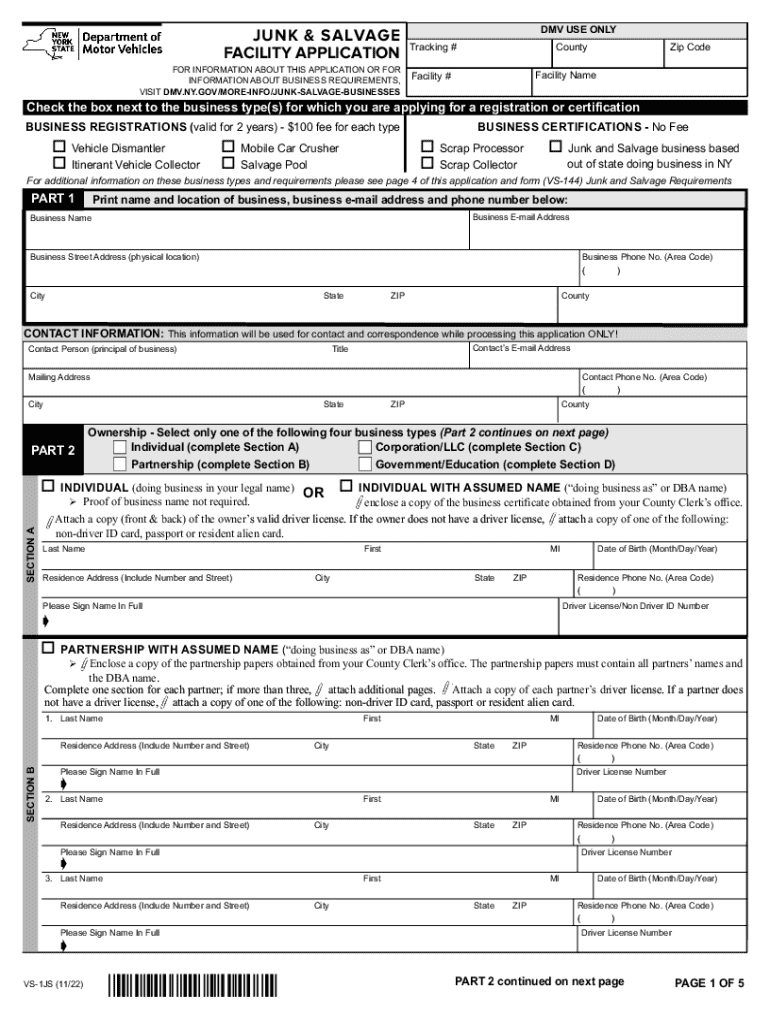
The Junk and Salvage Facility Application VS-1JS (11 22) is a specialized form utilized in New York State to register or certify businesses involved in the junk and salvage industry. This includes facilities that dismantle, recycle, or trade in automotive parts and scrap materials. The primary objective of the form is to ensure compliance with state regulations governing the operation of such businesses. By submitting the VS-1JS form, applicants demonstrate their intent to operate within the legal framework set forth by New York State, which includes adhering to environmental regulations, business practices, and safety standards.
How to Use the Junk and Salvage Facility Application VS-1JS
To effectively use the VS-1JS form, applicants should begin by thoroughly reviewing the form instructions to understand the requirements specific to their business type. This includes identifying the appropriate sections to complete based on the operation, such as dismantling versus recycling. Each section of the form should be filled out with accurate and complete information about business ownership, contact details, and descriptions of the facility’s operational scope. In addition, applicants must ensure that all supplementary documentation, such as proof of business registration and insurance, is attached as specified by the form’s guidelines.
Practical Tips for Completion
- Review Instructions: Begin by carefully reading through the entire form to grasp all specific requirements.
- Accurate Information: Provide precise details in all sections to avoid processing delays.
- Supplementary Documents: Include all required documents to support your application, such as proof of insurance.
Steps to Complete the Junk and Salvage Facility Application VS-1JS
Completing the VS-1JS form involves several detailed steps:
- Gather Information: Collect all necessary business details, including ownership structure and contact information.
- Section Completion: Fill out the relevant sections based on your operation, ensuring all fields are filled accurately.
- Attach Documentation: Compile and attach required documents, such as business licenses and proof of insurance.
- Review and Verify: Double-check all entries for accuracy and completeness.
- Submit the Form: Choose a submission method—online, mail, or in-person—based on what’s available and convenient.
Key Elements of the Junk and Salvage Facility Application VS-1JS
The VS-1JS form is structured to capture essential information regarding the registration and operation of junk and salvage facilities. Key elements include:
- Business Details: Comprising the name, address, and ownership structure.
- Facility Type: Specification of the operation, such as dismantler or recycler.
- Compliance Information: Details on how the facility adheres to environmental and safety standards.
Important Subsections
- Financial Disclosures: Information concerning business solvency and financial history.
- Operational Plans: Detailed descriptions of processes to ensure environmental compliance.
Required Documents
When submitting the VS-1JS form, various documents must be attached:
- Proof of Business Registration: Valid documents indicating the formal registration of the business entity.
- Insurance Certificates: Proof of insurance coverage pertinent to business operations.
- Compliance Records: Documents that demonstrate adherence to environmental and safety regulations.
Compliance and Penalties
Failure to comply with the requirements of the VS-1JS application can lead to significant penalties. Non-compliance can result in fines, loss of operating licenses, or legal action. It is crucial for applicants to ensure that all information provided is accurate and the business operates within the legal framework established by New York State.
Examples of Penalties
- Monetary Fines: Issued for missing or incorrect information.
- License Revocation: Potential loss of permission to operate if compliance is not maintained.
Who Issues the Form
The Junk and Salvage Facility Application VS-1JS is issued by the New York State Department of Motor Vehicles. This department oversees the registration and monitoring of facilities within the automotive recycling and salvage industry to ensure compliance with state laws and regulations.
Role of the Issuing Authority
- Regulatory Oversight: Monitors compliance with environmental, safety, and business operational standards.
- Approval and Certification: Grants permissions for facilities meeting all application and regulatory requirements.
Form Submission Methods
Applicants have several options for submitting the VS-1JS form, depending on their preference and convenience:
- Online Submission: Direct submission through the designated online portal.
- Mail Submission: Sending completed forms and documents to the specified postal address.
- In-Person Delivery: Hand-delivering applications to the appropriate New York State Department of Motor Vehicles office.
Submission Details
- Online: Ensure electronic copies of all documents are correctly formatted for upload.
- Mail: Use certified mail for a confirmation of receipt.
- In-Person: Call ahead to verify any specific requirements or appointment needs.
By adhering to these detailed guidelines and steps, businesses can effectively navigate the process of registering or certifying their junk and salvage operations with the state of New York, ensuring compliance with all necessary legal and regulatory requirements.




