01. Edit your form online
Type text, add images, blackout confidential details, add comments, highlights and more.

Type text, add images, blackout confidential details, add comments, highlights and more.

Draw your signature, type it, upload its image, or use your mobile device as a signature pad.

Send it via email, link, or fax. You can also download it, export it or print it out.
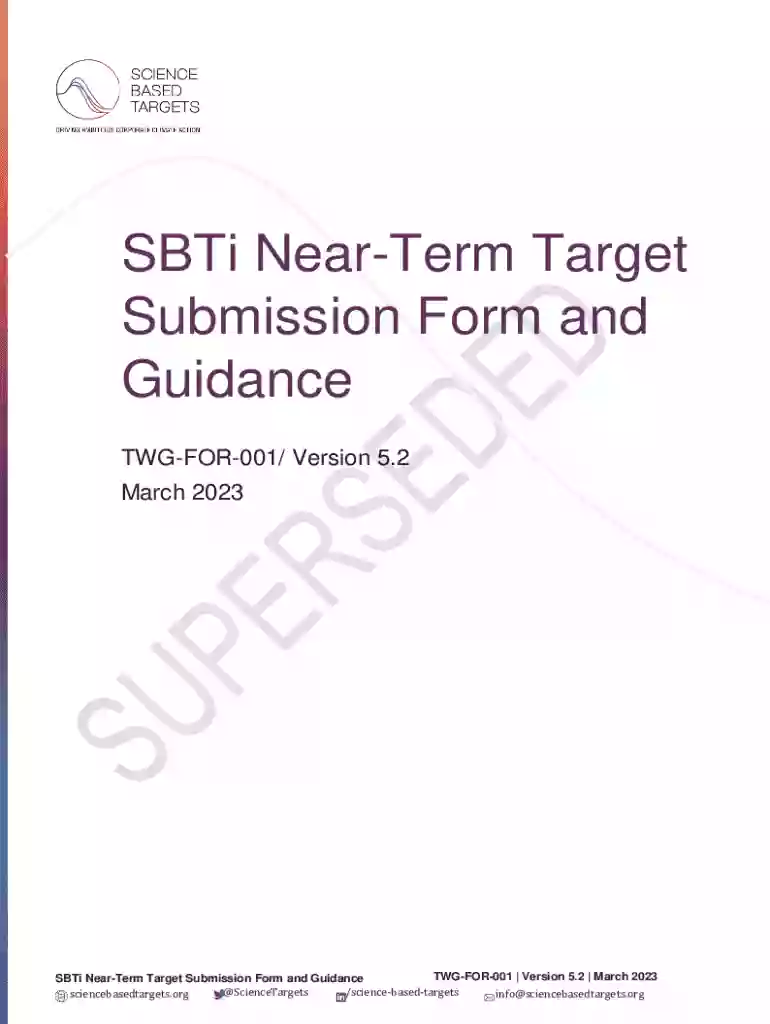
The SBTi Near-term Target Submission Form and Guidance is a structured document utilized by companies to submit their near-term greenhouse gas (GHG) reduction targets for validation by the Science Based Targets initiative (SBTi). It provides detailed instructions on submitting data that adhere to GHG Protocol standards, ensuring companies' targets align with climate science and contribute to mitigating climate change. This formal procedure is vital for organizations aiming to demonstrate their commitment to reducing their carbon footprint in a scientifically sound and verifiable manner.
The form includes several critical components that facilitate accurate and comprehensive submissions:
Company Details: This section requires general information about the company, such as the name, sector, and size, to establish context for the targets.
GHG Inventory Data: Companies must provide detailed emissions data, including sources of emissions across different scopes, to create a baseline for measuring reductions.
Target Information: This section demands explicit details of the greenhouse gas reduction targets, ensuring they are specific, measurable, and time-bound.
Supporting Documentation: To validate the submitted targets, companies are expected to append relevant documents, such as calculation methods and assumptions.
Progress Reporting: Companies should include current progress on previous targets, if any, highlighting the effectiveness of implemented strategies.
Review the Guidance Document: Familiarize yourself with the directive's requirements and standards to ensure all data aligns with the GHG Protocol.
Gather Necessary Documents: Collect emission data, calculation methods, and any other supporting documentation required for submission.
Complete the Company Information Section: Input accurate details about the company, including the sector and size, in the designated fields.
Detail the GHG Inventory: Accurately itemize emissions data from all relevant scopes to form a credible baseline for target establishment.
Articulate the Targets: Clearly define and enter the reduction targets, ensuring they are quantifiable and set within an appropriate timeframe.
Attach Supporting Documents: Make sure to append all necessary documents that support the validity of your emissions data and target calculations.
Finalize the Submission: Review the completed form for accuracy and adherence to guidelines before formally submitting it to SBTi for validation.
Utilizing this form is crucial for companies committed to reducing their environmental impact through scientifically validated targets. Participating in the SBTi initiative enhances a company's credibility and demonstrates a proactive stance towards environmental sustainability. It also aligns corporate strategies with global climate goals, potentially opening new opportunities for funding, partnerships, and public engagements that favor environmentally responsible practices.
The submission form aligns with the GHG Protocol standards, ensuring legal compliance in reporting environmental impacts. By adopting internationally recognized standards, businesses can safeguard against regulatory issues while fostering transparency and accountability. The adherence to legal standards also reassures stakeholders of the company's dedication to ethical and sustainable practices.
Once a company has submitted its targets using the SBTi form, the approval process begins. This involves several stages:
Initial Review: SBTi evaluates the submission for completeness and compliance with the guidance standards.
Validation Process: Expert reviewers assess the scientific validity of the targets.
Feedback and Revisions: If necessary, SBTi provides feedback for corrections or clarifications.
Final Approval: Once finalized and validated, targets are officially approved, which can take several weeks to a few months, depending on the complexity of the submission.
This form is primarily used by corporations and large enterprises across various sectors striving to validate their GHG reduction targets as part of a broader corporate social responsibility (CSR) initiative. It is particularly essential for businesses that wish to publicly disclose their environmental impact commitments. Enterprises in energy-intensive industries, such as manufacturing, oil and gas, and transportation, commonly utilize this form to ensure their targets meet global climate commitments.


Scenario 1: A Technology Company: A tech company submits the form to establish its target of reducing Scope 1 and 2 emissions by 25% within five years, aligning its operations with renewable energy sources.
Scenario 2: A Manufacturing Firm: A manufacturing firm sets a near-term target focused primarily on reducing waste emissions through improved process efficiency and submits this using the SBTi form for validation.
Scenario 3: An Automotive Giant: An automotive manufacturer uses the form to declare its aim to cut emissions across its supply chain, contributing to its overall sustainability commitments.
By actively participating in SBTi’s validation process, these examples illustrate how companies across various industries align their sustainability goals with international climate frameworks.
We've got more versions of the Sbti Near-term Target Submission Form and Guidance form. Select the right Sbti Near-term Target Submission Form and Guidance version from the list and start editing it straight away!
At DocHub, your data security is our priority. We follow HIPAA, SOC2, GDPR, and other standards, so you can work on your documents with confidence.