01. Edit your form online
Type text, add images, blackout confidential details, add comments, highlights and more.

Type text, add images, blackout confidential details, add comments, highlights and more.

Draw your signature, type it, upload its image, or use your mobile device as a signature pad.

Send it via email, link, or fax. You can also download it, export it or print it out.
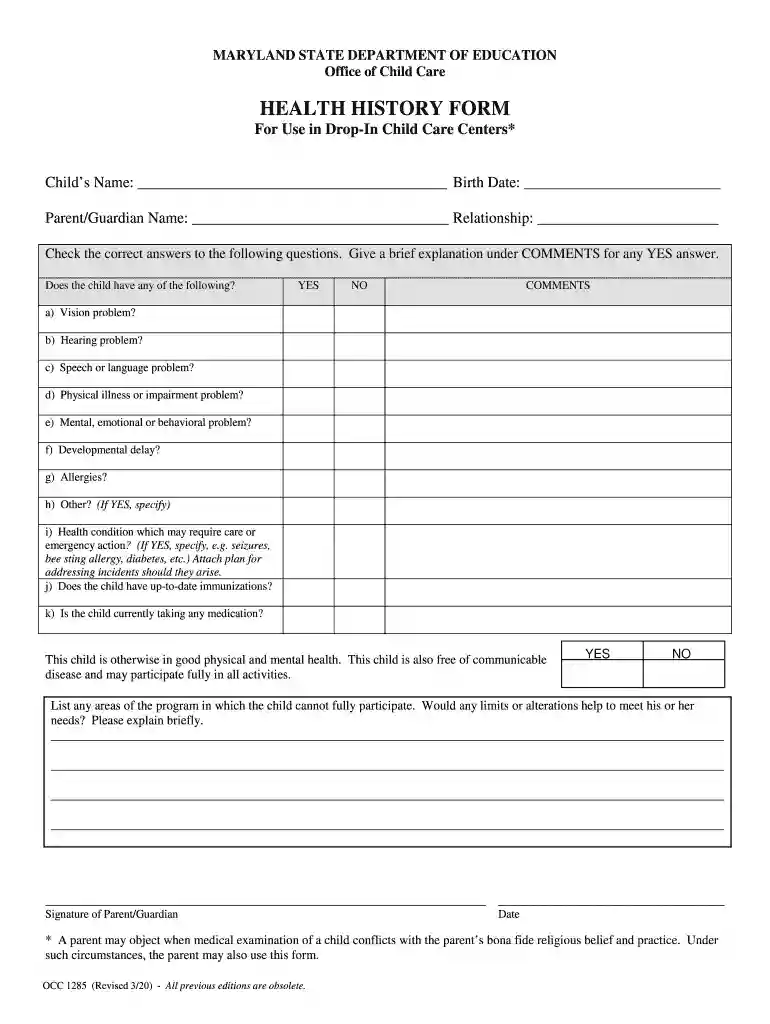
The "Office of Child Care - Maryland State Department of Education" form comprises essential documents required to ensure the safety and well-being of children in drop-in child care centers. These forms include the Health History Form, Medication Administration Authorization Form, and Emergency Form. Each of these forms is designed to gather vital information concerning the child’s health status, medical needs, and emergency contacts.
Using these forms effectively requires precise completion to ensure child safety and compliance with state regulations. Each form must be filled out by the parents or guardians with current and accurate information.
Completing the forms involves several detailed steps to ensure compliance with Maryland state guidelines. Providing thorough and accurate information is crucial for the safety and well-being of the child.
Each form comprises specific elements that need careful attention to ensure proper handling and care of the child.
Understanding terminology relevant to these forms is essential for proper completion and submission.
Completing these forms accurately ensures compliance with Maryland's legal requirements for child care centers, contributing to a legally sound environment.
Failure to comply with submission requirements of these forms can lead to significant consequences.
The Maryland State Department of Education mandates specific guidelines for paperwork related to child care centers, ensuring child safety and a secure caregiving environment.
The Office of Child Care forms are available in both digital and paper formats, providing flexibility according to user preference and convenience.
Submitting these forms can be done through several channels, depending on user preference and available resources.
Each process ensures the information on the forms is securely and promptly received, enhancing proactive child care management.
We've got more versions of the Office of Child Care - Maryland State Department of Education form. Select the right Office of Child Care - Maryland State Department of Education version from the list and start editing it straight away!
| Versions | Form popularity | Fillable & printable |
|---|---|---|
| 2020 | 4.8 Satisfied (102 Votes) |
At DocHub, your data security is our priority. We follow HIPAA, SOC2, GDPR, and other standards, so you can work on your documents with confidence.