




01. Edit your irs form 433 a online
Type text, add images, blackout confidential details, add comments, highlights and more.

Type text, add images, blackout confidential details, add comments, highlights and more.

Draw your signature, type it, upload its image, or use your mobile device as a signature pad.

Send form 433 a via email, link, or fax. You can also download it, export it or print it out.
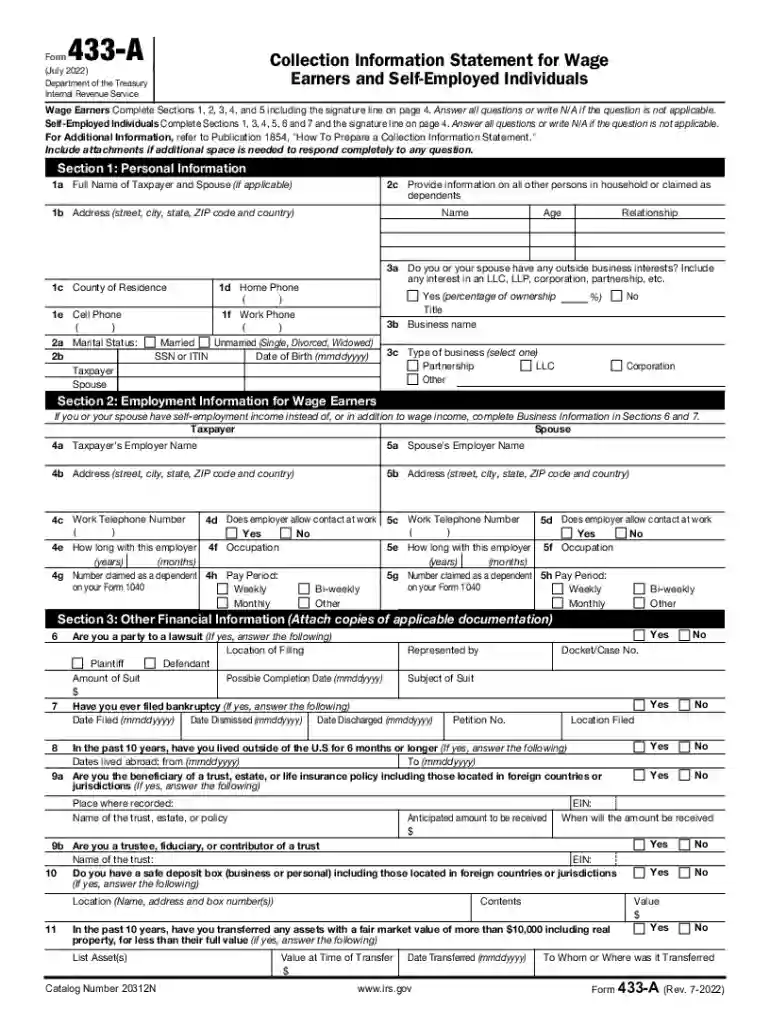
The IRS Form 433-A, officially known as the Collection Information Statement for Wage Earners and Self-Employed Individuals, is a comprehensive document utilized by individuals to report detailed financial information to the Internal Revenue Service (IRS). This form is essential for wage earners and self-employed individuals facing tax collection actions as it provides the IRS with a clear picture of one's financial situation, including income, expenses, assets, and liabilities. By accurately completing this form, taxpayers can potentially negotiate payment plans or installment agreements with the IRS to settle their tax debts.
When completing Form 433-A, taxpayers must adhere strictly to IRS guidelines to ensure accurate representation of their financial status. The IRS specifies that all sources of income must be reported, including wages, self-employment income, and other earnings. Taxpayers are also required to disclose all assets, including real estate, vehicles, bank accounts, and retirement accounts, along with any outstanding liabilities. Following the IRS instructions carefully is imperative to prevent mistakes that could delay processing or lead to unfavorable outcomes.
Filling out Form 433-A involves several crucial steps to ensure accuracy and compliance with IRS requirements. It is advised to gather all necessary documentation before beginning the form to streamline the process.
Form 433-A is primarily used by individuals who require negotiation with the IRS due to outstanding tax obligations. It caters to wage earners who receive regular income from employment and self-employed individuals who earn income independent of a traditional employer. This form is often used in scenarios where an installment agreement or other payment arrangement needs to be established with the IRS.
Form 433-A is structured into several parts, each designed to capture specific financial data. Understanding these segments is critical for precise completion.
The completion of Form 433-A is not just a formality but a legal requirement in dealings with the IRS regarding unpaid taxes and collection actions. The data provided on this form forms the basis for any negotiations or agreements reached with the IRS. Deliberate inaccuracies or omissions can result in penalties or legal action. Tax practitioners and legal advisors can guide taxpayers in legally maximizing their use of this form for debt resolution.
To properly fill out Form 433-A, you will need a variety of documents that accurately capture your financial situation. These documents ensure that the information provided to the IRS is both accurate and verifiable.
Failure to submit Form 433-A or providing false information can result in significant consequences. The IRS may impose penalties, escalate collection efforts, or pursue legal action.
Many financial and tax preparation software include features to assist in filling out Form 433-A. These tools can automate calculations and ensure compliance with IRS guidelines, reducing the chances of errors.
In summary, the Fillable IRS - Form 433-A is a critical document for taxpayers facing collection measures. Proper completion requires careful adherence to guidelines, accurate data entry, and comprehensive financial disclosure. Utilizing available tools and maintaining thorough records can help ensure a smooth and compliant interaction with the IRS.
We've got more versions of the irs form 433 a form. Select the right irs form 433 a version from the list and start editing it straight away!
With DocHub, you can rapidly approve your 433 a form or any other document on iOS, even without setting up additional programs. You can access your DocHub account from any web-connected browser and fill out and sign your form in any way you like with just a couple of clicks.
If you use Chrome, there are two straightforward ways to edit your irs form 433 a fillable online. First, visit the DocHub site, add your document, and edit it using our toolbar. You can also set up our Chrome extension and edit any document by dragging and dropping it in your web browser tab.
At DocHub, your data security is our priority. We follow HIPAA, SOC2, GDPR, and other standards, so you can work on your documents with confidence.
After we review the completed Form 433-A, you may be asked to provide verification for the assets, encumbrances, income and expenses reported. Documentation mayRead more
Note: If you have special circumstances which would prevent you from paying the minimum offer amount calculated on Form 433-A (OIC) due to economic hardship,Read more


