




01. Edit your 2021 tax 1116 online
Type text, add images, blackout confidential details, add comments, highlights and more.

Type text, add images, blackout confidential details, add comments, highlights and more.

Draw your signature, type it, upload its image, or use your mobile device as a signature pad.

Send 2021 irs 1116 via email, link, or fax. You can also download it, export it or print it out.
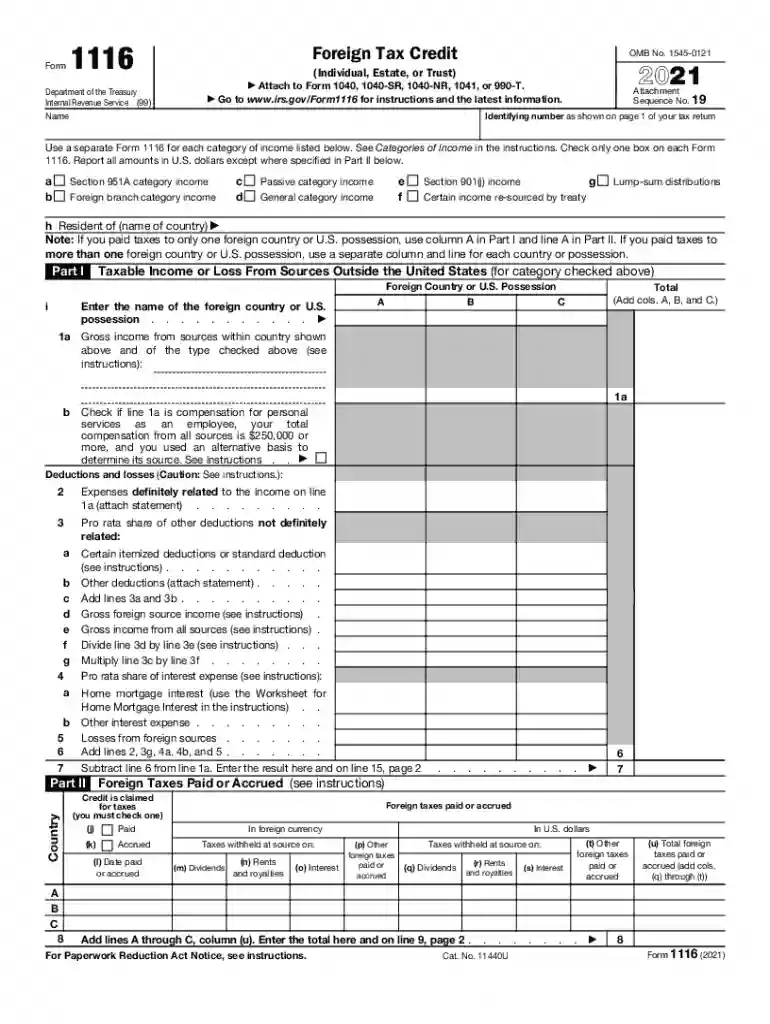
The Internal Revenue Service (IRS) credit refers to various tax credits administered by the IRS, allowing taxpayers to reduce their federal tax liability. Specifically, the Form 1116 is used for claiming the foreign tax credit, which offsets taxes paid or accrued to a foreign government. This credit is designed to prevent double taxation of income that has already been taxed overseas. Taxpayers, including individuals, estates, or trusts, can apply this credit to certain income categories, minimizing their overall tax obligation in the U.S.
Using the IRS credit involves a series of well-defined steps. First, taxpayers must determine eligibility by ensuring the taxes were legally owed and paid to a foreign government. The next step is to categorize the types of income and taxes, as this influences the computation of the credit. It is crucial to report these details accurately on Form 1116. Once filed, the credit is applied to the U.S. tax return, reducing the taxpayer's federal tax liability for that year. This process allows both individuals and businesses to maximize their tax efficiency.
IRS guidelines on the foreign tax credit are comprehensive, covering eligibility, calculation, and the filing process. These guidelines emphasize the necessity for accurate categorization of income and taxes, ensuring that taxpayers meet the established requirements. The IRS provides detailed instructions on how to fill out Form 1116, along with examples for common scenarios. It is important for taxpayers to adhere strictly to these guidelines to prevent errors that could delay processing or result in penalties.
Eligibility for the IRS credit largely depends on the nature of the foreign taxes and income. Taxpayers must ensure that:


It is critical to be aware of the filing deadlines when claiming an IRS credit. Typically, the deadline aligns with the general tax return due date, which is April 15 for individual taxpayers. However, extensions are possible if requested and approved by the IRS. Taxpayers should also be aware of any updates to IRS schedules that might affect these dates. Keeping track of these timelines ensures that taxpayers do not miss out on the benefits of the credits due to late submissions.
The IRS provides several methods for submitting tax forms, including those for claiming credits. Taxpayers can choose:
Failure to accurately report or improperly claiming the IRS credit can lead to significant penalties. This includes:
Various taxpayer groups benefit from the IRS credit:
Understanding these scenarios helps identify who should prioritize the use of this credit.

We've got more versions of the 2021 tax 1116 form. Select the right 2021 tax 1116 version from the list and start editing it straight away!
At DocHub, your data security is our priority. We follow HIPAA, SOC2, GDPR, and other standards, so you can work on your documents with confidence.
The IRS uses third party payment processors for payments by debit and credit card. You can pay online or over the phone. Paying by credit card? 1.75% Minimum
You can access your personal tax records online or by mail, including transcripts of past tax returns, tax account information, wage and income statements.Read more
Section 42(a) provides for a credit for investment in certain low-income housing buildings.


